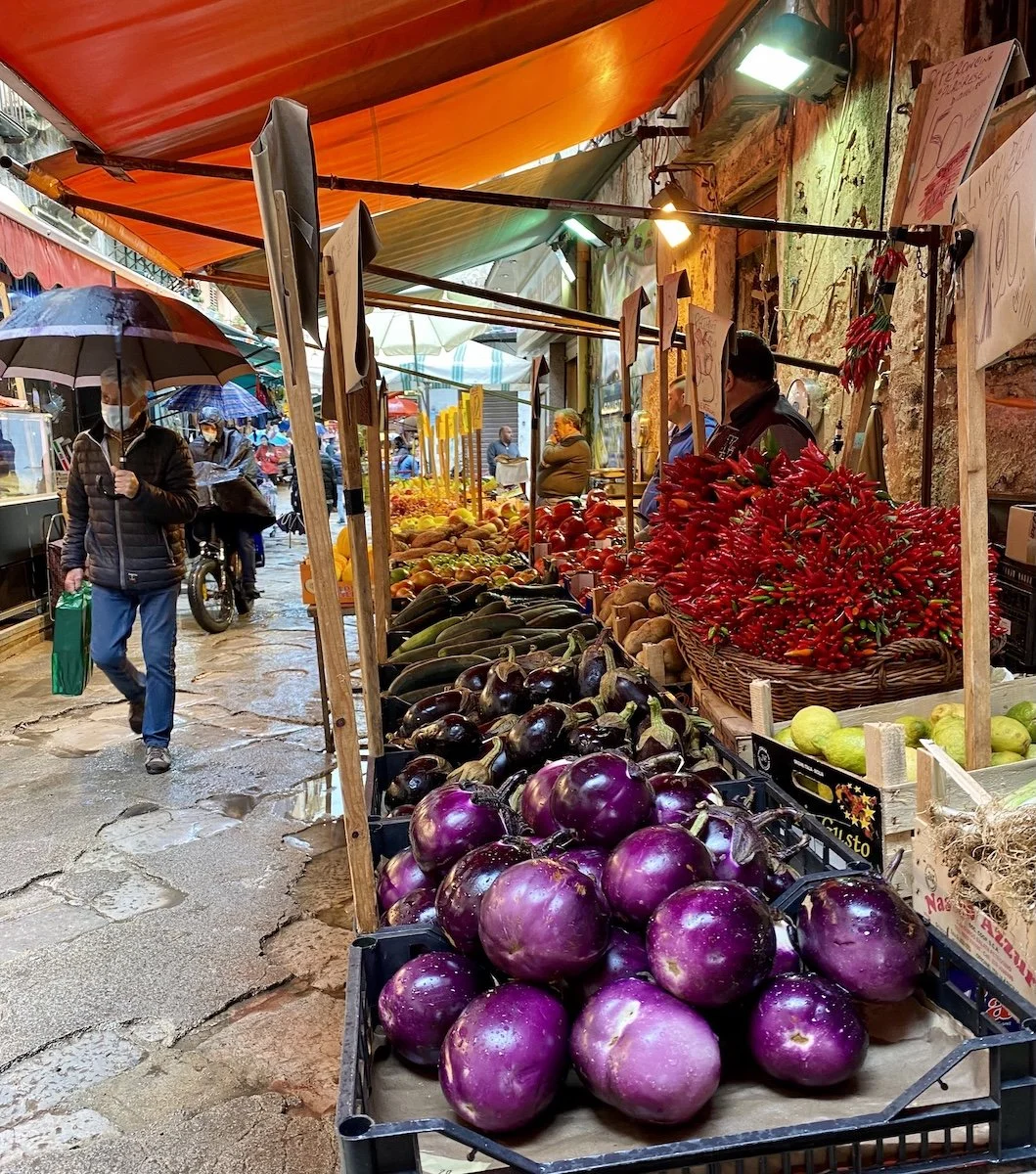
“The traveler sees what he sees, the tourist sees what he has come to see.”
Gilbert K. Chesterton
I've always preferred to be a traveler who wanders the alleyways, visits the market, sits at a café and talks with the locals rather than a tourist who ticks off major sights. My books reflect my wanderlust, but I didn't realize that I was a flâneus, French for a woman who wanders aimlessly. I have author Jeanne Matthews to thank for that new word!
I love nothing better than arriving in a city or town, exploring on foot, and being surprised by what I find—a quirky shop, a bit of local history, an inviting pocket park, a no-frills place for a pastry and coffee, etc.
I have found alleys fascinating since my time living in Naples, Italy, a city with more than 100 alleys (called vicos) which are narrow streets or paths, usually secondary, bordered by houses and palaces, and intertwine from the old town to the outskirts. These historic streets with colorful names often have rainbows of laundry waving overhead, death notices pasted to stone walls, and every doorway is a peek into a slice of local life. These alleys are sometimes lonely and dark but often have bustling crowds, pungent aromas, and shouting merchants offering just about everything under the sun.
San Gregorio Armeno is one of the most famous vicos. It’s the alley of the nativity scene (presepe) makers. I once had fun purchasing hand-made, painted, terracotta figures from various shops and learning about the local traditions like including il Dormiente, a sleeping man figure lying outdoors and bagpipe playing shepherd figures called zampognari.
One of my favorite memories of an alley find in Naples was coming across a hole-in-the-wall shop where a man was crafting child-size, furry, Pink Panther dolls. It was right before my young daughter’s birthday, and it made a wonderful gift.
Naples also has many colorful markets where vendors yell out their goods and prices to attract shoppers. I especially remember the Poggioreale Market, which is often referred to as "Shoe Alley" in English because of the abundance of footwear on sale. They have everything from high-quality leather to the cheaper imported duds. Clothing and housewares are found at the various stalls, as well.
Markets are a favorite of mine. In any new place I visit, I make sure to check out the local ones. I still treasure a large cut-glass vase I purchased at a flea market in Munich, Germany. At the time (pre-Euro), it cost me 5 Marks, the equivalent of $5, and I still use it all the time for flower arrangements.
Munich is also home to the Viktualienmarkt, one of my favorite outdoor food markets. It has over100 stalls and shops offering exotic fruit, game, poultry, spices, cheese, fish, juices, and flowers. It’s also a perfect spot to grab a picnic table and enjoy breakfast or lunch purchased from one of the vendors.
The villages of the Var department of Provence in the South of France are a market-lover’s dream. I discovered that each town square has a market on a different day. For example, Draguignan has one on Saturdays and Callian on Sundays. Other towns, like Seillans, Montauroux, Tourettes, Bargemon, and Fayence are open other days. They are all a feast for the senses, including mouth-watering aromas and tastes and splashes of color from the Provencal textiles.
Wonderful markets are found all over Provence. A short distance east of the Var, Cannes has an antique market, and a short distance to the west, Aix en Provence has a food market every single day on the beautiful Place Richelme, shaded by plane trees. On Tuesday, Thursday, and Saturday, the market swells outward through the squares and down the grand boulevard, Cours Mirabeau. I made sure to buy a box of calissons, the almond and melon sweet Aix is known for. I also enjoyed a café at a table on the Cours Mirabeau where I could enjoy the market scene.
To the north of Aix, I visited L'ile sur la Sorgue, a delightful island with canals & waterwheels known as the “Venice of Provence.” Every Sunday it is a food market and a sprawling antiques-and-brocante (secondhand / flea) market rolled into one. In fact, it is the largest antiques hub in France after Paris, with hundreds of dealers lining the water.
Spain also has a couple of markets I’ve enjoyed. In Barcelona, the Mercat de la Boqueria on La Rambla, which dates back to the 13th century, has beautiful and colorful produce displays and is the largest in the city, home to more than 300 stalls.
On the Spanish island of Mallorca, the weekly Tuesday and Sunday market held in the historic walled old town of Alcúdia offers a mix of fresh local produce, clothing, leather bags, plants, fabric bags made with local textiles, and even flamenco dresses. The stalls spread across the main streets and squares inside the walls, making it very easy to combine market browsing with a stroll through the old streets and along parts of the city walls and to stop for refreshment at one of the restaurants or cafes.
One of the most unusual markets I’ve ever visited was in Morocco, a ferry ride across the Mediterranean from Spain. It was called the Sunday Market and it was at a spot a short car ride inland from the white-washed, walled town of Asilah on the northern Atlantic coast. El Had des Gharbia was not a town but rather a country plot of ground tucked inside low concrete walls under a cedar grove. My family was the only one to arrive by car. Locals came by foot, donkey, and camel. The crowds and sounds of families catching up with their neighbors and haggling over purchases, the shouts and blaring bullhorns of salesmen, and the smells of chickens brought for slaughter and other animals available for sale overwhelmed all my senses. I remember one vendor pleading with me to buy a birdcage. My most pleasant memories include the friendliness of the people there and sitting down with one young vendor to enjoy sipping his delicious mint tea.
At another time in Morocco, this time in Marrakech, I spent a morning at a more typical Moroccan market, the Medina, the walled, historic neighborhood that serves as the city's main square. During my wanderings through the warren of narrow vendor-filled alleys, I browsed local wares, including lots of argon oil products, and I watched artisans dyeing wool and felting it,.
Similar places to a Moroccan medina that I’ve visited are in Istanbul. I entered the cavernous Grand Bazaar through one of many gates and encountered numerous narrow alleys, columns with vaulted ceilings painted with frescoe designs, and so many shops that it is sensory overload just wandering there.
I also enjoyed wandering the Egyptian Spice Bazaar in Istanbul and I also remember the alleys outside of it where I stopped at a small bakery and bought a piece of delicious "havuclu kek" (carrot cake). At a type of gourmet shop in another alley, I bought pomegranate sauce and had an interesting conversation with one of the clerks who spoke a little English. As he was speaking, he said one of the words in German, and I asked, "Sprechen sie Deutsch?". He said that he spoke some, but his Russian was better. My husband overheard and asked if he spoke Polish, and he answered in Polish! We learned he was from Bulgaria and knew many of the eastern European languages. As we left, he said. "Dowidzenia!" (See ya!)
In another Turkish city, Fethiye, on the western coast, we learned that Tuesday is market day, so we caught a dolmus outside the hotel that took us directly there. It was huge! There were hundreds of produce sellers and the fruits and vegetables looked fresh. We bought some lovely peaches and found out that the green we’d been enjoying in salad was called "roku" (possibly a type of arugula.). After the produce vendors, came everything else, clothing, housewares, leather, etc. We were happy with a few bargain T-shirts for 5 Turkish Lira ($2.50) each and a Turkish football jersey for 20 TL ($10).
My list of memorable market buys could go on, but a machete my husband purchased when we were wandering through the San José Mercado Central in Costa Rica back in the 1990s stands out, mainly because it probably wouldn’t get through TSA today.