

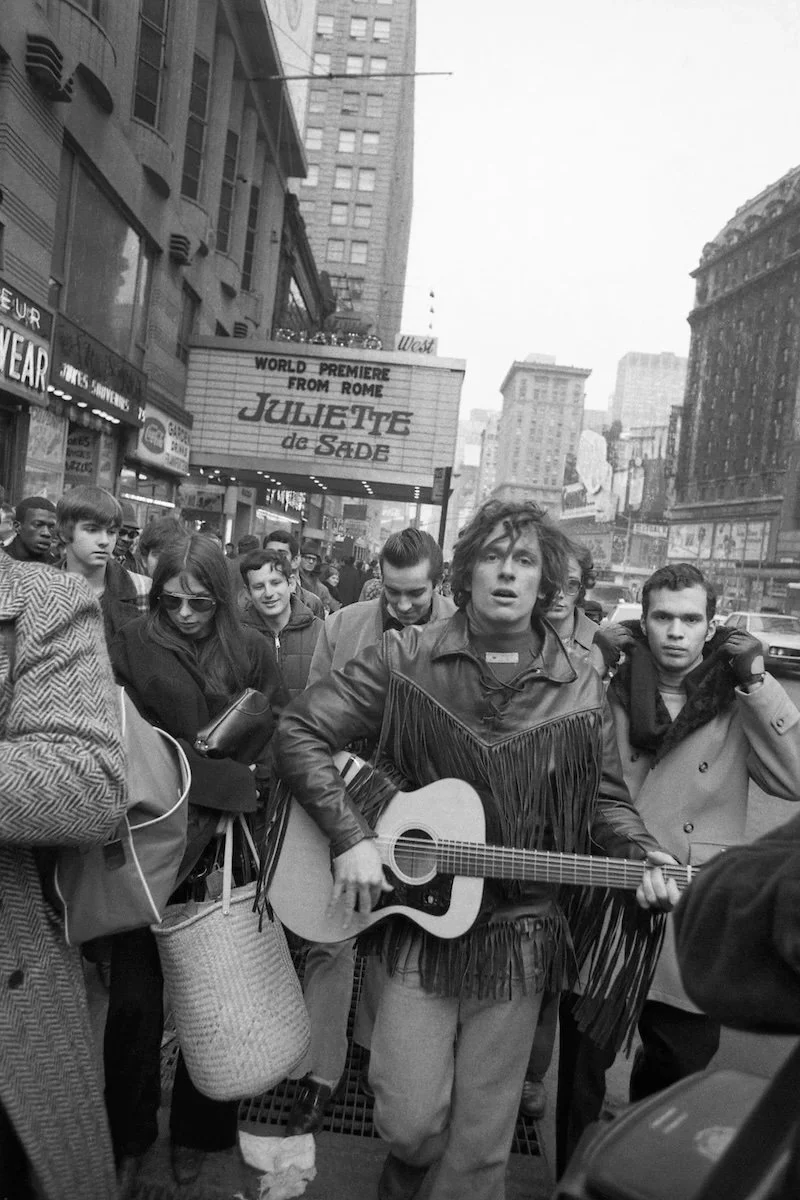
“I got rid of $1,000. You should have seen them scramble. I just can’t believe them.”
Michael J. Brody Jr, eccentric heir
Back in my undergraduate days in New York City, I had a part-time job at Bloomingdale’s department store. On the days I worked after classes, I walked down Lexington Avenue from school at East Sixty-Eighth Street to the store at East Fifty-Ninth. I enjoyed getting out in the fresh air and getting a little exercise after sitting in lecture halls. The route was pleasant, lined with a church, restaurants, pharmacies, cafes, and small shops. My usual diversions were window shopping and observing other walkers.
Then one sunny afternoon in May, I came upon a commotion on the corner of Sixty-Third and Lex. It was orchestrated by a naked, hippie-looking guy throwing paper money from a sixth-floor window. A small crowd was running around trying to catch some bills. I assumed he was on drugs, maybe PCP or LSD. I watched in horrified fascination for a few minutes but didn’t stay. I had to get to work on time.
An article in the Daily News later reported that Michael J. Brody Jr., a twenty-one-year-old heir to oleomargarine millions, was arrested on a drug charge after tossing $1,000 in small bills from the window of his apartment. When two patrolmen arrived, Brody, then fully dressed, invited them inside with handshakes and the explanation that he had been smoking pot. (One reporter suggested that those joints he chain-smoked contained more than mere marijuana, most likely PCP, which makes you feel like you have all this power and energy and you really don’t. Brody himself later admitted that much of his conduct was the result of hundreds of doses of LSD.) With a floppy hat on the back of his head and a guitar in hand, he was taken into custody. A look into his background revealed he had recently been released from a California psychiatric hospital.
I didn’t think much more about it then, but the incident came to mind recently, and I wondered what had become of Mr. Brody. A little research revealed a bizarre and tragic tale, only a small part of which I witnessed that beautiful spring day.
The year before the money tossing incident, Michael Brody, a recent college graduate, received access to a trust fund when he turned twenty-one. It was set up by his grandfather, Chicago oleomargarine millionaire John F. Jelke. The following January, Brody made news by offering to give money from his twenty-five-million-dollar fortune away to ordinary people to spread love and “cure the problems of the world.” He broadcast his phone number and home address and welcomed all comers.
The money giveaways started after he met a girl named Renee. (She showed up at his house to make a hash delivery for her drug-dealing boyfriend and didn’t leave. Three weeks later, Brody married the 19-year-old and gave away $50,000 in tips during his honeymoon in Jamaica. He later walked the streets of Manhattan handing out $100 bills to strangers.
His eccentric antics led to a guest appearance on the Ed Sullivan TV show that same January. He was paid $3,500 to play a Bob Dylan song on his guitar with his wife sitting at his side. But the story took a darker turn. An article in The New York Times the morning after his “Ed Sullivan” appearance quoted Brody as saying he had announced his big giveaway “while tripped out on drugs.” “What a joke I’ve pulled on the world!” he told the reporter. That same day, he chartered a helicopter with the intention of landing on the White House Lawn so that he could offer the North Vietnamese $10 billion (which he didn’t have) to broker an end to the Vietnam War. Of course, he was not allowed to carry out the operation.
Brody soon became a sensation, with reporters and establishment-hating hippies adding to his rising fame. He was even offered a contract by RCA Records and the Grateful Dead recruited him to open a show in Hawaii, the money from which he threw into the crowd.
Brody’s claims about his inheritance were grandiose. Family members said it was between one and three million, not twenty-five. As letters requesting money flooded in by the tens of thousands, the attention grew overwhelming. When checks started bouncing, he withdrew from the public eye to his home in Scarsdale, New York with his new wife. He resurfaced occasionally when legal problems arose. His interactions with the alienated public alternated between playing his guitar for them and shouting obscenities.
In an effort to get away from the insanity and the throngs of critics, Brody tried to keep a low profile as the year wound down. He and Renee moved to a home in Woodstock, New York. But the come-down from everything — maybe the drugs, definitely the fame — was brutal. After having given away an estimated $350,000, he became increasingly depressed. He wound up in a mental institution. Renee, left for California in a VW bus with the couple’s baby son. According to friends, Brody was ill-equipped to handle such a wild spree and the scrutiny it generated. His mother had died when he was 3, and he was raised by babysitters and housekeepers while his father was often absent. Young Brody was so desperate for friends that he’d invite local kids over for poker nights and then happily lose to keep them coming back. One friend speculated that Michael’s benevolence was a struggle to find connections.
Michael James Brody Jr was only twenty-four years old when he shot and killed himself with a deer-hunting rifle at his father-in-law's home in Ashoken, N Y, not far from Woodstock. He had been placed in psychiatric care for a second time after he was charged with arson in the burning of a rented house in Norwalk, Conn. He was free on $10,000 bond pending trial on charges that he had threatened the life of the U.S. President in a series of semi-coherent telephone calls.
In 2020, the story of Michael J. Brody Jr., the hippie millionaire, was made into a documentary called Dear Mr. Brody by Austin, Texas-based film maker Keith Maitland. Originally planned to have its world premiere at the 2020 Tribeca Film Festival, it was cancelled due to Covid 19. Instead, it has schlepped from one on-line film festival to another. Dear Mr. Brody is based on an archive of about 30,000 letters unopened by Michael that provide a sometimes emotionally devastating counterpoint to Brody’s beautiful shiny idea that you could use wealth to solve literally all the problems of the world. They contain many stories of debt, illness and desperation, written by people who were given a glimmer of hope, only to be disappointed.