• Home
  • ABOUT ME
  • BOOKS
    • USEFUL SITES
    • WRITING TIPS
  • THIS 'N THAT
  • Blog
  • NEWS
  • CONTACT ME
Menu

Joan Wright Mularz

Street Address
City, State, Zip
Phone Number
YOUNG ADULT MYSTERY AUTHOR

Your Custom Text Here

Joan Wright Mularz

  • Home
  • ABOUT ME
  • BOOKS
  • FOR WRITERS
    • USEFUL SITES
    • WRITING TIPS
  • THIS 'N THAT
  • Blog
  • NEWS
  • CONTACT ME
2023 world banner red.png

Blog


Exploring the Writing Life in the Sunshine State

June 1, 2019 Joan Mularz
FlAuthorsMap.jpg


Exploring the Writing Life in the Sunshine State


“I work everywhere, but I work best here.”

—Tennessee Williams (about South Beach, Key West, Florida)


For me, Florida was never the first place to come to mind when thinking about literature. And apparently, I’m not the only one who thought that way. Comedian George Carlin summed up the general consensus: “l like Florida. Everything is in the 80's. The temperatures, the ages and the IQ's.” However, taking the advice of Ernest Hemingway ("As a writer, you should not judge, you should understand.") I began to probe deeper. I’ve now learned that my new resident state has been and remains home to some iconic authors. Some were born in the Sunshine State and others were drawn to live and work here. Here are a few of them.

African-American author and anthropologist Zora Neale Hurston moved to Eatonville, Florida, a rural town north of Orlando, in 1894 at the age of three. She later used it as the setting for many of her stories about racial struggles. Her most notable book was Their Eyes Were Watching God (1937). In 2005, Time magazine included it on its list of the 100 best English-language novels published since 1923. That same year, Oprah Winfrey served as executive producer of the made-for-TV adaptation of the book. In 2011, the novel was adapted as a radio play for BBC World Drama.

Pulitzer Prize winner Marjorie Kinnan Rawlings bought an orange grove in Cross Creek near rural Hawthorne, Florida in 1928. She wrote about life among “Crackers” in the remote wilderness that was North Central Florida. Her best-known work is the Young Adult novel, The Yearling (1938). It was made into a film in 1946 and is commonly included on teen reading lists.

Lois Lenski,a Newbery medal-winning author and illustrator of picture books and children’s literature began to spend winters in Florida for the sake of her health in the early 1940s. Her book, Strawberry Girl (1945), told the story of a family from North Carolina who migrated to Florida at the turn of the twentieth century and their interactions with the region's “Cracker" culture. In 1951, she and her husband built a house at Tarpon Springs, Florida, where they spent half of each year. After his death in 1960, Lois moved permanently to Florida, continuing to write, publishing her last picture book Debbie and her Pets (1971) and her autobiography (1972).

Carl Hiassen, longtime columnist of the Miami Herald, has had at least nineteen of his novels on the New York Times bestseller lists. Like his first, Tourist Season, his books are humorous crime fiction and often feature themes of environmentalism and political corruption in his native state. He was born and raised in Plantation, Florida then a rural suburb of Fort Lauderdale.  He graduated from the University of Florida in 1974 with a degree in journalism. Among his numerous awards is a 2003 Newbery Honor for Hoot. 

Dave Barry, a nationally-syndicated Miami Herald columnist (1983-2005), won a Pulitzer Prize for Commentary (1988) for "his consistently effective use of humor as a device for presenting fresh insights into serious concerns.” He has also written dozens of books, both fiction (e.g. Big Trouble which was adapted into a film in 2002), and non-fiction (e.g. Best. State. Ever.: A Florida Man Defends His Homeland).

Elmore Leonard, an Edgar award-winning crime novelist, lived part-time in Palm Beach County, Florida from the 1990s till 2009. He set many of his stories there (e.g. Rum Punch)—everywhere from the glitz of Palm Beach to the backstreets grit of West Palm and the Glades. Many of his novels were made into films (e.g. Get Shorty) or were adapted for television (e.g.Justified).

The name Marjory Stoneman Douglas made the news in 2018 because of a tragic school shooting spree. But the woman the school is named after was an American journalist, author, women's suffrage advocate, and conservationist known for her staunch defense of the Florida Everglades and against efforts to drain it and reclaim land for development. Marjory moved to Miami, Florida in 1915 and began working for the Miami Herald.  Her most influential work was the 1947 classic The Everglades: River of Grass, which redefined the popular conception of the Everglades as a treasured river instead of a worthless swamp. Its impact has been compared to that of Rachel Carson's influential book Silent Spring. 

Kate DiCamillo, an author who writes for children as well as adults, was raised in Clermont, Florida which is west of Orlando. She is another University of Florida graduate. She said her book Because of Winn-Dixie was written in Minnesota during the worst winter on record while she was cold and lonely and homesick for Florida. She is one of six people to win two Newbery Medals. They recognized her novels The Tale of Despereaux and Flora & Ulysses. She was the U.S. National Ambassador for Young People’s Literature appointed by the Library of Congress (2014 and 2015).

Patricia Cornwell is a contemporary American crime writer who was born in Miami, Florida. She’s known for writing a best-selling series of novels featuring the heroine Dr. Kay Scarpetta, a medical examiner. Her books (e.g. Postmortem which received the 1991 Edgar Award for Best First Novel) have sold more than 100 million copies.

Tami Hoag is an American novelist best known for her work in the romance and thriller genres. More than 22 million copies of her books (e.g. Kill the Messenger) are in print. She currently lives part-time in Wellington, Florida in western Palm Beach County.

James Patterson is a prolific author of thrillers, non-fiction and romance novels who lives in Palm, Beach, Florida. His books (e.g. Along Came A Spider, first in the Alex Cross series) have sold more than 300 million copies and he was the first person to sell 1 million e-books. In November 2015, he received the Literarian Award from the National Book Foundation which cited him as a "passionate campaigner to make books and reading a national priority. Patterson has donated millions of dollars in grants and scholarships with the purpose of encouraging Americans of all ages to read more books. His awards include the Edgar Award, the BCA Mystery Guild's Thriller of the Year award, the International Thriller of the Year award, and the Children's Choice Book Award for Author of the Year.

Writer and filmmaker Ransom Riggs grew up in Florida, where he attended Pine View School for the Gifted in Osprey near Sarasota. He is  best known for the book Miss Peregrine’s Home for Peculiar Children (2011) which made The New York Times Best Seller List and was adapted into the 2016 film of the same name.

Karen Russell  is an American novelist and short story writer  from Coral Gables, FlorIda near Miami. In 2009 the National Book Foundation named her a 5 under 35 honoree. Her debut novel, Swamplandia!, was a finalist for the 2012 Pulitzer Prize for Fiction. She was also the recipient of a MacArthur Foundation “Genius Grant” in 2013. 

Lauren Groff, who currently lives in Gainesville, Florida, was named by Granta Magazine as one of the Best Young American Novelists of her generation in 2017. In 2018, she received a Guggenheim fellowship in Fiction. Her fifth book, a short story collection titled Florida, was released in June 2018 and was the winner of The Story Prize for short story collections published that year.  It was also a finalist for the 2018 National Book Award for Fiction.

Edward Bloor, a novelist and playwright who lives in Winter Garden, Florida has won numerous awards. His novel Tangerine alone won several. It was a "Horn Book" Fanfare Book and a 1998 Edgar nominee for Best Young Adult Novel. It also made the American Library Association’s Top Ten Best Books for Young Adults in 1997.

Then there is Key West, Florida which has often attracted eminent authors to live and write there. Notables include Ernest Hemingway (Pulitzer Prize 1953 for The Old Man and the Sea  and Nobel Prize for Literature 1954), John Hersey (Pulitzer Prize 1945 for A Bell for Adano), Tennessee Williams (Pulitzer Prize 1948 for the play  A Streetcar Named Desire), and Judy Blume ( 2004 National Book Foundation medal for distinguished contribution to American letters and Time magazine’s list of the top 100 fiction books written in English since 1923 for Are You There God? It’s Me, Margaret).

Key West has also been a sometime home to poets like Richard Wilbur (Second Poet Laureate Consultant in Poetry to the Library of Congress and two Pulitzer Prizes for Poetry in 1957 and 1989), Robert Frost (four Pulitzer Prizes for Poetry in 1924, 1931, 1937 and 1943), Elizabeth Bishop (Consultant in Poetry to the Library of Congress 1949-1950, Pulitzer Prize winner for Poetry 1956, National Book Award winner 1970, and Neustadt International Prize for Literature in 1976), and Wallace Stevens (Pulitzer Prize for Poetry 1955).

To its credit, in 1984 Florida became the first state to establish an affiliate of The Center for the Book in the Library of Congress. Located at the Broward County main library in Fort Lauderdale, the Florida Center for the Book strives to bring enriching literary experiences to readers throughout Florida through various avenues, including linking networks of individuals and organizations interested in books as well as developing and presenting a wide range of literary programs.

Author John Updike said, “The Florida sun seems not much a single thing overhead but a set of klieg lights that pursue you everywhere with an even white illumination.” Perhaps that illumination is the enlightenment that has inspired so many writers.      
 

Comment

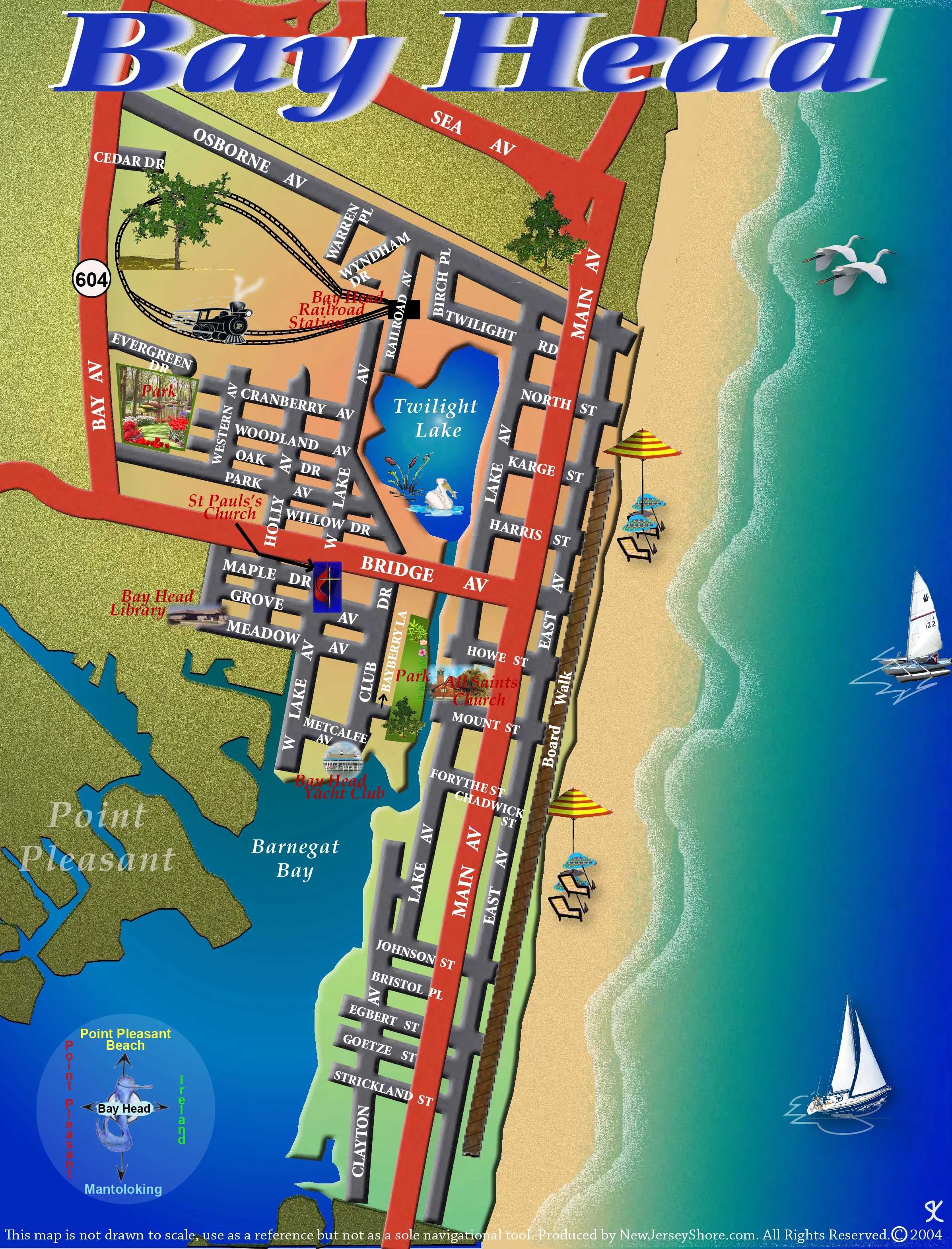
That Summer I Went to Bay Head

May 1, 2019 Joan Mularz
bay-head-map.jpg

 “History is often the tale of small moments—chance encounters or casual decisions or sheer coincidence–that seem of little consequence at the time, but somehow fuse with other small moments to produce something momentous, the proverbial flapping of a butterfly’s wings that triggers a hurricane.”

Scott Anderson

I was paying for my own tuition at that time so I was pretty focused on school. As a result, my social life was at a standstill. When a friend suggested we go to the shore for the Fourth of July weekend, I hesitated. I was taking summer courses and had little extra cash for a getaway, but she was persuasive. So, I scraped up the money and that weekend that summer we went to Bay Head in Ocean County, New Jersey. It was not the Jersey Shore of Snooki and The Situation. The town of Bay Head, situated on a long, narrow barrier island that separates Barnegat Bay from the Atlantic Ocean, has one of the largest historic districts in New Jersey.  Its large ocean-front homes are architecturally significant structures— at least they were until Superstorm Sandy wreaked devastation there on October 29, 2012.

Our weekend many years before that was idyllic though. On the fourth, we spent the day sunning and swimming and we talked about evening plans. She wanted to go to a “hidden” bar known for upscale clientele and the grasshopper cocktails she had heard about and I wanted to go see the fireworks. We compromised—bar first and fireworks after. At least that was the plan.

After showering and changing at the small inn we had booked, we set out to find the bar. The only clue was that it was in the basement of a beach mansion on the sand and you entered from a narrow road called East Avenue that paralleled the Atlantic coast to the rear of the residences. We found the road and proceeded along, passing private homes with high hedges. Eventually, we heard music and laughter and peeked into a walkway between the greenery. Closer inspection revealed an entrance for “The Bluffs.” We had found our destination.

Though part of an upscale hotel, the bar room looked like a private house basement and it was filled with tanned twenty- and thirty-somethings laughing, talking and drinking. I felt nervous and awkward but my friend was outgoing. She chatted easily and I floated along in her wake. When two friendly guys drifted over and started a conversation, I found myself drawn to one of them. As the evening wore on, I was laughing a lot.

The bar closed at ten so the four of us took a walk on the sand. The conversation flowed and the time flew. Sometime after midnight, we went to a diner for something to eat then the guys drove my friend and me back to our inn. We said goodnight and he asked if he could call me. I had a good feeling about him so I gave him my number.

A week later he called and we set up the first date that we now tell our children about.

Sad to say, “The Bluffs” is no more, except preserved as a memory in a coffee table book, The Bluffs, Bay Head, New Jersey - The Story of a Hotel at the Jersey Shore by Francine LaVance Robertshaw. The well-known and beloved landmark was torn down in 1996 to make way for two big houses. It avoided destruction by Sandy but like so many other beach towns, Bay Head’s historical architecture was already being assaulted by McMansions. The original grande dame of a building will always have a place in my heart though.


2 Comments

The Florida Journey Continues

April 1, 2019 Joan Mularz
IMG_6550 copy.jpg

“We must be willing to get rid of the life we’ve planned, so as to have the life that is waiting for us. The old skin has to be shed before the new one can come.”

Joseph Campbell


We’ve reached the sixth month mark in our relocation to Florida. During that time, we’ve continued to tweak our possessions. Lampshades have been changed out for lighter colors. It’s a small detail but it does give a brighter and more “Florida” feel to our rooms. We’ve let go of more things, not always an easy task when they have memories attached. Some have gone to the trash or Goodwill and a few larger items have been sold.

We’ve had the security system checked and explained and thought we understood it. However, after a weekend away, we returned and opened the garage door, not realizing it would trigger the alarm. By the time we got into the house, I quickly tapped in the code to turn it off. Seconds later, the alarm went off again and I realized I hadn’t pressed “off” after the code. No harm, no problem, right? Not exactly. The security company called and said that because the alarm went off twice, the “authorities” were on their way. It was embarrassing but we resigned ourselves to an all-too-public “all clear.” A patrol car showed up about half an hour later. (Good thing it wasn’t an emergency.) An officer rang the doorbell and inquired, “Are you folks okay?” I explained the mishap and he said, “Okay, but next time I’ll have to charge you.” Then he laughed and said, “Just kidding!” (I got the impression false alarms aren’t unusual in these wired communities.) 

At last report, the gate entry codes for guests were all set, or so we thought. They forgot to tell us to have guests press # after the codes. We learned about the glitch when a guest had a problem entering. It may not be the final solution however, because a new management company has taken over and the gate access system may be changed. If you’re coming to visit us, we’ll try to stay updated.

Air conditioning is a new fact of life for us and we struggle learning to deal with it. As two people with different sensitivities to heat and cold, we’ve had to compromise on the set temperature. It’s often warm for me but too cool for him. Another challenge is maintenance. We had one company come in to clean and check the AC system but we felt they took advantage of our ignorance. We paid their exorbitant fee but we’ve since learned no one in the community uses them. Next time we’ll check with the neighbors for recommendations. The learning curve continues.

We have different preferences for morning workouts. He bikes or runs and follows up with a session in the hot tub. I still enjoy doing my morning pool laps but I’m now being kind to my eyes by wearing swim goggles—not a pretty sight, but they work. 

We have long enjoyed kayaking but we left our old kayaks in Maine. So, we bought ourselves new Florida kayaks for Christmas and we enjoy paddling up and down rivers and the Intercoastal Waterway with its many canals. We pass lots of boaters, paddleboarders and other kayakers and we see ospreys, wading birds, turtles and occasional alligators, which thankfully have left us alone.

There’s little yard work for us here which is a luxury after owning a Massachusetts high-maintenance property. Our work pretty much consists of picking up dead palm fronds and putting them by the curb. An unexpected upside of less yard work is that my fingernails are growing longer and stronger!

We’ve learned that different dangers lurk in the outdoors here. In Massachusetts, we feared ticks and mosquitoes and the diseases they bring. Down here, poisonous toads can be a problem, especially for pets. Haven’t seen any yet but the “Toad Busters” trucks are out and about. 

Back in our early months here, the ocean was struggling with red tide. It soon went away but was replaced for a while by man o’ war jellyfish. Most of the time, however, we are enjoying the beach. Love that salty air!

Moving from a town with no sidewalks, roads like country lanes and minimal traffic to a city with busy multi-lane roads has been an adjustment. Stop lights here last a long time while the various straight and turning lanes have their opportunities. And it has taken a while to learn what lanes I need to maneuver into in order to avoid a forced exit or forced turn when I need to go straight. One positive is they have dotted lane lines to follow when you do make a turn.

Back in Massachusetts, I enjoyed a couple of great writing groups, so I was anxious to find something similar here. It has taken a while but I now take part in two monthly groups which each offer a different type of support. One encourages me to dig deep each time by responding to a writing prompt and having it critiqued. The other group provides feedback on my work-in -progress. 

Writing reminds me of books and, I have to say, I miss the wonderful Boston Book Festival with its deep roster of well-known authors giving presentations at no cost. The Palm Beach Book Festival also has an excellent line-up of authors but it charges a hefty fee.  

Finally, you can’t beat the plethora of restaurants with fresh seafood and outdoor water views down here, especially when Happy Hour prices make them affordable.


Comment

Turkish Delight

March 2, 2019 Joan Mularz
DSC_0013.jpeg

“Land Really is the Best Art”

Andy Warhol

As we left the Antalya otogar at nine pm for an overnight bus trip away from the Turkish west coast, we were leaving behind beach town vibes and hoping what lay on the other side of the mountains lived up to the hype. Was it really a land of otherworldly enchantment? 

First, we had to get there and the night was looong—nine hours of riding but they tried to make it as comfortable as an overnighter can be.  A young guy, wearing a peach and white striped dress shirt with white collar and black bow tie, served tea, soft drinks and small packaged cakes.  Two other attendants, in dress shirts with the bus company name on the collar and long ties, kept track of passenger tickets as the bus made several stops along the way to drop off and pick up people at various otogars. 

On a mountain road around midnight, the bus had some difficulty and the driver pulled off the highway. All of the attendants got out and looked at the engine with flashlights.  No announcement was made but fifteen minutes later, they all re-boarded the bus. They gave no explanation but the bus was working fine again.

At one am, we stopped at a restaurant-cum-shopping center called Gunaydin.  They made a long announcement in Turkish which a passenger translated and said we would stop for half an hour. We got off, used the facilities and bought espresso. The break may have been the driver's dinner stop however, because it lasted an hour.  When we got going again, it was hard to sleep.  Since we had small TVs at our seats, I watched part of that movie about blue people.  We made a few more stops in the middle of the night— where, we weren't always sure.

Our welcome to Goreme in Cappadocia was worth the ride. Our bus pulled into the otogar just after sunrise and the sky was a kaleidoscope of color. Hot air balloons floated everywhere amongst the fairy chimneys and other volcanic formations that dot the town. I counted at least seventy-five! It was pretty amazing. 

We walked up a small hill to our hotel but we were way too early for check-in.  One of the owners came into the courtyard with his tea and invited us to have breakfast on the roof terrace while we waited.  We ate and gaped as dozens of balloons were still floating overhead.  It gave our meal a magical feel.  

After we got settled in our room, we set out on a two-mile hike to the Goreme Open Air Museum, a Unesco World Heritage site. It’s an area of the rock formations that once housed a Byzantine monastic settlement and has been preserved for tourists. It has a number of small cave-like chapels carved into the rocks with the frescoes still partially intact.  Unfortunately, dozens of tour buses arrived at about the same time we did.  We waited on a long, slow line to get into one of the chapels then we saw it would be the same for the others. 

 It was way too hot and way too crowded, so we left that area and stopped in a cave church that was down the hill outside the official tourist section.  Inside, art students from Verona, Italy were working on restoring the frescoes and we got to watch up close with only a few other people.  

From there, we hiked into the Red Valley (Kizil Vadasi), famous for the red-rose color of the rocks. We wandered the trails and explored other caves carved into rocks without encountering many people. 

 It was a scorching day in September, but we had water with us, so we continued hiking on to the Rose Valley (Güllüdere Vadısı), which had more walking trails and more of the interesting rock formations. 

 All in all, we must have hiked about 5 or 6 miles. We were thirsty when we got back into town and found a small outdoor place for a 'buyak  bira' (large beer).

Cappadocia is a region of extreme weather— 104-113 Fahrenheit in the summer and bitter cold with some snow in the winter. When we were there, evenings were cool and the days were hot, but not in the hundreds. Average highs for September are in the 80s, with lows in the 40s. 

When we got back to the hotel, we were tired, especially since we hadn't had much sleep on the bus the night before.  We took a siesta for a couple of hours, until we went out for dinner.  We tried one of the local specialties, which was a tomato-based stew cooked in individual pottery jars—savory and delicious. 

The next day after breakfast, we went on a minibus tour we had arranged the day before because we’d surrendered our rental car in Antalya.  Goreme seems to be the best town for enjoying the caves and the phallic fairy chimneys rising from the landscape but Cappodocia has a lot to see beyond the town. 

We walked down the hill to the tour office.  Our tour guide, Merve, was a university graduate from the Black Sea and she was well-versed in the history of Cappadocia.  Our tour was in English, but our fellow passengers were like the United Nations.  There were young couples from St Petersburg, Russia, Beijing, China, and Edinburgh, Scotland, two single American girls - one from NYC and one from DC, and a couple closer to our age, from Sydney, Australia.

The first stop was on a scenic overlook, so we got a panoramic view of Goreme and the valleys with the rock formations.  Then we drove to the Ihlara valley and hiked a couple of miles through the Melendiz River Canyon, where we visited another cave church with some frescoes.  Partway along the river, we came to a tea house that was a lovely spot.  All through the canyon, we could see caves carved into the rock where monks lived in isolation many centuries ago.  There were also many dovecotes.  The monks used the birds to send messages and also used their droppings as fertilizer for their grapes.  The hike ended at Belisirma village where we had lunch on an outdoor terrace.  It was our main meal of the day and I enjoyed the local trout.

After lunch, we drove to Selime, where we scaled the rocks to visit an ancient cave monastery set up high from the road.  There were many chambers to visit, because the monks had, not only living quarters, but also some chapels.  From the monastery, the view looked like a Star Wars landscape.  In fact, our guide told us that, despite some of the hype about Cappadocia being the site of filming for the first Star Wars movie, they hadn't been able to get the permits.  It was actually filmed in Tunisia, which has a similar landscape.  

After that, we drove to Derinkuyu to visit the largest underground city in the area.  (For many centuries, the early Christians lived in these underground cities to avoid persecution.) This one was two hundred seventy-nine feet deep and had sixteen floors, of which we were able to go down eight.  We hiked down (and back up!) a couple of hundred steps and crawled through tunnels. It was a remarkable experience seeing how people conducted their lives in the bowels of the earth.

 The final stop was at an overlook of the Pigeon Valley (so-called because of the many dovecotes in the rock formations.). We ended the tour at about five-thirty pm back at the tour office, where Merve served us glasses of apple tea.  It was a nice way to end the experience.  

Before returning to the hotel, we hiked up the road past it, to a ridge overlooking the town and valleys, to watch the sunset.  Quite a few people had the same idea, many with their cameras and tripods. We settled down on the rocks and watched the sky turn to flame and engulf the valleys in a rose-golden glow.  

After sunset, we went back to our hotel, cleaned the dust of the day off, and went to a coffee place for an evening snack and the use of their Wifi.  (Our hotel had Internet access and we could receive emails at the hotel but couldn't send them.) It was a full day and lots of fun, but it was time to pack.

 After breakfast the next day, the airport minibus shuttle picked us up at the hotel in Goreme and drove us about one hour to Kayseri, where the regional airport for Cappodocia is located.  

We flew Anadolu Jet (one of Turkey's budget airlines) to the transcontinental city of Istanbul straddling Europe and Asia, happy to have experienced the otherworldly and futuristic landscape of Cappadocia.  

Comment

Family Vacation Back in the Day

February 1, 2019 Joan Mularz
Family Vaca Drawings.jpg

 “Memory…  is the diary that we all carry about with us.”

Oscar Wilde 

 (This memoir was written and the sketches drawn when I was about twenty-one. I called the story “The Negative Side of a Plus Vacation”. It was a plus because my family rarely took vacations and this was to be a beach getaway with a rental cottage near the ocean in Lavallette that would be a real treat. The negatives were things that seemed traumatic at the time but are the reasons I remember the trip. Needless to say, it was a time before cell phones and Internet.)

From my younger self:

It was decided that bright and early Saturday morning, the last one in July, the whole family would move bag and baggage to the shore. The idea was to spend one month relaxing, getting tanned and having a good time. This was accomplished in varying degrees and at rather sporadic intervals during our stay.

The whole caravan, after some two hours of loading our gear, consisted of my parents, three brothers, two sisters, myself, one car filled to overflowing, and one yellow sports car which had no room for any baggage, except two people and the tennis rackets.

We left as early as planned, minus a few hours lost trying to decide such weighty matters as “Would leaving the dog at a kennel be bad for its psyche?”, “Should we bring warm clothes just in case?” and “Does anyone have any overdue library books?”

We were also delayed by having to unpack unnecessary items which were put in the car by the youngest saboteurs—things such as their life savings of paper dolls and baseball cards, an entire army of toy soldiers including the fort, and a number of inflatable beach toys which had long since lost their inflatability.

Undiscouraged, we set out on the two-hour trip which we made in record time—five hours. Having spent three hours in traffic covering the last five miles of the beach road at tortoise-like non-speed, we innocently enough didn’t realize it could be a portent of things to come.

After obtaining the keys to the house at the real estate agent’s office, registering at the police station for beach tags, and shopping for food supplies, we turned to the task of unloading the load which had been loaded only hours before. The baby said, “Isn’t this fun?” It was a loaded question.

The next morning was like a new start. The sun was hot and it was a perfect beach day. For Daddy and I though, it was over much too soon. Our vacations were limited to weekends until the later part of the month. So, Sunday night, the two of us rode off in the little yellow sports car in the general direction of New York City and the nine-to-five world. Behind us, we left the others to their leisure.

Leisure? Frantic phone calls from my mother relayed the first melodrama of the season. One night early in the week, my littlest brother came down with the croup. Since there was no phone in the beach house, my mom sent a brother and sister to call a doctor from a phone booth. They only had one quarter, and since it was four am, there was no place to get any more change. Naturally, my sister called the wrong number, got told off by the man she disturbed, and came back to the house with the bad news.

Excitedly, they searched for more change until someone found a dime which had fallen into a crevice somewhere. (All the while, my little brother was breathing with difficulty, my other brother was telling my sister how stupid she was, and my mother, alarmed and alarming, was thinking out loud about the fatality of croup.)

They raced off again into the frightening, deserted, dark of the beach town and phoned again. The doctor’s wife answered, angry that they would call at such an ungodly hour, told them that the doctor was sleeping and to give my brother a lollipop to suck on. If he still had trouble breathing in the morning, she could give him an appointment.

Thankfully, my brother fell asleep in the meantime and, in the morning, help was finally obtained—but from another doctor. The problem was solved, or so it seemed until my mother tried to cash a check to pay for his prescription. After waiting for a credit okay from home via phone, the medicine was obtained.

For the rest of the week, the only thing my youngest brother required was rest. My mother got snatches of a tan in the backyard when my middle sister would watch him. My little sister complained that no one would take her to the beach. My oldest brother offered because he said he didn’t enjoy going by himself. However, my mother considered him too young to watch her. As a result, by the time the weekend came, they were all getting in each other’s hair.

 We told them not to lose hope for the family would be reunited in its hour of need for dinner on Friday night. We were and everyone relaxed. We all got in some weekend beach time bodysurfing at the ocean and crabbing in the bay.

Toward the end of the month when all eight of us could stay, my dad and I joined the others in full vacation mode. In fact, it was pretty mellow until my oldest brother and I took a spin in the little yellow sports car and the brakes failed. At least I was driving at a low speed down a side street, so we were unhurt and the car was fine. A neighbor’s split-rail fence was the lone casualty. Amends were made and that evening we enjoyed a cookout on our deck overlooking a canal from the bay, thankful for eluding disaster once again. We all crossed our fingers and toes that the rest of the vacation would be mellow. It was…  until the end of the month when we sat in traffic gridlock for much of the return trip.

Comment

The Journey of a Gift

January 1, 2019 Joan Mularz
sweater.jpg

“Too many people miss the silver lining because they’re expecting gold.”

Maurice Setter

A woman caresses me and who could blame her? I’m gorgeous and valuable. Even Nordstrom acknowledges this by placing me at the front of a display in the center aisle. My cloud-soft, white fibers are irresistible, thanks to the rabbit who was plucked raw, kept in a tiny cage until it was no longer useful, then suffered and died for me in China. The memory haunts me but I live in the moment and the white sequin polar bear wearing a red sequin scarf on my front cheers me. Glitz attracts money. I’m confident I’ll be someone’s holiday surprise.

The words the shopper speaks to her companion confirm my allure, “Oh Sally, my niece Julie will love this! She’ll appreciate the high-end cachet of this label too. I’m going to get it for her.”

I’m gently lifted with two hands and borne to a salesperson who snuggles me into a tissue paper-filled gift box. My fluffy heart swells with pride when I hear ka-ching. It tells me I’ll soon be loved and worn by an elegant girl.

Well, it was later rather than sooner because my presentation didn’t occur for another week. No matter; I luxuriated in my own silky texture.

 I knew gift day was imminent when I was transported in a moving vehicle. The ride was frigid but the destination was warm and filled with the aromas of spices and roasting poultry.

The scent of balsam engulfed me as I was set down under a tree and there I waited while a collection of humans ate a meal. I enjoyed my newfound warmth as I listened to the clink of cutlery and companionable chatter coming from a room nearby.

When it’s gift exchange time, I listen as others are presented and I rate people’s reactions to them. An iPad thrills someone. It isn’t as pretty as me but I give it 9 points for usefulness. Socks and flannel pajamas each get a tepid “thank you”— useful but boring, so 6 points.  A gift of jewelry elicits a kiss and an, “Oh darling, it’s beautiful!” Definitely expensive is my guess—hard to compete, so 10 points, but love (or guilt) have an unfair advantage.

Showtime! I’m lifted up and handed to the girl. As she undoes the ribbons and giftwrap, I anticipate my first look at her delighted face. When the tissue paper parts, my loft rises and I get a floaty feeling until I face a pretty young woman with her mouth stretched into a smile and eyes that don’t match. However, she holds me up and whispers, “Thank you, Aunt Sally. It’s so light and sparkly,” and my doubts are eased.

“A holiday sweater is perfect for right now, Julie.  Put it on and model it for us. Plus, I’d like to know it fits.”

I see that look in Julie’s eyes once more. She doesn’t want me. What’s the matter with her?

“I’ll be right back.” Julie carries me to her room, slips off the top she’s wearing, holds me up and talks to me, “You, my cuddly angora gift, are trashy looking. However, I’m not going to hurt Aunt Sally’s feelings so, here goes.” Julie grits her teeth, slips me over her head, slides her arms into my sleeves and regards my reflection in the mirror. Whispering, “You make me look hideous,” she touches up her slightly mussed hair and heads back to the main room. 

At this point, I want to scream, “Hideous? Just wait and you’ll see what hideous really looks like!” She couldn’t hear me anyway so I can only seethe.

When Julie rejoins the group, I’m vindicated. Choruses of, “You look lovely! Just beautiful!” and “You’ve outdone yourself, Sally!” fill the room. At least most of the group recognizes elegance.

My girl is quiet and takes a seat. Someone serves hot buttered rum and another sings a song everyone knows. Julie joins in but I go to work and soon heat is rising from her body. After several more songs, she excuses herself saying she’s tired. After a round of cheek kisses, we return to her room and I’m removed with just a bit too much force. I fear damage to my sequins. 

From my position on the floor where I was tossed, I glimpse her reflection in a large mirror. Everywhere my fibers touched is red and bumpy and I’m pleased I remembered how to cause an allergic reaction. 

The triumph of revenge is short-lived when several days later, Julie humiliates me. She donates me to Goodwill and the price tag they put on me completely underestimates my worth. Plus, they have the nerve to put me on a hanger and gravity puts stress on my fibers. I can feel parts sagging and stretching and it makes me depressed.

I soon hear scraping as hangers are slid along the rack. The space at my front opens up and I hear, “Oh my God, this is gorgeous!”

This girl with impeccable taste lifts me up and holds me in front of her body. Her friend gushes, “Love it! It’s perfect for New Year’s Eve and it’ll look great on you, Darcy.”

Darcy hugs me on the way to the checkout and says, “I can’t believe the price. It’s such a bargain.”

You have no idea, Dahling.

She strokes me and tells her friend, “I skimped on lunch all week to save these five dollars but it’s totally worth it for this. I’ve never dreamed I could afford anything so beautiful.” 

I feel an odd sensation—emotional connection. Maybe it’s karma. Darcy suffered to buy me so I’ll be nice to her. Take me home, girl! 

Comment

Relocating South

December 1, 2018 Joan Mularz
Unknown.jpeg

“Home is where the heart is”

Pliny the Elder 

I wasn’t born there and I left it twice for extended periods but New England was home to me for four decades. Though I gravitate toward warm, sunny places, I’ve loved it in non-summer for the skiing and snowshoeing and mountain hikes. I’ve had great friends, colleagues and writing group supporters there. I’ve even loved the often freezing cold (but exhilarating) Feaster Five on Thanksgiving morning. However, it was time to hit the life reset button.

After four decades of snow blowing and shoveling heavy snows and raking umpteen piles of beautiful autumn leaves in Massachusetts, my husband and I decided to follow the sun. We are not becoming snowbirds (technically “winter visitors). We plan to spend eight months in the warmth of the south and four months back north avoiding hurricane season in the lakes and mountains of Maine.

The process of relocation hasn’t been easy

First, we had to pare down our possessions and ready one house for sale. That took about a year. We put excess things in storage, donated items through once-a-month pickups, sold things online and had yard sales. 

The house was repaired and repainted, inside and out with sweat equity. The hardest part was removing the things we loved that evoked sweet memories. A clean slate was staged so buyers could visualize making it their own but it emphasized that it had ceased feeling like “home” to us even while we still owned it. That done, we endured several months of keeping things “perfect” for open houses and buyer visits until it was sold.

In the meantime, we found a place we loved down south. It wasn’t a rash decision. We had been scouting the area for several years and knew what we wanted. We made an offer, negotiated and signed the contract. Then we found out that we had to be approved by the Homeowners’ Association. We were a little nonplussed and wondered if any biases were being subtly employed. We’ve since learned the community is multi-age, multi ethnic, kid and dog friendly and has residents of varying sexual persuasion. So, what was the deal? I think it was a check to make sure you could pay your HOA dues—a somewhat invasive way to ensure the community doesn’t go belly up. 

Preliminaries over, we began the relocation process. The beginning involved a lot of moving boxes, bubble wrap and packing tape. Then we hired PODS to move our furniture and boxes, which we loaded ourselves with the help of friends. 

We notified the Post Office of our change of address and canceled newspaper delivery, electricity, landline telephone, internet and cable up north and set up those services at our new place. 

Address changes had to be submitted for credit cards, investments, AAA, cell company, New England doctors, AARP, pensions, health insurance, social security, EZ Pass, and services we would still need for our ski house (now winterized summer place) up north.

We had to apply for new drivers’ licenses, change our car registration and auto insurance to our new state, register to vote and find local doctors and contractors.

When the PODS with our stuff arrived and we had to unload them, a couple of our new neighbors gave us a hand and we also found some day laborers at a local resource center. The job of unpacking, hanging artwork, placing furniture and finding storage spots for things took weeks. One of the highlights has been finding a home for about fifty moving boxes, four large boxes of bubble wrap and a pile of moving blankets. Once all that was taken away, the garage space opened up.  Inside the living areas, we’ve had to decide what pieces work, what needed to be replaced with more appropriate new items and what we needed to let go of completely. It’s an ongoing process.

Moving from a single-family home to a townhouse with a homeowner’s association has brought its own learning curve. We’ve had to figure out how to dispose of packing paper and cardboard according to the community garbage and recycling rules. (We used to burn paper in a woodstove.) We had to figure out how to enter the gym when it’s locked. (Use the pool pass.) We were given remotes for the front gate but wondered how to let in guests without trekking over there. A trip to the property management office set up our gate access codes for guests and we can now click them in using our cell phones.  We had hoped to do without a landline phone to avoid robocalls but learned that we need one for the security system the association provides. (We’re still waiting to learn how to use the latter because we don’t have the code yet.) And a new climate brings new challenges. One neighbor showed us how to set up the garage door for hurricane stability. Another showed us how to open our hurricane impact windows so we can clean them. 

We are at the two-month mark in our new home and, though our first weeks here were hectic, we were spared missing beach walks because the red tide had descended. The easing of move-in tasks has thankfully coincided with a healthy ocean shore.  I am now embracing flip-flops and sandy feet in winter, loving my morning pool workouts that ease my arthritic knees and reaching out to establish new writing contacts. It hasn’t been easy but has it been worth it? Absolutely!

Comment

Rock Tour

November 1, 2018 Joan Mularz
TELEMMGLPICT000159095810_trans_NvBQzQNjv4Bq9ipoqzrpJx-0lCLDc3i7WrT5LfTkYhqvBvjfatlPy1M.jpeg

“If it weren’t for the rocks in its bed, the stream would have no song.”

Carl Perkins

“Rock” is a word of contradictions; as a noun it can mean steady or unmoving but as a verb it denotes movement. And that movement can be jerky and twisting or smooth and swaying.

NOUN:

When we think of the noun “rock,” we picture a stone mass of mineral matter. The word is derived from the Old English “rocc,” as in “stanrocc,” a stone rock or obelisk (c. 1300). 

Aside from actual stone, the word “rock” can be a metaphor. For example, the monolithic, limestone Rock of Gibraltar’s image has been used for decades by Prudential Insurance as a  symbol of the stability of the company. 

Dwayne “The Rock” Johnson, action star and semi-retired pro-wrestler is so-named for his rock-hard body and his steady strength fending off opponents. 

When someone can be depended upon, they are often told, “You are my rock.”

The word “rock” is also sometimes used to denote objects that are not stone but have its shape — a large diamond, crack cocaine, and, dating from 1946, ice cubes (as in having a beverage “on the rocks.”)

In U.S. slang, it can have a somewhat vulgar meaning as well. To “get one’s rocks off” means to experience an orgasm, “rocks” here being testicles, as a pun on medieval “stones.” 

Since a rock is inert, it can also be used to denote someone whose brain is inactive (“dumb as a box of rocks”) or has poor judgment (“have rocks in one’s head.”)

The noun “rock” reminds Christians of the Apostle Peter. He was Jesus’s most reliable follower, steady enough that Jesus said, “Upon this rock, I will build my church.” Of course, he used that analogy because the name Peter comes from “petros,” the Greek word for rock and/or “petrus,” the Latin equivalent.

There are a number of English words that derive from “petros.” Petroleum is rock oil. A petroglyph is a prehistoric rock carving. An object that is petrified is turned to stone and a petrified person is unable to move or think.

To my surprise, the word “parsley” comes from the Latin word petroselinum and from Greek petroselinon. It means rock celery.

VERB, MEANING 1:

One meaning of the verb “rock” is smooth swaying, like a baby’s cradle that is rocked to lull the child. Soothing songs (lullabies) often accompany the rocking. “Rock-a Bye Baby” is the American musical standard of child-rearing and various theories exist to explain the origins of the song:

One says it simply describes a mother gently rocking her baby to sleep, as if the baby were riding the treetops during a breeze then lowering the baby to her crib.

Another identifies the rhyme as the first English poem written on American soil, suggesting it dates from the 17th century and that it may have been written by an English immigrant who observed the way native-American women rocked their babies in birch-bark cradles suspended from the branches of trees, allowing the wind to rock the baby to sleep.

One links it to an 18th century legend in Derbyshire, England about the Kenny family who lived in a huge yew tree where a hollowed-out bough served as a cradle.

Yet another theory suggests that the lyrics, like the tune "Lilliburlero" it is sung to, refer to the son of King James II of England, widely believed to be someone else's child smuggled into the birthing room in order to provide a Roman Catholic heir for James. The "wind" may be that Protestant force coming from the Netherlands bringing William of Orange who would depose James. The "cradle" is the royal House of Stuart.

The most depressing theory is based on a 17th century ritual that took place after a newborn baby had died. The mother would hang the child from a basket on a branch in a tree and wait to see if it would come back to life. The line “when the bough breaks the cradle will fall” refers to the fact that the weight of a dead baby was heavy enough to break the branch.

VERB, MEANING 2:

Another meaning of “rock”, dating from the late 13th century, is “to move jerkily.” 

It took on a whole new context in 20th century America. The word was used to mean “to move with musical rhythm” in 1922 blues slang and often had sexual overtones (as in the song, “My Man Rocks Me” (with one steady roll). 

By 1948 it had come to mean “to dance to popular music with a strong beat.” A popular song then was “We’re gonna rock.”

The term “rock-n-roll” became a slang word for sex in the late 1940s and especially in the early 1950's when the number of young people under 25 in the US driving cars and trucks increased dramatically. More people were having sex in automobiles and when 2 people drove to make-out areas and got it on, the car would then rock back and forth. Thus, many people referred to having sex as rock-n-roll. Because of the sexual reference the term implied, it resulted in one of the early reasons why conservative adults back in those days disapproved of rock-n-roll as a type of main stream music. 

Rockabilly was one of the earliest styles of rock and roll music, dating back to the early 1950s in the U.S. especially the South. It blends the sound of country western music with rhythm and blues, leading to what is considered "classic" rock and roll. Some have also described it as a blend of bluegrass with rock and roll. The 1950s were the height of the Rock ’n’ Roll era as many of the songs attest to: “Jailhouse Rock,” “Rock Around the Clock,” “Rockin’ Robin,” “Rock and Roll Waltz,” “Rock and Roll Music,” “Rock and Roll is Here to Stay.”

Rock music has stayed. It has continued to “rock on” in many variations since the early days. 

 Here are a few examples:

British invasion rock transformed the American music world, starting with the Beatles and soon followed by other British bands. The Beatles were an English rock band formed in 1960. Rooted in skiffle, beat and 1950s rock and roll, they became widely regarded as the foremost and most influential music band in history. They later experimented with several musical styles, ranging from pop ballads and Indian music to psychedelia and hard rock, often incorporating classical elements and unconventional recording techniques in innovative ways. 

The 60s also introduced surf music (rock associated with surf culture particularly as found in Southern California), acid or psychedelic rock (associated with the counterculture), blues rock and garage rock (sometimes called '60s punk or garage punk). 

Heavy metal rock (or simply metal) developed in the late 1960s and early 1970s, largely with roots in the United Kingdom.  The lyrics and performance styles are sometimes associated with aggression and machismo. 

The 70s brought Southern California soft rock (or lite rock), British glam rock, hard rock and gothic rock (alternately called goth-rock or goth).

Alternative rock emerged from the independent music underground of the 1980s and became widely popular in the 1990s.

Rock music in its many subgenres still dominates music today and the language of rock and roll has seeped into our culture. The Urban Dictionary defines a “Rockstar” as someone who can stay up and party all night long and then wake up and take care of business in the morning (“rock n’ roll”}.

And, since it’s November, we all need to “Rock the Vote!”


Comment

Jeep Jaunt in Mui Ne

September 1, 2018 Joan Mularz
Joan Sledding Sand Dunes copy.jpg

“Sand lines my soul which is filled with the breath of the ocean."

A.D. Posey

The equivalent of sixteen dollars bought each of us a bus ticket from Ho Chi Minh City (the former Saigon) to the beach resort of Mui Ne, a four and a half hour trip up the Vietnamese coast. The driver instructed each person to remove shoes and provided plastic bags for us to store them for the journey. Assigned seats were reclining beds so we stretched out and had a relaxing exit through the frenetic city traffic. 

The scenery changed as we headed north, from urban streets packed with motorcycle traffic and suburban towns with flower-filled rotaries to rural areas where we began to see the first bits of elevation in the form of small peaks along the coast and in the distance to the west.  The China Sea came into view as we entered Phan Thiet, a coastal area made up of about thirty miles of towns (or wards) that have been transformed into a resort destination. We followed the beach road further north to the ward of Mui Ne with more than a hundred beach hotels, as well as restaurants, bars, shops and cafes.

Our hotel was a pleasant surprise. The bargain price of 700,000 Dong (about thirty-eight dollars a night) had made us wary, despite the photos we had seen at the agent’s office in Ho Chi Minh City, so we booked only two nights in advance in case we didn’t like it.  However, the hotel had tropical gardens, a large pool area that led to the sand and rooms with nice amenities and balconies.  Paradise! After a swim, we arranged to extend our stay to five days.

On our second day there, during one of our walks through town, we came upon a local company advertising a private Jeep tour of some of the natural wonders of the area. The price was reasonable and it sounded intriguing so we booked an afternoon tour for the next day. 

We woke to sunshine and blue skies and by afternoon it was hot, so the Jeep’s first stop was a welcome relief.  We drove to a soft, red creek known as the Fairy Stream (Suoi Tien). It is colored by the clay and limestone particles that filter in from the multi-colored rock formations at its shores. We got out, took off our shoes and walked upstream on the soft red dirt bottom. It was no more than knee-deep at its highest spots and felt pleasant and cool in the intense heat. Winding its way through bamboo forests, boulders, and the dunes behind Mui Ne, the whimsically-named stream soon opened up to a natural fairyland—a high-walled canyon of orange, white and yellow sand formations on the banks of the stream. (Water flows into the cliffs and erodes the sand blocks to create strange ever-changing shapes that ignite the imagination.) It was otherworldly and beautiful and led us to a waterfall.

After wading back downstream and returning to the Jeep, our driver took us into the center of Mui Ne’s fishing village. Fishing is at the heart of Vietnamese culture and many communities rely on it to provide income and food for their families. Offshore were many vessels in the elongated traditional wooden boat design used for deep-sea fishing. Closer to shore, the port was busy with the movement of round woven tubs, the traditional basket boats of Vietnam they call Thuyen Thung. These coracles are native to Wales but have been used in Vietnam for centuries.Some fishermen were using them as dinghies to paddle out to the wooden boats anchored offshore and carrying cargo to and from the larger vessels. Others were fishing directly from them with their nets. (It’s said that during the French Colonial Era, when a new tax on owning a boat was introduced, they were also a means of evading the tax. The fishermen argued they were not taxable because they were not boats at all, but baskets and they were successful.)

After some time spent wandering the waterfront looking at workers sorting and preparing the catches for sale, we boarded the Jeep again to see Mui Ne’s famous and enormous red and white sand dunes. We drove to the white dunes (doi cat trang) first, about 15 miles north of town.  This took us past some stunning coastal scenery.  At the dunes, I rented a hand-made plastic sled from a young boy and hiked up into the hilly desert dunes.  I coasted down several times. It was fun but very hot in the baking sun so we headed to the tree-shaded area at the bottom, got some cold drinks and set out in the Jeep again.

Next stop were the red sand dunes (doi hong) where we hiked to the top and watched the sunset. We experienced a Sahara-like remoteness far away from the built-up resort areas but it was not a solitary experience; the ridge was filled with people observing the fiery climax of the day. We hiked back down as the evening cooled.

On the ride back to the hotel, I noticed a metal plaque on the dashboard of the Jeep. It read “Property of the U.S. Army.” I wondered how it came into the Vietnamese owner’s hands. I later learned that when the U.S. evacuated from Saigon, it left behind lots of military vehicles and equipment, including not only Jeeps but also aircraft. U.S. planes still litter the field at Tan Sun Nhat airport.

Have you been somewhere on holiday and seen remnants of war?

Comment

Following the Remains of Great British Writers

August 1, 2018 Joan Mularz
Poets' Corner.jpg

“We carry the lives we’ve imagined as we carry the lives we have, and sometimes a reckoning comes of all the lives we have lost.”

Helen MacDonald, H is for Hawk

Discovering the tombs of so many famous writers and poets in Westminster Abbey made quite an impression on me during my first visit to London, England as a young woman. There were so many names I recognized because I had studied their poems and read their books going back as far as elementary school.  The ones I mention below are each identified by one piece of writing but each of them produced many more literary works of note.

I’ve since learned that the Abbey’s South Transept (“Poets’ Corner”) started with the burial of “The Canterbury Tales” London poet Geoffrey Chaucer in 1400 as he had apartments in the Abbey where he was employed as master of the King's Works. He is considered to be the greatest English poet of the Middle Ages—“Time and tide wait for no man.”

Other British-born poets were given a Poets’ Corner honor later. Among others, they included the following:

 Londoner Robert Browning was interred in 1889 (“Love Among the Ruins”). Browning lived with his poet wife Elizabeth Barrett in Italy and both died there—“Grow old with me! The best is yet to be.” Casa Guidi in Piazza San Felice, Florence, Italy, where Robert and Elizabeth Barrett Browning once inhabited the piano nobile apartment, is now a writer's house museum.

 Alfred Lord Tennyson (“Charge of the Light Brigade”), a Poet Laureate of Great Britain and Ireland from Lincolnshire arrived in 1892 —“’Tis better to have loved and lost than never to have loved at all.” A Tennyson Museum is at Farringford House, Tennyson's home of 40 years on the Isle of Wight.

 John Masefield (“I must go down to the seas again…”), another Poet Laureate of the United Kingdom from Ledbury in Herefordshire joined them in 1967—“In this life he laughs longest who laughs last.”

The Poets ‘Corner honor was extended to a few British writers of other genres:

Samuel Johnson (“A Dictionary of the English Language”) from Litchfield city in Staffordshire—“Patriotism is the last refuge of the scoundrel” was interred in 1784. The Samuel Johnson Museum Home is in the center of Litchfield.

The Victorian novelist Charles Dickens (“A Tale of Two Cities”) from the port city of Portsmouth in Hampshire arrived in 1870 —“Charity begins at home, and justice begins next door.” The Charles Dickens Museum is in one of his former homes on Doughty Street in London.

Rudyard Kipling (“The Jungle Book”) who was born in India (which inspired much of his work) to British parents—“He travels the fastest who travels alone” joined them in 1936. One home of Rudyard Kipling, Bateman’s, is a large estate now under the jurisdiction of the National Trust. It can be visited at Bateman’s Lane, Burwash, East Sussex. There is also a Kipling estate in the U.S. (where he wrote The Jungle Books and Captains Courageous) at Scott Farm Orchard in Dummerston, Vermont.

This one small area of the massive Abbey called “Poet’s Corner” overwhelms one with its gathering of hundreds of years of literary talent.

Many other writers, like the following, are memorialized in the Abbey but are buried elsewhere in England:

Stratford-upon-Avon, Warwickshire is where William Shakespeare (“Hamlet”) was born and he was buried there in 1616. He is widely regarded as both the greatest writer in the English language and the world's pre-eminent dramatist—“To thine own self be true, and it must follow, as the night the day, thou canst not then be false to any man." Shakespeare’s Birthplace Museum is on Henley Street, Stratford-upon-Avon. 

London-born John Milton (“Paradise Lost) was a poet and also a civil servant for the Commonwealth of England and was buried in 1674 in St. Giles' Church without Cripplegate, London—“They also serve who only stand and wait.” Milton’s Cottage, one of his former homes, is open as a museum at 21 Deanway, Chalfont St. Giles, Buckinghamshire.

Jane Austen (“Pride and Prejudice”) is from Hampshire and was buried in 1817 in Winchester Cathedral there. Her novels interpret, critique and comment upon the British landed gentry at the end of the 18th century—“Friendship is certainly the finest balm for the pangs of disappointed love.” Jane Austen's House Museum is on Winchester Road, Chawton Alton, Hampshire.

Though Lord Byron (“She Walks in Beauty”) was born in London and died of a fever in Greece in 1824 while fighting in the Greek War of Independence, he is buried at the Church of Saint Mary Magdalen in Hucknall, Nottinghamshire. (The Greeks mourned him deeply and some say his heart is buried at Missalongi there. They sent the rest of his remains to England to be buried at Westminster Abbey but the Abbey refused on the grounds of “questionable morality.”) He did rate a memorial though—“If I don’t write to empty my mind, I go mad.” Newstead Abbey in Nottinghamshire is the ancestral home of Lord Byron and now houses a museum containing Byron memorabilia.

William Blake, a poet of the Romantic Age, (Tyger! Tyger! burning bright…”) was laid to rest at Bunhill Fields Burial Ground, London in 1827. He is also considered one of Britain’s greatest painters and printmakers—“To see the world in a grain of sand, and to see heaven in a wild flower, hold infinity in the palm of your hands, and eternity in an hour.” There is a Blake Room at the Tate Museum in London.

The Brontë sisters, whose novels have become classics of English literature, were born in West Yorkshire and Charlotte (“Jane Eyre”) and Emily (“Wuthering Heights”) were buried there in the village of Haworth (Emily in 1848—“Whatever our souls are made of, his and mine are the same” and Charlotte in 1855—“Men judge us by the success of our efforts. God looks at the efforts themselves”). Their sister Anne (“The Tenant of Wildfell Hall”) wrote under the pen name Acton Bell and was buried in 1849 in North Yorkshire in the village of Scarborough —“But he that dares not grasp the thorn Should never crave the rose.” The Brontë Parsonage Museum is on Church Street in Haworth.

William Wordsworth, another Romantic poet, (“I Wandered Lonely as a Cloud”) is from Cumbria in the Lake District and was buried in 1850 at St. Oswald Churchyard in the town of Grasmere there—“The child is the father of the man.” His home, Dove Cottage, is also located in Grasmere and is now the William Wordsworth Museum.

“The Mill on the Floss” author George Eliot (pen name of Mary Anne Evans) from the town of Nuneaton in Warwickshire was buried in 1880 at Highgate Cemetery, London.—“It is never too late to be what you might have been.” Though one of the leading writers of the Victorian Era, Eliot was not buried in Westminster Abbey because of her denial of the Christian faith and her "irregular" though monogamous life with George Henry Lewes. A George Eliot Collection is at the Herbert Art Gallery and Museum in Coventry. The Nuneaton Museum also has a permanent display on their local writer George Eliot.

American-born T.S. Eliot (“The Wasteland”) from Missouri is memorialized in the Abbey as well, perhaps because he was a Nobel Prize winner who eventually became a British citizen—“April is the cruelest month, breeding lilacs out of the dead land, mixing memory and desire, stirring dull roots with spring rain.” T. S. Eliot is perhaps best known for his clever verse made popular in the musical, “Cats!” He died in London in 1965 and the Dean of Westminster offered burial in the Abbey but Thomas had left other instructions; his ashes were buried at St Michael's Church, East Coker, Somerset, the village from which his ancestor had set out for America in the 1660s. The T.S. Eliot House at 4446 Westminster Place, St. Louis, Missouri is a City Landmark.

 Though C. S. Lewis (“The Lion, the Witch and the Wardrobe”) was born in Belfast, Northern Ireland, he held academic positions at both Oxford and Cambridge Universities and was buried in 1963 in the churchyard of Holy Trinity Church, Headington, Oxford—"Since it is so likely that children will meet cruel enemies, let them at least have heard of brave knights and heroic courage.” C.S. Lewis’s home, The Kilns, Headington, Oxford, is now a study center and can be visited.

Like Lord Byron, other British writers who are memorialized at the Abbey, traveled widely in Europe and died in foreign countries but some, like the following, are buried abroad: 

Piazza di Spagna, 26, a house at the bottom of the Spanish Steps in Rome, Italy is where the Romantic poet and Londoner John Keats (“Ode to a Grecian Urn”) died of tuberculosis at the age of 26 —“A thing of beauty is a joy forever.” His tombstone in Rome’s Protestant Cemetery reads: "This Grave contains all that was Mortal, of a YOUNG ENGLISH POET Who, on his Death Bed, in the Bitterness of his Heart, at the Malicious Power of his Enemies, Desired these Words to be engraven on his Tomb Stone - Here lies One Whose Name was writ in Water, Feb 24th 1821". 

Sussex-born Percy Bysshe Shelley (“To a Skylark”) was a friend of both Byron and Keats and spent quite a bit of time in Italy.  Less than a month before his thirtieth birthday, Shelley drowned in 1822 in a sudden storm on the Gulf of Spezia while returning from Livorno to Lerici in his sailing boat. The boat was named “Don Juan”, a nod to Byron and he died with a small book of Keats' poetry in his pocket. Shelley's body was washed ashore and later, in keeping with quarantine regulations, was cremated on the beach near Viareggio. Like Keats, he is buried in the Protestant Cemetery in Rome—“O, wind, if winter comes, can spring be far behind?”

The apartment that Keats stayed in while in Rome has become a small museum devoted to his life and the life and works of other Romantics, such as Percy Bysshe-Shelley and Lord Byron. There are thousands of Romantic texts in the woodworked and glass cabinets along the wall. Keats's death mask and a few other relics from the poet's life are on display. 

Italy has another small museum related to a British writer that is based on pure storytelling. Shakespeare’s play, “Romeo and Juliet” takes place in Verona and the story is fiction—“Love is a smoke made with the fume of sighs.” However, the ever-resourceful and willing-to-bend-the-truth-for-tourism Italians have designated a building there as “Casa di Giulietta” fronted by a balcony said to have inspired Shakespeare. They even have a person on staff that answers advice-to-the-lovelorn letters and she signs them “Juliet.”

Finally, two British expat brothers and authors, Gerald and Lawrence Durrell, were not memorialized at the Abbey but Lawrence was short-listed for the Nobel Prize and Gerald was awarded the Order of the British Empire (OBE) honor. Born in India of British parents, they spent much of their lives abroad. The Durrells’ White House on the Bay of Kalami in Corfu is open on exclusive days for one hour as something like a Durrell museum.

Lawrence Durrell (“The Alexandria Quartet”)—“A city becomes a world when one loves one of its inhabitants” was caught in Corfu at the outbreak of World War II and escaped to Crete with his wife and daughter. Then he went on to Egypt, serving in Cairo and Alexandria, as well as in Belgrade, Yugoslavia as a British press officer throughout the war. After that, he lived and worked in Rhodes, Greece and Cyprus for many years. Villa Cleobolus, his kiosk-like home in Rhodes New Town, still stands in the Turkish graveyard near the harbor. Lawrence spent his last years in the south of France and was buried in 1990 on the grounds of his home in Sommieres.

Gerald Durrell (“My Family and Other Animals, Birds, Beasts and Relatives”) left Corfu with some of his family at the outbreak of World War II and returned to England. He was not only an author but also a British naturalist, zookeeper, conservationist and television presenter. He founded what is now called the Durrell Wildlife Conservation Trust and the Jersey Zoo on the Channel Island of Jersey. He died in 1995 and his ashes are buried at Jersey Zoo—“Animals generally return the love you lavish on them by a swift bite in passing-not unlike friends and wives.”

If you’ve read this far, you may very well say, “But she’s omitted the most important one!” Let me know which British author’s work, memorial or museum has inspired you.


 .

Comment

Trip to a Hammam

July 1, 2018 Joan Mularz
hammam_painting1.jpg

“If you never did you should. These things are fun and fun is good.”

Doctor Seuss

We stepped off the Easyjet plane in Marrakech carrying a thousand tiny bars of soap in our luggage. We weren’t being clean freaks; they were for our friends in the Peace Corps who needed them for a health clinic in a Moroccan hill town. We were looking forward to visiting that town and to meeting their Moroccan host family.

After an overnight stay in a Marrakech ryad (hotel) and a morning spent wandering the medina, we took a taxi to the bus station then took a three-hour bus ride to the coastal town of Essaouira where we met the host family—Hossein, Khadijah and their son. Hossein, the husband and father, was warm and welcoming and spoke English well. The child, an alert and active eight year old, liked TV and Spiderman, standing on his head and drawing pictures. Khadijah, his mom. spoke only a little English but communicated on a human level in a very nice way. It was she who provided two very memorable experiences for me.

  At the time, Khadijah was attending culinary school and the first experience was the meal she prepared for us. It started traditionally with mint tea and cookies, nuts, and sweets.  After that, she served a delicious shrimp soup, followed by fresh fish from the local pier cooked with olives, tomatoes, garlic, ginger, parsley and lemon. The exquisite presentation of the fish platter showed her skills and portended her future success as an entrepreneur offering Moroccan cooking classes for tourists. Khadijah’s Kusina now gets 5 star reviews on Facebook.

The second experience resulted from a conversation during that meal. I mentioned that I was interested in visiting a hammam (a traditional bathing facility) while in Morocco. Khadijah said that the ones offered for tourists were overpriced and she offered to take my Peace Corps friend Mary and me to her local hammam and to teach us the ritual. I was excited to have the opportunity and we agreed to meet her the next afternoon. She instructed us to bring towels, a scrubbing mitt and shampoo.

Since we had a few hours to kill before our rendezvous, we spent the next morning exploring. First stop was the Essaouira fish pier where a group of French female artists were sketching the bright blue boats. Afterwards, we walked the town ramparts then chatted with some local teenagers who had set up an information booth in the nearby square for International HIV-Aids testing day. Lunch was at a very cool restaurant where we sat on couches around a low table in a cave-like alcove and then we set off for our hammam experience.

Mary took me to a hanut (small store) to buy a scrubbing mitt and we met up with Khadijah who brought her own bucket full of goodies and guided us into a petit taxi.  It took us to her favorite hammam, a short drive from the town center.  

Once there, we entered the women’s part of the facility into a beautiful floor-to-ceiling tiled room that had blue and white padded benches.  We stripped down and checked our clothes at a counter.  They gave us each a big bucket and some plastic sandals.  Clutching our towels and buckets, we entered a series of steam-heated tiled rooms. They were filled with grandmas, middle-aged women and young girls in various stages of their bathing rituals, and for many of them it was the one place they could remove their headscarves. Khadijah found us each a small low-to-the-ground stool in one of the rooms and showed us where to fill our buckets with a mixture of cold and hot water. She gave us each a small packet of olive oil liquid soap and instructed us to massage it into the skin all over our bodies.  

The next step was called gommage.  You take a scrubbing mitt and rub that on your skin.  I started in on my arm and then Khadijah wasn't satisfied.  She took over and, rubbing harder, sloughed off lots of dead skin.  It was amazing. I dumped buckets of water on me to rinse off.  

The next instruction was to go to the relaxation room and lie down on one of the tables. I did as instructed and enjoyed the tranquility for a while. 

 Afterwards, I returned to the bathing area to shampoo my hair and soap up my body with a nylon loofah-type thing that Khadijah provided and then I rinsed with more buckets of water poured over my head and body. 

Next, Khadijah took out some small square tablets that looked like bath salts or bouillon cubes and dissolved them in water to make a paste which she smeared over her face and body and invited me to do the same.  After a final rinse, we were all done and I was feeling wonderful!  

One bonus of this experience was that it cost us the equivalent of about $3.00 apiece, including the taxi!

Have you had a local experience in another country that exceeded expectations?


Comment

A Trip of the Tongue

June 1, 2018 Joan Mularz
-CTj-Vcwf4Pjh8P3iVSnc-V2o5c@500x375.jpg

                    “Meow means woof in cat.”

                                                                George Carlin

I have moved around quite a bit during my life, so I’ve experienced firsthand the challenges posed by language differences and I’m not just talking about understanding languages that are not English. 

It took a few years of working and socializing with British people to realize that every time they called something I did “brilliant,” they weren’t referring to my intellect. I had a British student who referred to the juice packs in her lunch box as “Ribena.” It took me awhile to realize it was a brand name in the U.K., not a pet name or a non-English word. I never heard my British friends use the term “Bob’s your uncle” but when it popped up in British mystery novels, I looked it up. It means “your success is guaranteed” and relates to some long ago Prime Minister’s use of favoritism appointing his nephew to a political position. It’s a good example of needing to know the local context to understand an expression. If I said, “Bob’s your uncle,” I would merely be telling my American kids about my brother. 

And I didn’t have to cross the pond to be bewildered either. Growing up in New York, I caught lightning bugs on summer nights and quenched my thirst at the park by drinking from a water fountain. I also drank treats like sodas, egg creams and shakes, ate heroes, and enjoyed ice cream in Dixie cups or in cones with sprinkles. 

When I moved to Massachusetts, I had to translate. Kids caught fireflies and drank water from bubblers. Soda was tonic but the tonic of gin and tonics was tonic water and gin was bought at packies, not liquor stores. Shakes were frappes, heroes were grinders and nobody seemed to know what an egg cream drink was. The ice cream cups were called Hoodsies and cones didn’t have sprinkles; they had jimmies.

 As a young adult in New York, I went into “The City” (Manhattan), rode the subway, drove around traffic circles, and traveled uptown, downtown or crosstown. In Massachusetts one goes into “Town” (Boston) to ride the T. One drives around rotaries and the streets are alphabetical or seem to go willy-nilly around town. For beach vacations, New Yorkers go “down the shore.” In Massachusetts, people go “down the cape” or “up the coast.” 

I live part-time in Maine and English there has quirks of its own. I described one example in my book, Maine Roots Run Deep, when a teenager from away meets an old man who’s a native:

“… ‘Before we get stahted, we need somethin’ ta quench ahr thirst. A friend was up ta Bangor t’other day and got me some Moxie. Int’rested?’

‘What’s Moxie?’

‘Best soft drink in the world.’

… I’m curious, so I say, ‘I’ll try some Moxie.’

‘Young lady, you are in for a true Maine experience. Moxie comin’ right up!’

… The old man looks at me, screws up his eyes, and says… 'You’re not only kind, ya have moxie.’

I’m confused. ‘Well, yes, you gave me a Moxie to drink.’

‘I mean the other kind of moxie. Moxie the drink is spirited, so a person with spirit or pluck or gumption, for that matter, is said ta have moxie.’ He gets a mischievous smile on his face and adds, ‘Course, the naysayers claim it takes courage ta drink that soda, so ‘moxie’ can also mean courage.’”

Traveling out west has taught me new meanings for some words. In New England, “The People’s Republic” refers to liberal-leaning Cambridge, Massachusetts, but in Colorado it refers to Boulder, a town whose inhabitants are often referred to as “granolas.” On the east coast, a “gaper” is a person who stares, but in western ski towns, a gaper is a skier or snowboarder who is clueless. Hikers in New England try to bag 4,000 footers but out west they climb 14ers.  The western U.S. also introduces new words and a visitor soon wonders about the differences between plateaus, mesas and buttes and whether or not a wash, an arroyo and a gulch are the same.

The optimal way to learn languages other than English is to not only learn the words but to understand their idioms. Literal translation of a foreign idiom doesn’t explain the meaning. Likewise, literal translations of our expressions can lead to some confusion. For example, when my husband wanted to tell an Italian colleague that he was knowledgeable and competent, he said he was “sulla palla” (literally “on the ball”). The reaction was a puzzled expression until it was explained. Oddly, the Italian expression should have been "in gamba" which literally means “in the leg.” Neither the English nor the Italian idioms make much sense to me.

“Break a leg,” an English expression for good luck, would be met with a wince by many Italians. Their expression for good luck, “In bocca al lupo” (in the wolf’s mouth) is equally perplexing to English speakers.

I explored the quest for English-Italian communication in my book, Upheavals at Cuma in an encounter between two teens:

“… I feel a light touch on my arm and turn around. He puts his finger to his lips as if to say, ‘Don’t tell anyone’ and hands me the ‘pesca.’ I offer the two coins but he refuses. He points first to me and then to himself and asks, ‘Amici?’

At this point, I’m freaked and I try to give the ‘pesca’ back. All I know is that ‘amo’ means love, and I don’t even know this kid!

His frown returns and he runs his fingers through his hair as if he’s frustrated. Then his large brown eyes light up in sudden recognition. ‘Amici…friends, no?’

Friends…that’s okay.”

In German, idioms are sometimes related to their food. For instance, someone who got lucky “had a pig” (Schwein gehabt). If they don’t care and think “it’s all the same to me,” they say “Das ist mir Wurst” (It’s a sausage to me). 

When we fall in love with someone, we say we are “head over heels” but the Germans are “Hals über Kopf” (throat over head). Theirs is more of a tossup of the usual order. 

If a German tells you they have “Die Daumen drücken” (thumbs pressed), it’s the same as our “fingers crossed. When we cross our fingers, the thumb does press against them, so it a difference of where a culture focuses. 

Cross-cultural communication seems to be a theme in my books and I explore it again between a German and American teen in White Flutters in Munich:

“… ‘I wonder if German fish speak the same language as American… or Greek… or Russian fish. Don’t you sometimes wish that people had a universal language and understanding?’

‘Du bist sehr tief.’

‘See? That’s what I mean… no universal understanding! I have no idea what you just said. It’s exasperating!’

‘I don’t understand this exasperating but if you had just asked me, I would have translated. I said, you are very deep, meaning…’

'I know what it means… and for your information, exasperating means irritating.’ Then, noticing the look of incomprehension on his face, I add, ‘You know… upsetting…’

‘Ah zoh…’

‘The fact that even you, with your good English skills, can’t understand everything I say, emphasizes my point. As for me, I’m pathetic. I’m living in a country where I can’t understand much more than food and hotel words!’

‘You know what I think? I think that Freundschaft… friendship… is a universal language. We can use it to help one another understand German and English, no?’”

I think it’s important to learn the language of the places you spend time in but one thing I’ve learned is that real universal communication is not verbal. The things all people understand are smiles, tears, laughter, music, art, and body language. Combining all of those with words is ideal.

Have you had to communicate in an unusual way? 


Comment

Exploring Islands in the South China Sea

May 1, 2018 Joan Mularz
Lamma overview copy.jpg

“She paints the view from the veranda of our house, the  sweeping feathery boughs of flame of the forest trees, the sea beyond with junks like wind-borne butterflies. Further out, the receding headlands of Lamma Island, each a paler shade of grey-blue, disappearing into the misty mirage of ancient ink and brush scrolls.”  

Alice Greenway, White Ghost Girls
 

In one small area of the South China Sea, Hong Kong is the most famous island of the Wanshan Archipelago but far from the only one. There are two hundred and sixty-plus outlying islands and some of these are accessible from Hong Kong by ferry.

One of my favorite trips was to Lamma Island. Buildings higher than three stories are prohibited there and the only automobiles are diminutive fire trucks, ambulances, and open-back construction vehicles. The community's means of transport is either by foot or by bicycle. We took a catamaran ferry to the small fishing village of Sok Kwu Wan on Lamma. From the town, we hiked a circular path through green hills unspoiled by development. In the beginning we skirted the coastline past two sandy beaches, Mo Tat Wan and Tung O Wan. This part of the hike took us through tropical foliage like banana trees and past the ruins of the homes of early settlers of the island. It had some ups and downs but was relatively easy. From Tung O Wan, we headed inland and started to climb. We encountered a lot of steps. The high point (Shan Tei Tong) is the tallest mountain in Lamma at 1,158 feet above sea level and it brought us to a pagoda-like pavilion with an expansive view. It’s here that we met a German girl who told us of her recent travels and made us put the multi-colored sands of Mongolia on our bucket list. As the author Lawrence Durrell said, “But that is what islands are for; they are places where different destinies can meet and intersect in the full isolation of time.”

 The downhill took us past many burial places in bamboo forests and brought us back to Sok Kwu Wan where we had a meal at one of the many fish restaurants on the waterfront. The whole trek took us about 2 hours and 15 minutes.

Another ferry ride from Hong Kong took us to the dumbbell-shaped island of Cheung Chau. About an hour away from Hong Kong, it’s a fishermen's island and former pirate haven with no high rises, no cars, but lots of bikes. The village harbor area on the west side has many alleyways with small shops and fish restaurants and the east side has a nice sand beach, Tung Wan, with shark nets for protection. We took another swim in the sea and found a bunch of beach glass on the shore. (Lee Lai Shan, a windsurfer from Cheung Chau, won Hong Kong's first and last Olympic gold medal in 1996, the last year before Hong Kong began competing as part of China.) After leaving the beach, we visited the Pak Tai Temple. Pak Tai is the island's patron deity and was credited with saving islanders from the plague in the 19th century.

Not all of the islands require a ferry ride. Lantau Island is connected by train to Hong Kong Island. This is mainly because Lantau is home to both Hong Kong International Airport and Hong Kong Disney. It’s not all commercial though. One day we took the train to Tung Chung on Lantau where we got on a cable car to take us to Ngong Ping, site of the112 ft. high, bronze Tian Tan Buddha as well as the Buddhist Po Lin monastery. The 4-mile, 25-minute cable car ride is breathtaking as it crosses over a bay and then over 3 steep peaks before landing in Ngong Ping village. A walk through the village brings you to the 250 steps leading up to the Tian Tan Buddha. At the top, the view is expansive and the terrace is decorated with large statues of Buddhist saints (Bodhisattvas). 

All of these excursions were counterpoints to the urban experience of Hong Kong Island’s north shore, which is fascinating in its own way. It has morphed from the place of miniature skyscrapers and a sprinkling of white bungalows and luxury flats near the peak as depicted in Richard Mason’s book, The World of Suzie Wong, into a cosmopolitan behemoth. It now has more buildings over fourteen floors than any other city in the world and puts on a daily light and sound show over Victoria Harbor that is dazzling. 

  However, you can still find your Zen on Hong Kong Island. Forty percent of the territory is country and nature reserve and the south side is home to wooded areas and beautiful beaches. 

The south can be reached by taking a train from Hong Kong’s Central Station to Shau Kei Wan and transferring to a bus. The bus ride is over narrow, winding, mountainous, coastal roads with spectacular views. Shek O (rocky bay), on a peninsula in the southeast, is a pretty village with some beautiful villas, no high rises, and an excellent sandy beach for swimming.

West from Shek O along the south shore is the town of Stanley. It was named for Lord Stanley, British Colonial Secretary in 1842 when Hong Kong was ceded to the United Kingdom. There’s no direct bus from Shek O to Stanley but taxis are both available and reasonable. Stanley has a decided Mediterranean feel with a lovely harbor, waterfront restaurants, and nice beaches. It also has a thriving market.

From Stanley, you can take a bus all the way along the south and west coasts and back to Central on the north shore. It’s another ride with great coastal views taking you through other beach towns like Repulse Bay, and Deepwater Bay. (Forbes calls the latter the "wealthiest neighborhood on earth”.)

Interesting features of some architecture along this road are the giant holes you see in high rise buildings. These “dragon gates” are deliberate and part of a belief system called feng shui. They allow the dragons that tradition says lie under the hills, to fly from the mountains to the water. Blocking the dragon's path is thought to bring misfortune.

Hong Kong prompted Paul Theroux, author of Kowloon Tong, to say, “When I went to Hong Kong, I knew at once I wanted to write a story set there.”

Is there an island somewhere that has inspired a story for you?

Comment

Bumps in the Writing Road

April 1, 2018 Joan Mularz
images-1.jpeg

“Straight roads do not make skillful drivers.”

Paolo Coelho, Brazilian novelist

Many types of obstacles may lie in the path of a writer’s journey but those who succeed demonstrate that most can be overcome.

Sometimes the greatest impediment is the writer’s SELF DOUBT. It’s important to remember that even extremely successful authors have suffered crises of confidence.

Twelve different publishers turned down J.K. Rowling’s first book. A single mom, depressed and living in poverty, she even contemplated suicide. Imagine if she never got to share Harry Potter!

Likewise, Stephen King’s first novel was rejected thirty times. He was so frustrated he threw it in the trash. If his supportive wife hadn’t saved it, Carrie would not have been read by millions of people.

TIME can be another constraint because lives are busy and full of distractions. Good writers find the time.

Arthur Conan Doyle, creator of Sherlock Holmes, was a busy English surgeon but he passed the time between patients by writing stories. The poet William Carlos Williams worked as a doctor in Rutherford, New Jersey during his entire writing career.

 James Joyce wrote part-time while teaching English on the European continent and Frank McCourt, the author of the Pulitzer-winning memoir, Angela’s Ashes, taught in New York City high schools and colleges during his entire career.

 Kurt Vonnegut maintained a string of day jobs including a stint as an advertising agent and running a Saab dealership in Barnstable, Massachusetts. He was working as an English teacher when his novel Cat’s Cradle became a bestseller.

Herman Melville worked for 22 years as a deputy customs inspector at the New York docks while continuing to write in the evenings, on weekends and during vacation.

T.S. Eliot worked at Lloyd’s Bank while he completed and published “The Waste Land” and Lewis Carroll, the author of Alice’s Adventures in Wonderland was also a mathematician, photographer and teacher.

Some writers have to figure out MOTIVATION. For novelist Anne LeMott, it’s the need to not have regrets at the end of your life because you’ve never written your memoir or novel. For Colson Whitehead, who wrote The Underground Railroad, it’s about being appreciated. He has said, “… when writers put their work out into the world, they’re like kids bringing their broken unicorns and chewed-up teddy bears into class in the sad hope that someone else will love them as much as they do.”

Some use the excuse of LACK OF SUPPORT from family not to write. Paul Theroux, in his cantankerous way, refutes this need: “Your mother will not make you a writer. My advice to any young person who wants to write is: leave home.”

LEARNING DISABILITIES could be seen as a major obstacle but have not deterred some of our greatest writers.

Richard Ford, a Pulitzer Prize-winning American author is dyslexic and so is Academy Award-winning screenwriter and novelist John Irving. Both men credit their disability with making them slow down and being more thoughtful about words. French writer, Gustave Flaubert who was also dyslexic, explained his disability this way: “I have the handicap of being born with a special language to which I alone have the key.”

Dav Pilkey was diagnosed with ADHD and dyslexia at an early age. His disabilities caused him to act out in class, and he spent lots of time banished to a desk in the school hallway. It was at this desk where he created Captain Underpants, the character that made him famous as an author and illustrator of children’s literature.

Both Agatha Christie (the best-selling author of all time) and Avi suffered from the learning disability called dysgraphia, which causes the reversal or misspelling of words. They both persevered and had great literary success.

Amazingly, there are successful authors who have overcome CATASTROPHES, either imposed by others or as a result of a physical condition.

 John Milton wrote “Paradise Lost” after he went blind at the age of 43 and at that same age, Jean-Dominique Bauby, a well-known French journalist and editor of the French fashion magazine Elle, suffered a massive stroke which left him speechless and paralysed. He wrote his memoir The Diving Bell and the Butterfly by blinking every time a person reciting the alphabet reached the required letter.

Victor Frankl, who was imprisoned in several concentration camps during the WWII, went on to write a number of books. His most famous, Man’s Search for Meaning, has sold over 10 million copies and been translated into 24 languages.

Paulo Coelho, the best-selling Portuguese language author of all time whose seminal work, The Alchemist, has been translated into 80 languages, was committed to a mental institution at the age of 17. His parents were concerned about his introverted, non-conformist behavior so he was fed tranquilizers and given electroshock treatments before he was finally released at the age of 20.

Most famous writers have allowed no excuses like WRITER’S BLOCK or LACK OF IDEAS. Isabel Allende has said, “Show up, show up, show up, and after a while the muse shows up, too.” Edith Wharton put it another way: “…Habit is necessary.”

And finally, don’t let PERFECTIONISM deter you. As E.B. White said, “A writer who waits for ideal conditions under which to work will die without putting a word on paper.”

Have you overcome obstacles in your writing career?

Comment

Travels That Test the Palate

March 1, 2018 Joan Mularz
IMG_2468.jpg


“If you reject the food, ignore the customs, fear the religion and avoid the people, you might better stay at home.”  

James Michener


 There was a soft knock on our front door and I opened it to find my obviously distraught five-year-old. “It’s crying!” he sobbed. Knowing where he had been, I empathized and wrapped him in a hug. It was a sight I had not wanted to see myself.

The day had started out with an invitation to witness a yearly ritual at our Italian neighbors’ farm. Their land sprawled across the hillside below our villa. The family was self-sufficient in many ways. They grew fruits and vegetables, made their own wine, and raised animals for meat. Most years they had plenty, not only for their own consumption, but enough to sell at the market in Rome. They used the market profits to buy whatever else they needed.

My husband is a photographer and he had already enjoyed documenting their winemaking process, from the scrubbing out of the giant vats, to the picking and crushing of the grapes, the bottling and the tasting. So he was excited to witness the annual pig slaughter and meat preparation as a learning experience and photo op. He said yes. Our young son was curious and followed after him.

Watching the slitting of the large animal’s throat and hearing its squeals as its blood dripped into a bucket had unnerved my son but it had not quelled his curiosity. After he calmed down, he said he wanted to go back! I voiced my concern but he was determined to see it through. I watched my little guy make his way down through the farm’s vineyard hoping he would not be traumatized by a very graphic demonstration of how meat is obtained for food.

Both of my guys returned together later in the day and they were quiet but somewhat in awe of what they had observed. The farmer had demonstrated how they would make use of every part of the animal to sustain them throughout the year, even drinking the pig’s warm blood!

One of my son’s school friends also had a startling animal experience in Italy due to different cultural expectations. His neighbor raised rabbits and the little boy loved to play with them. One day the family asked to buy one and their neighbor agreed. When he brought it to their house later in the day, it was dangling from his fist freshly slaughtered. The family had wanted a pet for their son but the farmer assumed they wanted dinner.

Like many other countries, Italy presents you with a close-up view of freshly slain meats in the shops and markets. Rabbits, for example are often hung from hooks with their fur still attached. I assume it’s a way of demonstrating they are fresh-killed. The animals are limp with their eyes closed and the fur is attractive so they are not hard to look at.

Not so with the guinea pigs we saw in Ecuador. This locally popular food is cooked on a spit. We often encountered these grills set up on the pavement outside restaurants, kind of like we sometimes see roasting chickens here. The big difference is that the heads are left on with eyes wide open and mouths that appear to be screaming under torture. They are definitely not a sight for the squeamish.

In some cultures, animal slaughter takes on other meanings. When our friends visited a small village in Mali, Africa where their son was volunteering in the Peace Corps, they were presented with a slain goat. It was a sign that they were honored guests but it was a bit unsettling. They were unsure what they were supposed to do with it but the locals had a plan. In the evening, the goat was roasted over an open fire for a celebratory meal.

Through years of travel, we have been presented with many foods we were previously unfamiliar with— Venezuelan goat stew and squid in its own black ink, German Leberkäse (liver loaf) and sautéed calf brains, Polish head cheese (aspic jelly with meat chunks), French frog’s legs, Florida fried alligator bits, and Italian cinghiale (wild boar). We’ve also had Montana’s buffalo beef, Vietnamese dragon fruit and grilled elephant fish, Thai prawns in green curry and squid in red curry. Most have been delicious but a few not so much. They all provided memorable experiences though.

Have you eaten something interesting and different on your travels?

Comment

Navigating New York City in the Sixties

February 1, 2018 Joan Mularz
images.jpeg

“We were all on this ship in the sixties, our generation, on a ship going to discover a New World.”

John Lennon

 The oversized garage-style doors of the ferry terminal opened and the crowd moved out toward the swaying wooden pilings of the dock and over the lowered gangplanks. It was a rush for premium seating purchased for a nickel. I made a beeline for the stairs so I could claim an outdoor seat on the upper deck, right side, that would face the Brooklyn shoreline, the military base on Governor’s Island and the morning sun.

My fellow passengers were a mixture of types—business men and women, many of whom worked on and around Wall Street, retail workers for the large department stores, civil servants, blue collar workers, and students headed to one of the many colleges in Manhattan. They read newspapers, scanned notes, got their leather shoes spiffed up by one of the roaming shoeshine guys, drank coffee, ate something purchased in the terminal or at the onboard snack bar, or they socialized with friends. Few tourists were aboard during early commuter times.

I’d taken this ride many times before, either with my mom for shopping excursions or with my dad to visit his office and have lunch. That day I felt a mixture of excitement and apprehension because it was my first day commuting to study design at the Fashion Institute of Technology on West Twenty-Seventh Street.

For four years, I’d gazed out the windows of high school classrooms framing the southern tip of Manhattan across this bay.  Mine was a sheltered environment of ritual, conformity, conservative values and large, close family connections. This would be a new chapter in my life filled with new challenges and ideas. I tried to quell my nervousness by contemplating the horizon though The Narrows, breathing in the salty air, and enjoying the familiar sounds of overhead seagulls, passing tugboats, and the steady slap of water as the ferry moved through the waves.

When we bumped into the wooden pilings of The Battery and the gangplank clanged down, I began my adventure into the tumultuous 60s.

I navigated the next two years hauling around an over-sized black portfolio and devouring Women’s Wear Daily. Two interesting books for me then were The Psychology of Clothes by J.C. Flugel and The Naked Ape by Desmond Morris.

 My memories recall a patchwork of events that were sometimes euphoric but often achingly sad. The can-do optimism of John Kennedy’s election came to a crashing halt with his assassination in 1963. I was in a biology lecture when we were told he’d been shot. Class was dismissed and by the time I reached the lobby on the ground floor, the loud speaker announced he was dead. I cancelled plans to attend a Broadway play with a friend that evening and went home. We felt numb and besides, all Broadway shows had closed down. Like many of my generation, I spent the next three days weeping and glued to the TV watching reruns of the assassination in Dallas, the return of the body to Washington, D.C., the swearing-in of LBJ, the funeral preparations, the hunt for the killer, the shooting of Lee Harvey Oswald by Jack Ruby on camera, the lying-in-state in the Capitol rotunda, the funeral procession, Mass, burial and eternal flame. It seemed the whole city—no, the whole world, was in mourning.

A few months later, America was introduced to music that was anything but sad and like many I was ready for something to lift my spirits. The Beatles were the perfect antidote.  I first heard “I Want to Hold Your Hand” over the sound system of a Manhattan ferry terminal and it felt like a major cultural shift. Along with much of the nation, I soon saw the Beatles arrive at Kennedy Airport via the CBS Evening News with Walter Cronkite. Two days later, I watched their American TV debut on the Sunday evening Ed Sullivan Show broadcast from Studio 50 on Broadway. After that, my study time was often interrupted listening to “The Swinging Soiree with Murray the K” on WINS radio in New York —my main source for listening to Beatles music and for hearing Beatles gossip.  Murray the K called himself “The Fifth Beatle” and broadcast from their suite at the Plaza Hotel.

By 1963, the Vietnam War was seeping into the American consciousness. It was coming into our living room every night via television news. The 400 troops originally sent by President Kennedy in 1961 had been increased to 16,000 and New York City had a couple of anti-war protests.

I finished an associate degree in 1964 and worked at a succession of fashion-related jobs I didn’t like, so I was in a funk. The Vietnam situation was worse (23,000 troops). The city had more anti-war demonstrations and a few young men burned their draft cards. I paid attention but I was more focused on figuring out my personal goals.

The Beatles’ popularity increased and remained an antidote to the bad news. That year I went to see them at Shea Stadium in Queens along with 56,000 other fans. I was in a nosebleed seat, so high up I had to strain my eyes to see the stage but when the Beatles arrived by helicopter, it was electric.

By 1965, the Vietnam War troops had mushroomed to 190,000. The city had a few more draft card burnings but also a pro-Vietnam march. The times were so controversial that my favorite rock radio station, WINS, changed to an all-news format. The biggest event in the city, The New York World’s Fair, was focused on “Peace Through Understanding.” Exhibitions centered on the space race, technological innovations and culture. Large new machines called computers were introduced to many, including me, for the first time.

 I decided to go back to school and get my bachelor’s degree. I didn’t have much money so I took a job at New York University near Washington Square in Greenwich Village because it offered free tuition. For three years, I took evening classes and worked days in the registrar’s office. A couple of the books I read for fun were The Group by Mary McCarthy and for the first of many times, A Moveable Feast by Ernest Hemingway.

I lived on Eighth Street for a short period but mostly I commuted. My morning walks from the subway station took me past a fruit cart where I often bought an apple for lunch then past a university building, infamous for a tragic fire in 1911 that killed 146 garment workers.  

On my lunch hours and occasional evenings, I explored The West Village. On cold days I wore a funky thrift shop fur that fit in to the bohemian vibe of the area. Walking through the narrow streets down there, it wasn’t unusual to see well-known performers hanging out on a stoop or walking along wearing jeans trimmed with jingle bells.  It was a scene filled with psychedelic posters, folk clubs, coffee houses, head shops and small expensive clothing boutiques like Chiaroscuro (which became a favorite new word). My favorite store, Azuma, on Eighth Street, sold paper goods and little oddities. It was in front of that store that a guy offered me a part in a student film about Renoir.  I felt flattered that I could be film-worthy but wondered if I needed to lose weight because most of Renoir’s subjects were fleshy. It also dawned on me that he painted a lot of nudes. I was definitely not willing to go there so I declined to make my film debut.

 I did make friends in the Village and one them sometimes went to The Bitter End on Bleeker Street with me so I could listen to (and look at) singers like Jake Holmes or Eric Andersen. In return, I went with him when Joni Mitchell was singing. All were a treat.  I helped that friend move into an apartment too. At that time, you could find cheap rent in The Village and you got what you paid for. I’ll never forget opening the refrigerator that came with the place and seeing an army of cockroaches pour out.

 Some of my friends lived in the East Village, which had even cheaper rents. I once went to a party there and didn’t get home for several days because citywide transportation had shut down. It was due to The Great Northeast Blackout. It was a lark at first but the city was scary in the pitch-black evenings with no traffic lights working and soon garbage began to pile up in the streets. The girls I stayed with had some interesting friends to bide the time with though. One guy took me to an East Village art cinema. The film was fine but the art exhibit in the lobby made me gag—lots of bloody scenes that were hard to make sense of. The Fillmore East on Second Avenue was in the East Village and some of my friends went there for concerts. It was pretty much a drug scene and the building was a firetrap so I avoided it. I preferred the outdoor concerts in Central Park and one of my favorites was by Jim Kweskin and the Jug Band.

The Vietnam War continued to escalate in 1966 (385,000 troops) and 1967 (486,000 troops). There were more draft card burnings at Union Square and in the Sheep Meadow at Central Park. The SDS (Students for a Democratic Society) often had sit-ins in the lobby of the university building where I worked and there was a huge anti-war march with hundreds of thousands participating. New York had a “Flower Power” Day and there were several “Be-ins” in Central Park to protest the war and racism, at least one attracting 10,000 people. I was against the war but I shied away from the large events that often drifted into hippie free-for-alls or clashes with cops.

There was protest of a different sort in my house. My two oldest brothers grew mustaches and shoulder-length hair, much to my father’s dismay. Coincidentally, the musical Hair opened on Broadway. There were also heated discussions about the war. Dad was a proud veteran of World War II and couldn’t understand our objections to the Vietnam conflict. When one of my brothers got a low draft number, he avoided the Army, not by going to Canada as some of his college friends suggested, but by joining the Navy. Dad was proud of him but we were all worried about his safety.

LSD, which is now illegal, had become recreational by then and was accompanied by light shows and hypnotic sitar music. It seemed like everyone was getting high on one form of drug or another, but I was observing too many stoners and the effects of “bad trips” to want to participate.  The closest I came was seeing a light show at the Museum of Modern Art and reading Tom Wolfe's book, The Electric Kool-Aid Acid Test.

I did attend  “A Happening in Central Park” (a Barbra Streisand concert in the Sheep Meadow).  It was free and it was sponsored by Rheingold beer. I got there early with friends but we couldn’t see the stage due to the crowds.  We spread out a blanket, had a picnic, and enjoyed the festive scene anyway.  It was humid and rain was threatening but when the music finally began after dark, it was magical.  A sound system amplified her voice throughout the park to 135,000 people and, though you couldn’t see her, you felt she was right there.  For two and a half hours, her hauntingly beautiful songs filled the night air.

In 1968, both Robert Kennedy and Martin Luther King were assassinated and the Vietnam War troops reached their peak of 549,000. My brother was in the Pacific. The mood was bleak.

One bright spot of that year for me was attending a New York Shakespeare Festival Mobile Theater production produced by Joseph Papp.  Black actor Cleavon Little starred in a modernized interracial political comedy version of Hamlet. He was dynamic!

That was also the year I decided to finish my degree full-time because evening classes were dragging on too long. It meant losing my free tuition so I switched to Hunter College uptown, which I could handle financially with a part-time job at Bloomingdales on Lexington Avenue.

In 1969, some of my friends drove upstate to attend Woodstock but not me—still wasn’t into the hippie scene and I’m glad I avoided the mud! I was into teacher education and one book that made a lasting impression was 36 Children by Herbert Kohl. It’s a memoir of a young teacher’s revolutionary year working at an impoverished public school in Harlem.

The Sixties was the decade that has most affected my worldview. It left a kaleidoscope of sights, scents and sounds etched in my memory—some sad, some cautionary, some happy and some inspirational, but all of them vivid.

Do you have a decade that does that for you?


Comment

Tools of a Writer's Journey

January 1, 2018 Joan Mularz
images-2.jpeg

“A drop of ink may make a million think.”

                                                                                                                   Lord Byron

Like most adults of my generation, once my chubby childhood fingers mastered the proper grip and achieved decent motor skills, I started writing with a pencil. On the positive side, mistakes were easy to erase but there were downsides: pencil points broke if you pressed down too hard, the paper could tear if you rubbed too much and the end product was an unexciting gray print.

So I was surprised to learn that some famous authors have professed to love writing in pencil—John Steinbeck and Joyce Carol Oates, for example. Andre Dubus III writes longhand with a Blackwing pencil which he describes as, “… like when you taste a really good wine or a cognac: You know it’s good stuff.” Seems kind of pretentious for a simple pencil. Truman Capote wrote the first and second drafts of his novels entirely in pencil either while lying down or enjoying a cigarette and coffee—unorthodox and unhealthy, but his works were literary classics.

I was excited when I was considered old enough to use a fountain pen. My first was made by Parker, a brand favored by Dylan Thomas. Simone de Beauvoir also wrote with a fountain pen but favored a Sheaffer or an Esterbrook.

Some authors still write books with a fountain pen and lots of paper today. Neil Gaiman owns about sixty fountain pens and enjoys writing novels with two different types. He has said, “I found myself enjoying writing more slowly and liked the way I had to think through sentences differently.” Stephen King started writing longhand when sitting at a computer became too painful after a car accident. Like Gaiman, he found the act of using a fountain pen forced him to slow down and think about each word.

Most of the writing pieces I’ve found from my high school years are written in ink—either with a fountain pen or ballpoint. I liked the elegance of fountain pen script but it could be messy and a blotter was a necessary accessory. Ballpoints were much more convenient for scribbling down ideas and taking notes.

It was pointed out to me that typing would be faster— or could be. My mother was an excellent typist and we always had a machine in the house but it wasn’t until I took a Typing elective in junior year that I learned the basics. My technique relied on visually seeking the letter keys, instead of memorizing the keyboard and trusting my fingers as I read what needed to be transcribed. The process was slow.

In college, I needed to up my game. I wrote term paper rough drafts with a typewriter and white correction tape, which my professors returned with lots of hand-written markings. The final submissions incorporating the feedback often required several retypes to get them perfect without whiteout corrections. (It was before personal computers became widely available.)

It blows my mind that many famous authors say they prefer a typewriter today, even though it’s old fashioned and noisy. Perhaps they like the nostalgic aspect. Danielle Steel has written more than 100 books on her 1946 Olympia manual typewriter and Larry McMurtry pecks away on a manual Hermes 3000. On the other hand, perhaps typing authors are hoping for a cash windfall like the one Cormac McCarthy received. He wrote all his novels with a light blue Olivetti Lettera 32 he bought in 1963 for $50 and sold in 2009 to an American collector for $254,500. (To McCarthy’s credit, he donated the profits to the Santa Fe Institute, an independent, non-profit research and education center.) He wasn’t giving up on typewriters though; it was replaced with another Olivetti Lettera 32.

 I progressed to an electric typewriter in graduate school. The machine was speedier and my typing was a little faster but the process was the same—rough drafts with whiteouts, markups and lots of retypes. I recently resurrected it from the attic and sold it to a mom for her teenage writer child who wanted the retro feel. Perhaps she wanted to channel the creativity of Hunter S. Thompson who typed his books on his IBM Selectric until he died in 2005.

Though there are other authors who still use typewriters, whether manual or electric, the majority use computers as word processors today and I am with them and have been for years.

My first home computer was a cumbersome desktop model with five-inch floppy discs and minimal memory.  As a high school teacher, I found it a word-processing godsend for preparing lessons, writing letters and stories, and accessing educational software that was inserted into a disc drive. I also used it for the first draft of my first novel.

In 1992, I took a new job at a middle school of technology where each classroom was equipped with 3 desktop computers that used the new hard discs. I soon wanted a more powerful machine at home to match my new ones in the classroom.  And it had to be able to handle the emerging Internet phenomenon.  I upgraded to 64 megabytes of built-in memory plus I gigabyte on the hard drive—a lot at that time. It became the workhorse of my personal writing life.

At school, I noticed how computers interested the students and how they soaked up information through technology so I looked at ways to incorporate computers into my curriculum and began applying for grants to obtain more of them. 

With a colleague, and through workshops, courses, and my own research, I learned about advancing technologies that I passed on to the students.  Each year, over nine years, the curriculum acquired more depth, involving, among other things, Internet research, typing informational papers, digital video documentation of projects, computer video editing, CD-Rom creation and web site design— all skills that have helped me as an author.  During that time, my home computer was upgraded to 256 megabytes plus 60 gigabytes of memory on the hard drive and 800 megahertz of power, plus a DVD burner to keep up with the web site management and various other program coordinator tasks. It was still a desktop model though, so I did all of my personal writing in my home office in Maine overlooking the lake.

The marvelous advances of those days seem almost primitive now with wireless and mobile technology. I keep looking forward to more amazing leaps and making sure I keep current as an author using my smart phone for making notes and my laptop for researching, writing, editing, illustrating and publishing books, and using social media for blogs and marketing. The best part is that I can do all of these things wherever I happen to be.

Which writing tools do you prefer?

Comment

The Looong Journey to My First Published Book

December 1, 2017 Joan Mularz
snoopy-good-writing-is-hard-work.jpg

“Beyond talent lie all the usual words: discipline, love, luck, but, most of all, endurance.” 

James Baldwin

Living near the cave of one of the ancient Sibyls spurred my imagination.  I felt its intrigue from the first time I entered and I knew there was a story in me waiting to be written. But write a novel? I had a decent command of the English language and some success with essays many years before, but I had never written anything lengthy. Still, I considered it. At the time though, I observed the details of the place but was too absorbed in learning the language and joyously inhaling the heady thrill of Italian culture to do much writing beyond some diary notes.

 Back in the States a couple of years later, the idea lingered, but I was a busy mom and full-time teacher. I was writing but it was mostly curriculum development and related books for the classroom. Ideas for the Italian novel ran through my mind but I wrote nothing down.

 Five years later, my husband’s job took us to Germany and I was on a two-year leave of absence from my job. It was the perfect opportunity to transfer ideas from my mind to paper. Using an Apple IIe with all of ten megabytes, I pecked away at my first draft. One friend read it and gave it faint praise, like it was “cute” or something. I wrote to another friend, a writer, and asked her to read my manuscript but she declined, perhaps for fear of offending me with honest criticism. I realized I had work to do but once again life got in the way. Our stay was extended and I was not only caught up in cultural immersion and language lessons, I was teaching again.

Six years later back in the States again, in addition to a new teaching job, I started a new graduate program. I was also developing a new curriculum, writing grants and presenting at many conferences. I hadn’t forgotten my book but I only worked on it when I got away to Maine on weekends. Progress was snail-like.

Nine more years later, I decided to take early retirement from teaching to focus on writing. I got serious about revising my book and joined a summer writing group in Maine. Feedback was helpful.

I sent out dozens of queries to both agents and publishing houses and got enough letters of rejection to paper a small room. I was momentarily excited when I received high praise from an agent who wanted to represent my book at Book Expo America. The caveat was that she wanted me to pay for the privilege. I started researching and found out that legitimate and ethical agents are members of the Association of Authors’ Representatives. (She wasn’t a member). I was also advised to check out the web site Preditors and Editors to help me avoid scams. I had learned a lot—the hard way.

My next step was to find another writing group closer to my home in Massachusetts. That was a mixed experience but I learned more about punctuation (like rules for quotes and the differences between a hyphen, an en-dash and an em-dash) and also the benefits of networking at conferences of professional writing organizations.

 Since my target audience was teens, I joined the Society for Children’s Book Writers and Illustrators. At a couple of its conferences, I was able to take workshops and meet with editors for feedback. I found these encounters invaluable.

I followed up with a couple of weekend-long writing workshops, one through a university and another run by an established author.

Through all of these years, I revised, revised, and revised until I had something I was proud of and I sent it off to a copy editor.

I decided to opt for self-publishing because I liked the idea of being in control of the process. I knew it would be time-consuming and tedious but I had taught in a middle school of technology and I like the challenge of figuring out tech details.

“Upheavals at Cuma, an E.T. Madigan Mystery” was published in 2014. The learning curve was a slow uphill struggle and it took many years from the conception of an idea to completion. I had learned much and felt satisfied that I was able to put a story I felt compelled to write in print.

That was not the end, but actually a new beginning. To my surprise, I was brimming with ideas for more E.T. Madigan Mysteries. I wanted to continue writing and I wanted to get more and better support. I have since found that with critique partners and local writing groups. I ‘ve learned to network and absorb advice from other writers and editors and I’m pleased to say that I’ve published two more E.T. Madigan Mysteries in the last three years. The learning never ends though and that’s a good thing.

Comment

Down to Nine Dragons' Delta

November 1, 2017 Joan Mularz
paddler.jpg

“No matter the border, the Mekong has been an indiscriminate giver and taker of life in Southeast Asia for thousands of years…for without its waters life is a daily struggle for survival; yet with its waters life is a daily bet that natural disasters and diseases will visit someone else’s village…”

Tucker Elliot, The Rainy Season


 We arrived at Tan Sun Nhat Airport in Ho Chi Minh City unsure how we would be received, given the Vietnam War history with America. However, we found the people welcoming and the former Saigon captivating.

On that positive note, we decided to venture to the Mekong (or Nine Dragon) Delta, a vast low-lying coastal area where the Mekong River and a network of its tributaries flow into the sea. This ecological treasure trove is also a place that evokes memories of fierce fighting and wartime atrocities. Tim O’Brien, in his Vietnam War novel The Things They Carried wrote, ”And in the end, of course, a true war story is never about war. It's about sunlight. It's about the special way that dawn spreads out on a river when you know you must cross the river and march into the mountains and do things you are afraid to do.” We wanted to see if the wounds of war were still evident there a few decades later.

The “gateway” to the Delta is the town of My Tho. In his book, A Bright Shining Lie: John Paul Vann and America in Vietnam, Neil Sheehan wrote, “Vann turned the jeep’s engine loose and sped south down the two-lane tarmac road that was the main route into the Mekong Delta…He was on his way to the 7th Infantry Division headquarters at My Tho…the cockpit of the war.” That was 1962.

The next morning, we were heading down what was likely the same road Vann had taken but we were on a bus filled with tourists from many countries. Located about 40 miles southwest of Ho Chi Minh City over poorly maintained roads, it was suggested that the easiest way to visit the Delta was with a guided tour. It was a real departure from our usual independent exploring but we opted to do it for two reasons: traffic in Ho Chi Minh City was so heavy and chaotic that pedestrians had to play chicken to cross the road and the directional signs were written in Vietnamese, a language we could not read.

The two hour ride was over some very bumpy terrain but our Vietnamese tour guide made light of it, laughing and yelling “Rock ‘n Roll!” in English. Much of the countryside reminded us of parts of Italy with lots of small businesses set in garages with metal roll-down doors. There were shops that made things like furniture and doors and many repair shops for bicycles and motorcycles. Tire tube repair seemed to be a thriving business.   

 At My Tho, we boarded a launch to take us across the Mekong River. The waterfront was busy with eight ferries going back and forth and construction workers hustling to build new bridges. They had some heavy equipment to do the work but a lot of it was hand labor. Looking back at the town, we saw that the riverbank was crowded with tin-roofed cement buildings extending out over the water on wooden pilings and some had signs painted in Vietnamese on their facades. Balconies had laundry hanging and plants growing in pots. It did not, in the least remind me of the sight Tobias Wolff describes in his book, In Pharaoh's Army: Memories of the Lost War. Recounting his yearlong hitch in My Tho as a lieutenant in the Special Forces serving as adviser to a South Vietnamese Army, he wrote, “I’d never been to Europe, but in my My Tho I could almost imagine myself there. And that was the whole point. The French had made the town like this so they could imagine themselves in France.”

We crossed to Con Thoi Son (Unicorn Island) where we switched to small sampans that held 6 people each and we paddled into one of the small canals overhung with tropical foliage all the way up to a small village.  There we walked a tropical pathway and over a “monkey bridge” spanning a canal to a thatched roof open-air building. We sampled local honey wine, honey tea, and specialty candies like lotus blossom. The island has many fruit orchards and small cottage industries that make sweets.

After paddling back out, we re-boarded the launch.  On another part of the island, we sampled local fruits—jackfruit, sapodilla, pineapple, papaya and small bananas.  A small dish of chili pepper/salt mixture was provided to dip the fruits in, giving them a pleasant piquant flavor.

Next stop was Ben Tre Island where half the houses were leveled during combat in 1968. Today it is a peaceful place that is home to, among other things, a coconut candy operation and several hotels, including one run by an American veteran and his Vietnamese wife. At an open-air restaurant on the island we stopped for lunch.  We ordered elephant ear fish steamed in coconut juice, a delicious local specialty. It was served whole and presented upright in a wooden stand. We quenched our thirst with Tiger beer and then took a walk into one of the quiet villages on the island.  

When we met the group back at the riverside, we were divided into different launches, depending on itinerary.  Back in My Tho, our group boarded a bus with some new people, all of whom were heading to Can Tho for an overnight.  That ride took several hours in bumper-to-bumper traffic because it was the beginning of the weekend. It seems that the Mekong Delta islands have become a tourist destination.

At the ferry, the line of vehicles was crazy—like the Vineyard ferry in August. So...we all got off the bus and boarded the ferry on foot.  On the other side, we found a place with outdoor tables and ordered drinks while we waited for the bus to pick us up again and take us to our hotel.  

Wake-up call was around 6am.  After breakfast, we walked down to the river and boarded a launch to take us upstream to a floating market where big boats sell fruits and vegetables.  Each vendor has a specialty and they pile up their produce so that it is decorative.  Some also hang samples from a pole on the boat.  Smaller boats carrying buyers weave their way through the market.  We pulled into a spot next to a pineapple seller.  The woman was an artist with a sharp knife.  She would take a small pineapple (still attached to its stem), remove the rind and cut it into what looked like a flower on a stick—all within a few minutes.  We bought one for 10,000 Dong (about 50 cents) and enjoyed its sweetness.  After that, we switched to a smaller boat to get closer to other vendors

Back in the launch, we headed to a rice paper making operation and then to a rice factory.  The Mekong Delta is known as the 'rice bowl' of Vietnam and we passed many spring-green rice fields on our travels.  Finally the launch took us back to Can Tho for a lunch of pho ga, chicken soup with rice noodles and fresh herbs.  An after-lunch walk helped us to stretch before the long trip home—mini-vans to the ferry, boarding the ferry as pedestrians again and then hiking to the waiting bus.  That turned out to be quite a hike since the traffic was heavy again and the bus took a while to reach us.  After about an hour on the bus, we parted with some of the group who were heading further upstream and into Cambodia and part of yet another group joined us for the long ride back to Ho Chi Minh City.

In his book, The Quiet American, Graham Greene said, “I can’t say what made me fall in love with Vietnam…everything is so intense. The colors, the taste, even the rain… The river is beautiful.”

The Mekong Delta is lush with agriculture and aquaculture and Vietnam is seductive. I too was falling in love.

Have you ever fallen in love with a place? 

Comment

Getting to School

October 1, 2017 Joan Mularz
getting to school.jpg


“Success is a journey, not a destination. The doing is often more important than the outcome.”

 Arthur Ashe

For many children around the world, getting to class is extremely difficult. Some schools require a three-mile walk each way. For disabled or malnourished kids, the challenges are overwhelming but violent environments or hazardous obstacles add to the ordeal even for healthy children. 

  My dad often spoke of walking to his high school, located on a high hill that seemed a long way from his neighborhood. As a child, I thought it was a super-human effort. Recently, I Googled the distance and was amazed to learn the school was only about two miles from his home. It was not a long, perilous journey comparable to those of children in some remote areas of Asia and Africa but it was an effort I admired.

Still, it had never occurred to me to walk to my own high school, a distance of one and three-quarter miles. I rode the city bus, along with the majority of my classmates. It wasn’t that I disliked walking; for the previous eight years I’d made a daily, quarter-mile, uphill, morning trek to elementary school, walked home for lunch, hiked back for the afternoon session and then home again at the end of the day. Everyone in the neighborhood did it so it was no big deal. In fact, it was kind of fun.

In college, I couldn’t exactly walk from home to school because there was a large body of water to cross. An extended walk on one of the land portions of the trip before classes would have required waking before dawn. My only walking was to the city bus from home then from the bus to the ferry, the ferry to the subway and the subway station to school. I did get in about a half-mile walk after classes however, on the way to my after-school job. I loved that walk of about twelve or thirteen city blocks. I still love walking in cities, enjoying the pulse of activity, the people watching, the window-shopping and the multi-culture absorption.

Graduate school was an hour-plus drive from home by car that gave me time to mentally transition from mom to student. I left for evening classes when my husband came home from work and took over the feeding, bathing, story reading and tucking in of our two young children.

When my children were ages three and four, I alternated with other mothers driving our kids and their friends to preschool. When they started kindergarten, the school bus picked them up at the end of our drive and my responsibilities were getting them out there on time and keeping the dog from running after the bus.

Their early elementary years were spent in Italy and that meant a new school commute for the kids. My husband drove them down our hill to the main road each morning and waited until they were picked up and transported to school by a warm-hearted, mini-bus driver named Ciro. After school, they were dropped off at the bottom of the hill. At first, they walked up the steep incline but a chained, snarling guard dog owned by a neighbor farmer frightened them. I didn’t like walking past the dog either so I drove down every afternoon, picked them up and brought them to our house above the farm.

 I drove to my Italian language lessons in a tiny Fiat Seicento, a car I fondly remember for its ability to fit into the tiniest of parking spaces, to navigate the narrowest of streets, and for the quirky sign on the dashboard that made me smile. It was an old-fashioned embossed label that said, “Tullio e Luisa uniti per sempre.” It was an odd place for a declaration that two people were united forever. On my drives to school, I often pondered whether they chose to record their marriage that way or if it was it a coy way of commemorating back seat relations.

When we moved to Germany, I drove south on the Autobahn toward the Alps for my day teaching job but I rode a bike through city streets for my job teaching English in the evenings. When I attended German language classes, I walked from my city apartment to the train station, traveled by U-bahn using a monthly pass, and then walked from another station to class. When I completed enough classes to qualify for a certificate exam, my walk to the testing site took me to a place famous in the history of student resistance against the Nazis—Geschwister Scholl Platz, where the White Rose group is commemorated for their courage and mourned for their loss by executions.

Back in the States, I drove in heavy commuter traffic, either early mornings to the school where I taught or early evenings to another graduate program. That university was about a fifty-minute drive from work, plus a stop for a gobbled quick meal. My kids were then adults so the drive time was a mental transition from teacher to student.

Though my conveyances varied, I never had to go to extremes like some to get my education. I didn’t have to hike across Himalayan glaciers, climb unsecured Chinese ladders up a cliff, cross a damaged suspension bridge or walk a tightrope over a swollen Indonesian river. I didn’t have to swing attached to a steel cable 1,300 feet high over a Colombian river, ride in an overcrowded Indian horse cart, hitch a ride on a Myanmar bull or try to stay dry on an inflated tire crossing a Philippine river either. Millions across the world exhibit a persistence getting to school that’s remarkable.

My obstacles were minor in comparison, requiring shorter amounts of time and distance and aided by conveniences. Would I have had the motivation if the challenges were greater? I’m thankful I didn’t have to find out.

How about you? Did you or someone you know have a tough or unusual way of getting to school? 

Comment
← Newer Posts Older Posts →


You can also reach me through:

Facebook: https://www.facebook.com/joanwrightmularzauthor

X: https://x.com/Jwright_mularz

Instagram: https://www.instagram.com/rangepalm/

Pinterest: https://www.pinterest.com/jowalmu71/

POWERED BY SQUARESPACE.