• Home
  • ABOUT ME
  • BOOKS
    • USEFUL SITES
    • WRITING TIPS
  • THIS 'N THAT
  • Blog
  • NEWS
  • CONTACT ME
Menu

Joan Wright Mularz

Street Address
City, State, Zip
Phone Number
YOUNG ADULT MYSTERY AUTHOR

Your Custom Text Here

Joan Wright Mularz

  • Home
  • ABOUT ME
  • BOOKS
  • FOR WRITERS
    • USEFUL SITES
    • WRITING TIPS
  • THIS 'N THAT
  • Blog
  • NEWS
  • CONTACT ME
2023 world banner red.png

Blog


Ski Trails and Writer Tales

September 1, 2017 Joan Mularz
J- ski-b &w.jpg

   “Skiing is the next best thing to having wings.”                                    Oprah Winfrey

Writing is a sedentary occupation but downhill skiing is a fun way for me to take a break from the keyboard and get winter exercise and mental stimulation. 

I’m not an expert skier; my kids surpassed me in middle school. But I do okay and I’ve had some amazing ski journeys down some world-class mountains.

Wondering if skiing is a sport that many authors have enjoyed, I did some research. I found slim pickings but one name that popped up frequently was Ernest Hemingway—the epitome of the outdoorsman/author. Not only did he live in Sun Valley Idaho but he also spent whole winters skiing the Alps (especially Schruns, Austria) with his wife, Hadley, and fellow-author, John Dos Passos. They were true adventurers, observing nature as they skinned up logging and cattle trails and staying overnight in alpine huts. Hemingway did most of his writing during that time when he was holed up due to avalanche danger and he used his own experience backcountry skiing for the story, “Cross Country Snow” that appears in his first American volume of short stories, In Our Time (1925). One of my own most adventurous descents was also in Austria, skiing in soft, ungroomed snow down the back side of Ischgl into Switzerland.

Since the character of James Bond skis in several books (e.g. in For Your Eyes Only in Cortina D’Ampezzo, Italy), I looked up his author, Ian Fleming. I learned that, each March, Kitzbühel, Austria celebrates the world’s most famous spy, the author who created him, and their mutual passion for alpine skiing. The Ian Fleming Snow Challenge is a ski race and social meeting of 007 fans.

Ludwig Bemelmans, author and illustrator of the Madeline children’s books was born in the Austrian Tyrol. I found no evidence of him skiing but one of his paintings depicts skiers on a mountain and was a cover for The New Yorker magazine in 1955. One of his stories, “Hansi,” is about a little boy and a ski trip down a mountain.

One of my most surprising finds was about Arthur Conan Doyle, author of the Sherlock Holmes books. In 1894, Doyle visited Norway where the first light, thin, Telemark skis and flexible bindings were invented.  That same year, he visited Davos, Switzerland and imported a pair of downhill skis from Norway for what he called “ski running.” (At that time, few Swiss had ever tried downhill skiing.) He was among the very first to ski on the Swiss Alps and introduced his English countrymen to the sport.

The name Heinrich Harrer first came to my attention when my two children participated in the Heinrich Harrer Cup, a ski competition for international schools. Harrer was an author of many books including Seven Years in Tibet and was also an Austrian explorer and mountaineer (known for the first ascent of the north face of the Eiger as part of a four-man team). An excellent skier, he qualified for the Austrian 1936 Winter Olympics team and, in 1937, won the downhill event at the World Student Championships at Zell Am See.

Lowell Thomas, who was an internationally famous writer, radio broadcaster, filmmaker and television host, was a devoted skier who enjoyed Aspen, Colorado. The first of his many books was With Lawrence in Arabia (1924).

Most of the authors who I found to be skiers were men. I did find references to a few female authors but the scant information didn’t indicate that they were accomplished skiers.

A Boston Globe article in 2012 mentioned that Jennifer Egan, who won the 2011 Pulitzer Prize for her novel A Visit From the Goon Squad, had recently had a ski vacation in Aspen. The article said it was a well-deserved break after the success of the book. It could have been one of many ski outings or her first time—but it didn’t say.

For the author Sylvia Plath, skiing was a one-time disastrous experience. During a semester break in college, she was introduced to skiing in Saranac, New York. Her date tried to give her instructions but she fell and fractured her fibula, ending up in a leg cast. She recreated the scene in her novel, The Bell Jar.

I couldn’t determine if Danielle Steel was a skier but she has the distinction of having her novel, Winners, named by The Telegraph newspaper in the UK as “one of the corniest ski novels you won’t believe got published”!

Ski resorts like Squaw Valley, California, Aspen, Colorado and Sun Valley, Idaho offer writing conferences and workshops and they draw both male and female writers. The participants don’t take ski breaks, however, because they are always summer events. Speaking of summer, I once had a winter ski day in Montgenevre, France that was so sunny and warm, it felt like I was skiing on sand dunes!

Are there any more writers out there who, like Hemingway, take breaks from skiing to write? Have your ski adventures inspired your writing? Or, like Jennifer Egan, have you taken a break from writing to ski? 

2 Comments

Musical Time Traveling

August 1, 2017 Joan Mularz

“Music imprints itself on the brain deeper than any other human experience. Music evokes emotion and emotion can bring with it memory. Music brings back the feeling of life when nothing else can.”

 Dr. Oliver Sacks, MD, Author, Neuroscientist

 Hearing the lyrics, “If I had to choose just one day, to last my whole life through, it would surely be that Sunday, the day that I met you…”(Nat King Cole), has the ability to bring me back to days of adolescent yearnings. Teens are all about emotion and nothing stirs emotion quite like music. We were seniors in an all-girls high school, crazy about boys but lacking boyfriends. Talking about crushes consumed us and we each longed to be swept away by our one-true-love. Love was a fuzzy concept though, thought to be something like we saw in movies or felt when we listened to popular love songs. The song was the repetitive soundtrack of group sleepovers where we would sneak out to sit on a hill to look at the stars and share secrets.

Sometimes a song brings me back to a moment with a person. When I hear the Irish lullaby, "Too-Ra-Loo-Ra-Loo-Ra,” I am back as a toddler with my nana. Recalling the Italian children’s song, “Mi Scappa La Pipi” returns me to laughing with my own young children.  And the Christmas carol, “Up on the Housetop” always reminds me of a long lost friend who played Santa one time.

Other songs transport me back to places. The country song, “I Saw His Car in Her Driveway” has me driving to Crested Butte, Colorado with my husband for a ski vacation and “A White Sport Coat and a Pink Carnation” returns me to a bus trip through Europe when I was young and single. The title song from the movie, “A Man and A Woman” brings me back to student days in Manhattan. Each time I hear “I Want to Hold Your Hand,” I remember the first time I heard it. I was in a ferry terminal and it came over the PA system. I felt I was experiencing a seminal shift in culture. The Beatles seemed that revolutionary.

Music also allows me to travel back to specific events and the emotions I felt then. Aretha Franklin’s “Respect” always makes me giggle as I remember lip-syncing it with my teacher colleagues at a school assembly. I’m not sure who laughed harder—the students or us. Hearing “The Caisson Song” reminds me of the nervousness I felt at a piano recital in elementary school.

Neuroscience explains this time-traveling through memory as the left side of the brain trying to understand why the right side of the brain reacts with pure emotion to a specific piece of music. The left side searches for a connection and puts it in context—like, “Oh yeah, I heard that in 1991 when I was with so-and-so.”

Is there an old song that triggers such vivid memories for you that it takes you on a trip back through time and space?


Comment

Driving to Africa

July 1, 2017 Joan Mularz

Perhaps travel cannot prevent bigotry, but by demonstrating that all peoples cry, laugh, eat, worry, and die, it can introduce the idea that if we try and understand each other, we may even become friends.

 Maya Angelou


We drove at high speed from Germany to Spain via autobahns, autoroutes and autopistas. At Algeciras, we boarded a car ferry for Morocco aware that we were about to experience a non-western culture. What would the people be like? As we floated nine miles across the Mediterranean Sea past the Rock of Gibraltar, we encountered our first Moroccan man and he was friendly. We struck up a conversation and he advised us to stay a bit south of the city of Tangier at an Atlantic coastal village called Asilah. He assured us it was very nice. We thought it was an interesting suggestion but reserved judgment.

When the ferry bumped its way into the dock at Tangier, a crowd of people overwhelmed us as we drove ashore. Screaming touts were gesturing for our attention— all male with no women or children in sight. We, including our two young teens in the back seat, stared in wary fascination as my husband inched the car slowly forward. The words were mostly Arabic and bits of French and the signs were for hotels, restaurants, shops, taxis and more. In their clamorous way, they were simply trying to help visitors find tourist destinations. But how could we possibly make sense of all of the choices amidst such chaos? Remembering the pleasant description of Asilah from the man on the ferry, we made an on-the-spot decision to head to that village for the night.

We drove into Tangier center, asked for directions to Asilah and headed south. In less than an hour, we arrived at a quiet walled village at ocean’s edge. Its whitewashed buildings gleamed spotless under the glare of the sun. The ferry passenger’s suggestion seemed to be a good one. We found a nice hotel near a wide sandy beach and the kids were happy because it had a swimming pool—so much for no western amenities!

In the morning, we walked through a gate into Asilah’s medina (old town). It was quiet and the pace seemed unhurried. The buildings in the narrow alleys were filled with beautifully carved arched doorways painted mostly in blue or green.

While we were wandering, we met a friendly young guy named Mohammed. He didn’t speak much English but he was enthusiastic about his hometown and offered to show us around. We expected him to state a price for the service but when we asked, he said he wanted no money. He was personable and the kids liked him so we took him up on his offer.

 His informal “tour” was quite interesting. At one point, he took us to the sea wall and showed us waves splashing over large rocks painted with white circles on them - watery graves of dead locals. One of the most surprising stops was at his own home where he introduced us to his mother. Far from objecting to a visit from foreign strangers, she invited the four of us into her main room. We sat on a built-in couch covered with colorful cushions and she offered us tea. It was a lovely gesture and a nice respite from the heat of the African sun.

Before we parted from Mohammed, he did recommend a shop in the medina. He may have gotten a kickback from our purchases but we were interested in shopping. And hey, the kid had to make a living. We exchanged contact information and said goodbye to him.

In the shop, we were served mint tea and had some interesting conversation as we browsed the selection of carpets. We actually found two carpets and some leather poufs. When I expressed interest in a djellabah, the shopkeeper brought out some samples. I thought a pale blue cotton one would be a great summer nightgown. The merchant acted shocked and insisted it was not for a young woman. He suggested a black lace negligee and looked to my husband for agreement. My husband said it was up to me. I told him that I like lace but this one was not my style and definitely not comfortable for summer temps. We bought the blue cotton, much to the disapproval of the merchant. It wasn’t a price thing but more of a cultural expectation that I should put pleasing my husband before comfort.

We ended up staying several days in Asilah and one day took a drive to a Sunday market in the countryside. Arriving there, we realized that we were the only ones with four wheels. Others came by camel, horse, donkey or on foot. The merchants were welcoming however and we soon found ourselves drinking more mint tea in a tent that protected us from the dust and the market hustle and bustle. A young guy wearing jeans and a sweater poured our drinks from a silver teapot into small glasses. He made it a pleasant ceremony and we had an enjoyable respite from shopping. Afterwards, we browsed the market offerings—everything from birdcages to live animals. The only one of us who seemed uncomfortable was our teenage son. He was wearing Jams (Hawaiian-style board shorts) and they drew a lot of interest from the locals making him very self-conscious. Like most teens, he just wanted to blend in.

On the drive back to Tangier, we picked up two hitchhikers, French gendarmes. They were friendly and with our rudimentary French skills and bits of Italian, German and English, we learned that they were assigned to Morocco to check on drug traffic. The kids were impressed with their uniforms and we enjoyed their language assistance when we stopped to buy a piece of roadside pottery.

Our time in Morocco was a mix of old and new, familiar and exotic—like our last few days near Tangier: the beach had modern amenities but it did offer camel rides! As we had learned elsewhere, cultural barriers can be crossed with earnest attempts at human interaction.

Comment

Literary Journeys

June 1, 2017 Joan Mularz

“The more that you read, the more things you will know. The more that you learn, the more places you’ll go.”

Dr. Seuss 

Journeys through books are eye-openers. The best books give you the sense of a place and the culture of its people.

Donna Leon, through her many Commissario Guido Brunetti Mysteries (like Acqua Alta and Death at La Fenice) does this for Venice, Italy and Lawrence Durrell does it for many places including Cyprus (Bitter Lemons of Cyprus) and a certain era in Alexandria, Egypt in the quartet of Justine, Balthazar, Mountolive and Clea.

In A Year in Provence and subsequent books in the series, Peter Mayle conveys the southern French slower pace and joie de vivre. He conveys how projects progress slowly but the light and the food are amazing.

And then there is Hemingway; A Movable Feast remains one of my favorite books because it depicts the storied Paris of artists and writers.

With Paul Theroux’s travel stories I’ve been a vicarious rail traveler from England to Asia (The Great Railway Bazaar) and around the coastal towns of the British Isles (The Kingdom by the Sea). What I like most is that he doesn’t just observe places from his moving perch, he gets off the train, mingles with the locals and experiences the ethos of each place he visits. Traveling by rail is not my personal preference but his adventure from Boston to Patagonia (The Old Patagonian Express) was once an inspiration for making a road trip from Boston to Mexico City and on to Baja California. Theroux also gave me an informative and detailed tour around the Mediterranean coast starting from Gibraltar, east along the southern European side, south to Albania, Greece and Turkey and west along the northern African side ending in Tangier, Morocco (The Pillars of Hercules). It was an inspiration for getting off the beaten path, noticing details, being flexible, making plans on the fly and for boarding the car ferry to experience Morocco in person.

Book journeys sometimes teach you how not to act. I learned early on that I didn’t want to travel with the kind of American brashness that Mark Twain (aka Samuel Clemens) portrayed in Innocents Abroad. To quote him regarding the French, “We never did succeed in making those idiots understand their own language.”

Sometimes writers describe places in a way that makes you want to avoid them. I have no desire to walk the Pennsylvania section of the Appalachian Trail after reading A Walk in the Woods by Bill Bryson.“ He warns of random murders and says, “Lots of people leave Pennsylvania limping and bruised. The state also has what are reputed to be the meanest rattlesnakes anywhere along the trail, and the most unreliable water sources, particularly in high summer.”

A book like Wild by Cheryl Strayed reinforced for me how a journey can be harrowing when tackled unprepared. Her hike of the Pacific Crest Trail was kick-started by grief and impulse. I give her credit for persevering but she was the type of hiker who often needs to be rescued at great cost to the Forest Service.

Some books describe journeys of daunting excitement. Kevin Fedarko takes the reader on an ill-advised raft trip down the Colorado River at its highest flood stage (The Emerald Mile). It’s too crazy to want to duplicate but you have to admire the gutsiness and skill of the adventurer.

 In A Single Pebble, John Hersey has you experience the difficulties of sailing upstream through the gorges of the Yangtzee River in China before the dams were built. Each time toiling laborers pull the boat with ropes as they walk the steep cliffs, you worry that someone will die. In the end, he predicts how the building of dams will be a double-edged sword. They will eliminate some dangers but will have a negative affect on the way of life of the river inhabitants.

Gavin Young took me on an assortment of ships from Piraeus in Greece, through the Middle East and all the way to Canton in Slow Boats to China and Chris Cleave took me on an escape route from the Nigerian conflict to England and back in Little Bee. In Suite Francaise by Irene Nemirovsky, I walked out of Paris trying to escape the Nazis and in The Blue Bicycle by Regine Deforges I rode with Lea Delmas through the war-torn French countryside delivering messages for the Resistance.

My own journeys are less dramatic and usually require little courage, but for good adventures, I often turn to books for advice. 

Comment

Viaggi con un Cane Amato (Journeys with a Beloved Dog)

May 1, 2017 Joan Mularz
FullSizeRender (1).jpg

“The best part of the journey is the surprise and wonder along the way.”

Ken Poirot


She traveled all over with us and loved to go hiking, from the time we picked her out of a litter in Napoli. Running ahead then back to check on us over and over, she must have climbed each mountain three times before we got to the peak.

The first time she crossed the Atlantic was when we returned to the U.S. from Italy after a two-and-a-half-year stay. We sent her ahead because we had to make a business stop and good friends offered to pick her up at Logan Airport in Boston.

A December blizzard rerouted the flight to New York where she was detained at Kennedy for two days. In retrospect, the ordeal must have been especially difficult because she was pregnant. At the time, we had no idea. We’d been careful when she was in heat and let her run free only in a back garden that was enclosed by a wall. It hadn’t been high enough to keep out a determined suitor.

The snowy roads in eastern Massachusetts were still not in great shape but our friends made the drive in to meet her so she wouldn’t be stuck at another airport holding facility. They took great care of her until we arrived a few days later.

The next weeks were a whirlwind of sorts for our family as we reentered American culture, got our furniture out of storage and moved back into our old home, jobs and schools. Our sweet little pup seemed happy to be reunited with us and content with her new country, home and wintry climate. She was unhappy only when our kids left on the school bus each morning without her.

The birth of her litter surprised us.  She was a small dog and, to our chagrin, we hadn’t noticed excess weight or other telltale signs of impending motherhood. She gave birth to the first pup one evening while lying on the floor next to my chair as I watched TV. I was stunned and unsure of what to do because the pup was encased in a thin membrane. She seemed stunned as well because her motherhood instinct for dealing with it didn’t kick in right away. By the time I called the vet and received instructions on removing the membrane and massaging the pup, it was too late. It died from suffocation and my ignorance contributed to it. I felt awful.

Afterwards, she was calm and I assumed it was over. It was the beginning however; whelping continued over the next couple of hours. We both had learned what to do; working together, we brought three healthy puppies into the world.

After finding suitable homes for the puppies and having the vet take care that she wouldn't have any more, she settled into a carefree surburban life.

Five years later, she headed back across the Atlantic with us to our new home for the next six years, Munich, Germany. Living in a city apartment for the first time, she showed signs of anxiety, so I took her to the vet.  He diagnosed her with stress caused by city traffic noises. She soon acclimated, the nervousness subsided and when she wasn’t traveling with us, loved being doted on at an excellent Hundepension in the countryside.

We once brought her on a road trip visit back to Italy and she saved us from being turned away from one of the last available hotels in Lago di Garda.  Their policy was “no pets allowed” or as the signora said, “i bambini sono meglio dei cani” (children are better than dogs). However, they made an exception for us when I told them she was un cane Italiano.

On her final return to the States, she was in her carrier on our flight, traveling from Germany via New York to Boston.  At Kennedy Airport, we had to claim her and take her for a walk before transferring her for the domestic flight. Afterwards, she didn't want to return to the carrier but we had no choice. She began to cry and bark and it continued for the whole flight. It was a small plane and her distress was audible.

Her final years were spent in New England with at least one major trip out west by car to visit our kids who loved and missed her. Rather than submit her to the hill climbs of San Francisco where one lived, we left her at the other’s university in Colorado where the veterinary school treated her like a princess. We returned to find her well groomed and loving the open range at the base of the Rockies.

She had good years until she began to slow down.  At first, she’d tire on hikes and we’d carry her. Then we didn't take her along any more.  Soon she no longer recognized us from a distance and checked our identities by sniffing.  Further confirmation of her declining eyesight came when she walked right off our deck and again when she wandered into a shower stall and couldn't get out.  Her bladder became uncooperative and her eyes lost their luster and we knew she needed help. The vet suspected a brain tumor and the final difficult decision had to be made. She was ready for her final journey.

Her name, Puntina, was inspired by a little pink dot she had on her nose as a puppy. She shared 17 years of adventures with our family and we still miss her. Though only a mongrel, she cut una bella figura.


Comment

Tuk Tuk to a Painful Past

April 1, 2017 Joan Mularz
skulls.jpg


 “The real voyage of discovery consists not in seeking new landscapes but in having new eyes.”

Marcel Proust


I crossed into Cambodia from Viet Nam on a bus that cost about 20,000 Dong — the equivalent of twelve U.S. dollars. At the border, a mandatory health check included a digital temperature machine aimed at my forehead. Today’s enemy is H1N1.

Cambodia seemed poor and the roads were dusty, despite a low water table. Many of the rural homes were wooden and built on stilts. Traffic was light with more bicycles and motorbikes than cars. I passed water buffalo and fields of corn and rice and many of the farms had Khmer stone arches at the entrances –similar to U.S. ranches with their log and metal gateways. Small Buddhist shrines set on posts stood in many yards. It seemed a peaceful place.

As the bus entered the city limits of Phnom Penh, the scene changed from rural poverty to urban busyness. At the bus station, I transferred to local transportation, a tuk tuk, a motorized cart with a driver in front, passenger seats in back and open to the air with a canopy on top.

The next morning, another tuk tuk took me back to a horrific time in Cambodia’s past. I knew about Pol Pot and the Khmer Rouge and their atrocities between 1975 and 1979, not only from news on TV, but also from students and colleagues at the Khmer-English bilingual school where I taught. I was here to visit the “Killing Fields” and pay my respects.

It was a hot and dusty ride of about ten miles, making me wish I had done as the Cambodians do and worn a surgical mask. When I arrived at the Choeung Ek Genocidal Center, however, I forgot my own discomfort. It is here that mass graves were discovered and a memorial of bones of almost 9,000 victims has been built. There are still some unopened mass graves there and they believe they could hold at least another 9,000. This particular area contains victims who were moved from the Tuol Sleng prison in Phnom Penh to be eliminated. There are, however, mass graves all over the country and victims are in the millions. Choeung Ek is only one of the “Killing Fields.”

Back in Phnom Penh, I visited Tuol Sleng – a former school the Khmer Rouge turned into a prison. It is now the Genocidal Museum and the victims’ photos, implements of torture and claustrophobic holding cells are pretty overwhelming in their horror. One building had porches on each level wrapped in barbed wire – to prevent prisoners from jumping. Suicide was an easier death.

The purge is reminiscent of the Nazis’ “final solution” for non- Aryans. The Khmer Rouge targeted intellectuals who would be hard to manipulate.

That journey was one of sober reflection about the atrocities committed and it gave me a new appreciation of the ordeal some of my colleagues went through; they escaped being put to death for their intellect but have found the strength to continue as educators in the country that took them in as immigrants — ours.

Comment

Snowshoe Trek

March 1, 2017 Joan Mularz


“In life, it’s not where you go, it’s who you travel with.”

Charles Schulz


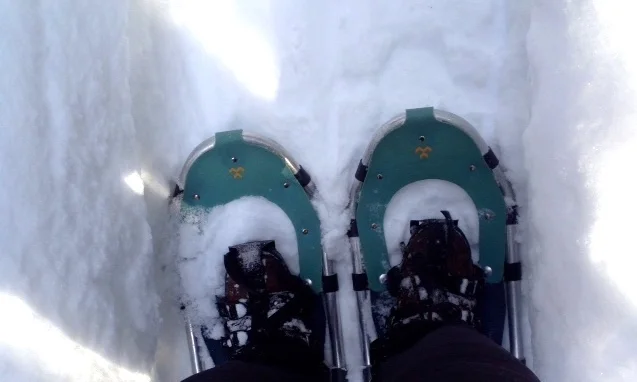
The woods were as still as a wind chime inside a closed window, save for the crunching of our snowshoes. The two of us were also silent, enjoying shared space without need for much conversation after so many years together.

Deep vanilla drifts blanketed the untrodden trail ahead and the air filled with swirling sucrose. Though we were far from the ski slopes, evergreen branches appeared blasted by snow guns, but the snow burdens were from Mother Nature. Branches formed natural gallerias overhanging the path and we had to duck our heads to pass through. He cleared wayward branches for me and broke track. I thanked him and he said there was no need.

At times, we came to more open areas with ice-glazed, knee-high brush sparkling in the sunlight and glassy shards clinging to naked branches at eye level. I turned my face upwards to bask in the light and he got out his camera and crouched to capture the crystallized beauty.

Above us, a winter branch gave no camouflage to a lone hawk perched upon it, though they were of similar hues. I took a grab shot with my cell knowing the image would not do the bird justice. No worries though. I knew his SLR shot would be well composed, sharp and artistic. My expertise was taking candid shots of him, a photo record of the photographer rather than an art form.

Further along, white birch tree trunks seemed caught in the midst of a skin peel without chemicals. Underneath they had the smoothness and sheen of legs encased in support hose — an arboreal beauty regime! Then, as if to remind us of mortality, we passed a dead birch, its bark loosened around a decayed trunk. Death seemed to have struck standing up while half-dressed.

He stopped to shoot the Sharpei-like folds of ice in a stream before we ventured across and I stopped to collect old man's beard and lichen for an art project. The beauty of natural objects struck us both but we incorporated them into our sensibilities in different ways.

We kept moving along the trail, our muscles still working with little effort. It felt good to be alive.

The trail continued to meander like rabbit tracks in the snow and many animal prints, including those of snowshoe hares, were stamped on the snowy surface. We pointed them out to one another, deep melon-sized ones, narrow hooves, paw prints, scratches, etc. and we guessed at their provenance — moose... deer... bobcat... wild turkey? We noticed scratchings on tree trunks and made cursory searches for fallen deer antlers and moose racks buried in the snow, despite assuming they were found by scavengers in late autumn. Fresh scat, from pea-size scatterings to piles of pecan-sized balls lay in stark brown relief to the whiteness and we laughed, remembering one child's long-ago giggling fascination with a booklet of animal scat descriptions.

After a while, the trail led to a frozen cove of the big lake. Stepping out onto a green-painted wooden dock sitting at an odd angle due to frost heaves, we felt the glacial bite of wind on our cheeks and tucked our chins further down into our thick fleece neck warmers. The vast expanse of glaring white snow-covered ice revealed none of the life the water harbored in summer. The striped and speckled, black and white loons, the skittish longhaired mergansers and elegant wraithlike herons had gone to milder climes for the winter season.

We ventured out onto the ice alone, confident that weeks of sub-zero temps had made it solid. As we turned west toward the main part of the lake, our warm breath became visible as it expelled into the cold air. We wouldn't spend too much time out there where there's no protection from wind whipping up mini storms on the surface in fits and starts — just long enough for him to get the shot he was seeking.

We passed wooden boathouses, their ramps pulled up and poking out of drifts and faded summer cottages with hoary screened porches. Every so often, we checked one another for white patches on our faces, a sign of frostbite. Each time we found none, we trudged further out.

At the point where the cove joined the main lake, the mountain came into view, a skiing behemoth commanding the eastern shore. The slopes formed a pattern of curves and lines and I mentally identified the ones I liked to ski while he captured the lights and shadows with his lens.

We were startled from the peace of observation and composition by noxious fumes and belching motors. Four snow machines raced past, a blur of colorful cabs, padded snowsuits and jet-black blades and helmets. We watched till the roar quieted to a hum and they disappeared into the distance.

Standing still had made the chill set in and we each gave a shiver and turned toward the cove again. All the way back, we heard the alternating roars and hums as the machines whizzed across the ice to and fro. It was only after we reached our entrance point to the land trail and slipped back into the woods that quiet was obtained again.

Out of the wind, we paused for an energy bar and realized we were sweating, despite the cold.  We finished chewing, swigged some water and energized, took the hillier loop back, challenging ourselves.

As we came round a curve, he signaled to me and pointed to a small deer poised in a shaft of light. It seemed frozen in time, studying us with intense brown eyes for several seconds; then it turned and leapt away. We watched the bobbing white tail recede into the forest and disappear.

We smiled at one another acknowledging the magical moment, then moved on, frosty pink cheeks warming, muscles working, spirits high, glowing, contented, feeling young.

Comment

Overcoming Shyness

February 3, 2017 Joan Mularz

You would think that growing up in a large Irish-American family, I would have had the "gift of gab," but no, I was often stricken mute in social situations. 

Read more
Comment

Sin Frenos en Ecuador

January 2, 2017 Joan Mularz

"There were three of us and our first mistake was renting the small, low-to-the-ground, electric blue Daihatsu auto." 

Read more
Comment

My First Time

December 17, 2016 Joan Mularz

 “Travel makes one modest. You see what a tiny place you occupy in the world.”

(Gustave Flaubert)

Firsts often have the effect of awakening our senses and expanding our thinking. This was especially true for me the first time I traveled outside the three-state area of New York, New Jersey and Connecticut. I was a college student and, after taking some art history courses, made Europe my goal. I wanted to see the world-famous art works I had learned about. The only problem was that I had no savings and a low-paying job.

 I came up with a savings plan. I skimped on lunches, made my own clothes, and basically had no social life for close to a year. Every pinched penny went into my Europe fund until I had enough money to book a trip.

That summer, I, a trans-Atlantic travel virgin, boarded my flight with a great deal of satisfaction. I had earned the right to travel the hard way: self-sacrifice. It also took no small mount of courage to convince my parents that I could do it, spread my wings without their hovering and survive in foreign places.

There were many "firsts" on that trip — the first time I was on an airplane and a funicular train, the first time I had oxtail soup or used a bidet and the first time I went up mountains, or even saw them in person.

I learned the importance of speaking at least some of the language of each country I visited. For example, I tried to tell an Italian boy that he was handsome by comparing him to an American actor. The problem was that the actor's last name was similar to an insult in Italian! We worked it out with a lot of hand gestures, meager bits of both languages and laughs. In France, despite auditing a French class at my university before I left, I forgot the French word for "exit" and had a hard time finding my way out of the Metro! Be assured that I will never forget the word sortie.

In France, I also learned the more of the local language you can speak the better. I was very proud of myself when I walked up to a gendarme and asked, "Ou se trouve le Louvre?" His answer was incomprehensible but I was saved when he switched to English. That was another thing I learned: we Americans are way behind in the language department. Most Europeans can converse in multiple languages and I admire that.

I had a hard time figuring out European boys. On the one hand, they made a shy girl feel appreciated because the ones I met were open about their admiration. On the other hand, it was hard to be sure you weren't just the next American girl in a long line they professed to adore.

It was local boys, however, who showed me that you have to get away from the tourist haunts to get the authentic feel of a place and that the most memorable moments of a trip are unscripted and spontaneous.

In the Netherlands, I was shocked to realize that my "Americanness" seemed obvious to a boy I passed on the street. Was it the way I walked… my light-colored clothes… my shoes? It bothered me slightly that I didn't fit in.

That trip also made me conscious of contrasting views of beauty and morality. Nudity was considered art in most museums but the Vatican Museum put plaster fig leaves on classical statues. If the intention was to shield the viewer from noticing the male appendage, it didn't work. The irony was that the cover-ups riveted one's attention on the body part.

The things I wrote about back then were often descriptions full of wonder. I marveled that I was able to walk through the same streets or go into the same places as renowned people hundreds of years before me had done. I was also astounded that the Renaissance had produced such a wealth of paintings and sculptures that the Uffizi Gallery had the overflow pieces stacked against walls in the hallways! It was like I was walking in somebody's multi-million-dollar attic.

Some of the lessons I learned on that first trip are things I try to remember when I travel today; bone up on the language and culture of a place before you visit, be open to adventure while you are there, walk and talk with the locals and appreciate the differences you encounter. 

That first time was a 'leaving the security of the nest' journey. 

Comment
← Newer Posts


You can also reach me through:

Facebook: https://www.facebook.com/joanwrightmularzauthor

X: https://x.com/Jwright_mularz

Instagram: https://www.instagram.com/rangepalm/

Pinterest: https://www.pinterest.com/jowalmu71/

POWERED BY SQUARESPACE.