
"In Turkey, everything you see, everything you touch, has a story, a rich texture of history."
Orhan Pamuk
Several years ago, the highways heading south from Selçuk on the western Turkish coast were very good, though they didn’t give us much warning before work areas. At one place, they were repairing the northbound road and, all of a sudden, the southbound lanes were two-way with no barriers for several miles. Thank God no one was passing. We also saw one car driving the wrong way in the breakdown lane!
There were plenty of places to eat along the road, as well as plenty of gas stations. We stopped at a Shell station near Mugla (Muu-la) and got gas and a small snack of a large Brezen and cold mango iced tea.
Just past Mugla, the road became mountainous and winding and the views were lovely. After an almost four-hour drive, my husband and I arrived at the Hotel Villa Daffodil in Fethiye (FET-i-ye) in late afternoon.
After settling into a nice room with a balcony facing the pool area and changing, we walked along the sea wall that borders the harbor and enjoyed a beer at a harborside outdoor café. It had a large movie screen and they were playing “National Geographic Wild.” They also had hookahs (water pipes) and several people at other tables were using them.
From there, we walked to Address restaurant (also on the harbor) for dinner. I had excellent grilled calamari and my first glass of Turkish white wine.
The next morning, we had a nice breakfast on the hotel terrace and met a friendly British couple who were in Fethiye for the second time. After breakfast, we walked to the harbor and purchased water taxi tickets to Calis Beach (20 TL roundtrip for both—about $13.50). The trip took about a 1/2 hour and went through a marshy canal or waterway at one point that runs behind the beach. The beach itself was lovely and the water was warm —felt great! We got 2 lounges and an umbrella for 15TL.
On the way back to our hotel after the return boat trip, we picked up a couple of Efes biras and some roasted hazelnuts for “5 o’clock” on our balcony.
Fethiye is a beautiful resort city situated on the “Turquoise Coast” in southwest Turkey where the Aegean and Mediterranean seas converge. It is a swimming and sailing paradise with a bit of history thrown in. Our view every morning while we ate breakfast was of the sleek sailboats and yachts moored offshore. The harbor at the center was a beehive of activity with water taxis and charter boats to the beaches and islands. The center itself has the remains of a Roman amphitheater and the hills are dotted with ancient Lycian tombs.
On our second morning, after breakfast on the terrace, we got into our car and drove further west from the hotel along a scenic, narrow, windy road of a coastal peninsula. Most of the road was high above the water, but there were quite a few low spots with little bays, and each one had a beach. We spent several hours at one called Kucuk Samanlik (Karaagac) Koyu. For 15 TL, we were able to get parking, beach use, 2 lounges and a straw umbrella. We had a closeup view of one of the islands in the bay and watched a constant parade of boats heading out (sailboats, cabin cruisers and big charter boats, many quite beautiful). The sand was shaded by pine trees which made it pleasant and the water was lovely.
The beach had mostly Turkish families with children. The bathing dress there was quite interesting. Little girls wore bikinis, but the women’s attire varied. Some swam in 2-piece bathing suits with modest bottoms. Some swam in long pants, long tunics, head scarves and water wings, and others swam in tops with sleeves and Bermuda-length shorts.
My husband made a friend of a young Turkish guy who helped him up onto a float that he swam out to. The guy didn’t speak much English but my husband learned the word güzel from him which he took to mean “excellent” or “great.”
Later on, the young guy from the float came over by our lounges to chat. His English was rudimentary but he tried hard. He was a 20-year-old radiology technician who had been trying to teach himself English with the help of tv and computer. He said he was from Trabzon on the Black Sea but worked in a nearby large city and was single. He had come to Fethiye with 5 family members by plane for a holiday, and he said he loved English and US people and especially seemed enamored of New York.
We got back to the hotel around 2pm and spent late afternoon poolside. I did some laps. Afterwards, my husband walked to a nearby market to get a couple of Efes biras, and we had our “5 o'clock” on our balcony. In the evening, we drove to Calis Beach, watched the sunset over the islands, and had a nice dinner of grilled sea bream and a bufe of mezes.
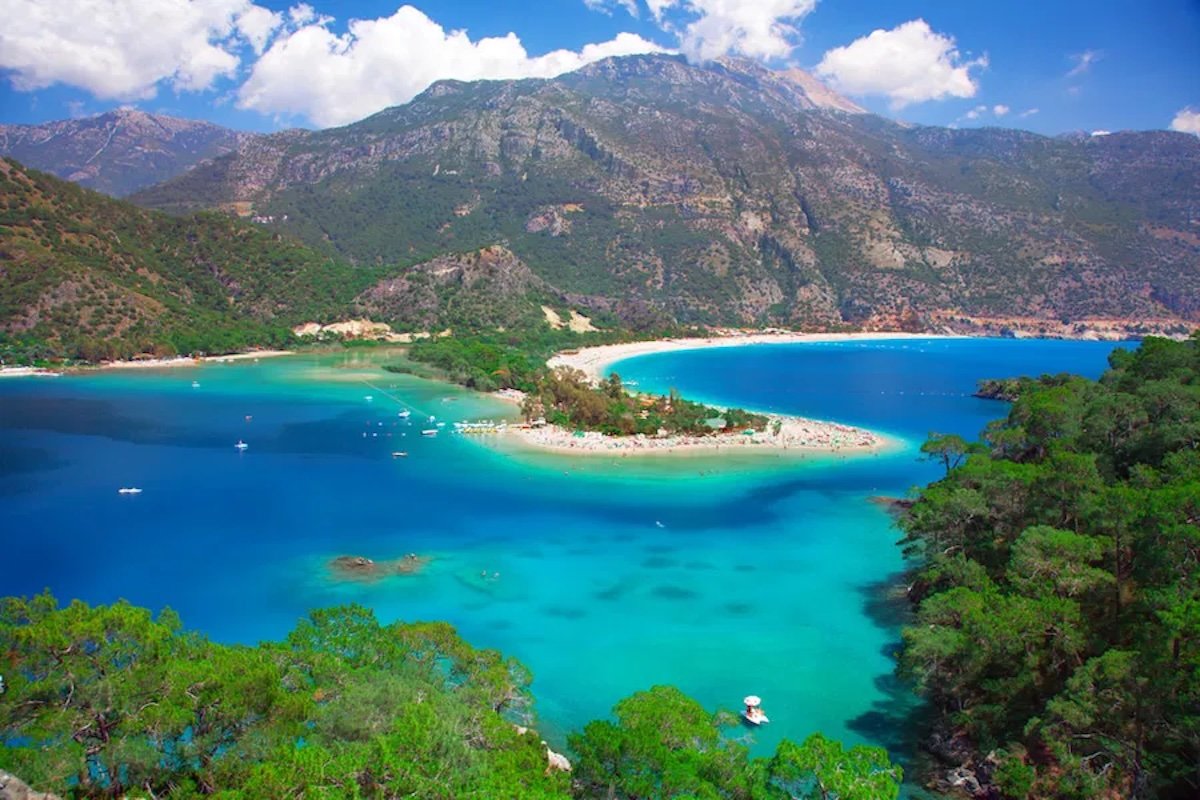
After breakfast on our third day, we talked to the hotel manager about the best way to get to Oludeniz, famous for its blue lagoon. We were unsure whether we should drive from Fethiye or take the dolmus (minibus), but the hotel manager assured us it was faster to drive and that parking would be available. We opted to drive.
We headed out of town and tried to follow the signs for Oludeniz. We did miss one turn, but when we realized that we had gone too far, we stopped at a gas station and asked for directions. We couldn't understand the man's words, but his gestures told us we had to go back the way we had come. Sure enough, we saw the sign and made a left. Then we came to a T in the road with no sign. Luckily, we spotted a minibus with Oludeniz printed on the back, and we followed it. The road began to climb, and took us through the town of Hissaronu, apparently a British holiday enclave, judging from the restaurants advertising things like Yorkshire pudding!
As the road descended again, we came into Oludeniz. We drove straight to the beachfront and asked where we could park. A man pointed to an Otopark sign some 200 yards behind us. So, we turned around, entered an alley between 2 businesses, and turned into a parking area. The attendant directed us to a spot under a shade tree, which was great in the heat. Parking for the day was 7 Turkish lira (a little less than $4). We walked toward the bay and bought tickets for a boat ride to another bay near Butterfly Valley, known for swarms of red tiger butterflies and a canyon with a waterfall.
The boat ride was fun. Oludeniz is a big paragliding spot and we could see many making their descents from the cliffs that line the coastline there. We chatted with a British guy who had just moved to Oludeniz, after vacationing there for years. He was on his way to do some scuba diving. He told us a lot about the area and recommended going to Kalkan on our way south.
The boat eventually pulled into a small bay and we disembarked onto the beach. There was a cafe, bar, and some campsites. The main attraction was behind the beach though. We paid 5 TL to enter the valley that heads into a narrow canyon. The vegetation was very dry, as if they had been experiencing a drought, and it was evidently not the season for butterflies. Oh, well. As we hiked into the canyon, we did see some black mountain goats. The drought had affected the waterfall as well. It was not much more than a trickle, prompting one guy from the UK to say, "I've seen better waterfalls in Yorkshire!". Just poor timing, I guess.
We caught the one o’clock boat back to Oludeniz, where we got some doner kebab sandwiches and cold drinks for a picnic lunch. On the boat ride back, we learned that the bay itself is not the blue lagoon. One couple showed us the walkway leading to the lagoon entrance (a national park.) To say it had been discovered, is an understatement! People were on lounges all around the edge. What spaces weren't taken up by lounges, we're taken up by water sport concessions. We decided to swim on the bay side, which was less crowded than the lagoon, but still lovely. The water was aquamarine and clear, and so salty you could float with ease.
When we had had enough sun, we drove back to Fethiye - much faster now that we knew the way. After our daily “5 o'clock” with Efes bira on our balcony, we walked into the centrum and went to Megri Locantesi (a local restaurant) for dinner outdoors under an arbor covered with grapevines. It was very good.
Our fourth day was market day in Fethiye. After breakfast, we caught a dolmus outside the hotel that took us directly to the market. It was huge! There were hundreds of produce sellers and the fruits and vegetables looked fresh and wonderful. We bought some lovely peaches and found out that the arugula we had been enjoying in salads was called roku in Turkish. After the produce vendors, came everything else, clothing, housewares, leather, etc. The vendors were not pushy. They pleasantly tried to engage you, but if you were not interested, they respected that. We were happy with a few bargain T-shirts for 5 TL each and a Turkish football jersey for 20 TL. (We tried to bargain for the latter but it seemed that, if the price was listed, they didn’t bargain.) The majority of vendors, however, did not have prices shown.
We bought some ice-cold bottled water then walked back to sehir merkesi (centrum.). We browsed through the shopping area and stopped at a bench on the waterfront to eat our delicious peaches.
We walked back to the hotel, spent a lazy afternoon, and swam in the pool. In the evening, we walked back into town and had a great meal of a sizzling Turkish stir-fry at Kral restaurant. It was our last evening in Fethiye.
We drove further south on the fifth day and reflected on our stay of Fethiye. It attracted many Europeans from other countries, as well as a lot of wealthy Turks (judging from the size and number of Turkish yachts in the harbor). The modern (U.S. brand stores) was juxtaposed with the traditional in the city (Muslim mosques and calls to prayer). The latter were heard but did not seem to be widely observed—at least we did not witness it.
There were many elementary and high schools there, and each one seemed to have its own uniform. Many of the students reminded me of Catholic school, with the girls in plaid pleated skirts and the boys in slacks and short-sleeved cotton knit shirts with collars.
Though the Turkish language is Middle Eastern, there were many words we could figure out from French & Italian (a pastanesi (bakery) is like a patisserie or pasticceria) or from German a dus (shower) is like duche.
Many of the homes and buildings had solar panels next to water tanks on the roofs. Though everyone seemed to have a cell phone, there were still public telephone booths. We didn’t actually see anyone using them though.
Our encounters in Fethiye taught us another Turkish expression, Gule gule. It means “Good-bye, till we talk again.”