• Home
  • ABOUT ME
  • BOOKS
    • USEFUL SITES
    • WRITING TIPS
  • THIS 'N THAT
  • Blog
  • NEWS
  • CONTACT ME
Menu

Joan Wright Mularz

Street Address
City, State, Zip
Phone Number
YOUNG ADULT MYSTERY AUTHOR

Your Custom Text Here

Joan Wright Mularz

  • Home
  • ABOUT ME
  • BOOKS
  • FOR WRITERS
    • USEFUL SITES
    • WRITING TIPS
  • THIS 'N THAT
  • Blog
  • NEWS
  • CONTACT ME
2023 world banner red.png

Blog


Where Did That Word Come From?

June 1, 2024 Joan Mularz

“Words over time have a way of just oozing around.”

 Linguist, John McWhorter 

Many words that we use today originated in literature. Writers often invent words or phrases (Authorisms) when they cannot find a suitable existing one.

Banana Republic - The pejorative term meaning a politically unstable, undemocratic and tropical nation whose economy is largely dependent on the export of a single limited-resource product, such as a fruit or a mineral. was coined by O Henry (William Sidney Porter) in his 1904 collection of short stories entitled Cabbages and Kings.

Blurb - In 1907, Gelett Burgess, an artist and author, created the character Belinda Blurb, an alluring woman whose spot on a book cover was supposed to boost its sales. Today, we use the word “blurb” to describe the text snippets on a book jacket.

Catch-22 – This is the title of Joseph Heller’s 1961 novel which takes place during World War II, and follows a bombardier named John Yossarian with the United States Air Force. The titular Catch-22 is a paradox where “an attempt to escape makes escape impossible.” The phrase became widespread after release of the movie based on the book in 1970 and describes the paradox of “damned if you do, damned if you don’t.”

Chortle – It is a word created by blending chuckle and snort and was created by Lewis Carroll. It made its first appearance in Through the Looking-Glass.

Freelance - This is a weird word to describe artists and writers who are paid for their services rather than through employment. In fact, it sounds slightly medieval — which is no coincidence, considering that it was coined by Sir Walter Scott in Ivanhoe to describe knights (Free Lances) who offer their services in exchange for money. 

Grinch - It’s easy to imagine that green grump staring down from Mount Crumpit when you see the word “grinch.” However, Dr. Seuss was not the first writer to use the word. That was Rudyard Kipling in the poem, “The Lament of the Border Cattle Thief.”

Hard-Boiled – This term is documented as being first used by author Mark Twain (Samuel Clemens) in 1886 as an adjective meaning “hardened.” In a speech he alluded to hard-boiled, hide-bound grammar. It is still used to mean “hardened, hard-headed, uncompromising.”

Malapropism - Mrs. Malaprop is a character in the 18th-century Irish play The Rivals by Richard Brinsley Sheridan who delights in elaborate, polysyllabic words and constantly misuses them. Her name comes from the French phrase mal à propos, which means inopportunely or inappropriately, but in English a "malapropism" is now specifically a misused word, in honor of Mrs. Malaprop.

Mentor - A mentor is an older teacher or guide who helps you through life, and no one needed a mentor more than Odysseus in Homer’s The Odyssey. His mentor was the original mentor; in fact, his name was Mentor, and he was a trustworthy friend to the hero.

Nerd – Dr. Seuss (Theodor Seuss Geisel) is often credited with being the person who invented the word “nerd.” It first appeared in his 1950 book If I Ran the Zoo; however, it wasn’t used in the same context that it is today. Instead, in the book, a boy named Gerald McGrew is visiting a zoo, but doesn’t find them exciting enough, and if he was in charge, he would bring in better animals, leading to the lines “And then, just to show them, I’ll sail to Ka-Troo/And Bring Back an It-Kutch a Preep and a Proo/A Nerkle, a Nerd, and a Seersucker, too!”

Pandemonium - In Paradise Lost, John Milton named the capital city of Hell Pandæmonium, but he didn’t invent the name out of thin air. He used classical roots: the Greek "pan," meaning all, and the Latin "demonium," or demons. Together they mean "the place with all the demons." Today, of course, pandemonium describes the chaos that results when all hell breaks loose.

Quark – Despite having nothing to do with particle physics, James Joyce helped contribute to the lexicon of the field. In 1963, Murray Gell-Mann was looking for a name for his theoretical elementary particle of matter that are smaller than a proton or a neutron. Gell-Mann originally came up with the word “quork,” which rhymed with pork. Months later, Gell-Mann was reading Finnegan’s Wake, because that’s what theoretical physicists apparently do for fun, when he came across the line: Three quarks for Muster Mark! Gell-Mann like the spelling of the word because the hypothetical particles came in threes. For what Joyce meant by quark, he was referring to a German cottage cheese-like food made by warming soured milk.

Robot – This word was first seen in the English translation of the 1920 play R.U.R. (Rossum's Universal Robots) by Karel Čapek. It comes from the Czech word “Robotnik” meaning forced worker, serf, or slave.

Scaredy-Cat - Few phrases describe a nervous feeling so well as scaredy-cat, which first appeared in Dorothy Parker’s1933 short story “The Waltz.”

Serendipity - This word, meaning the faculty or instance of making happy and unexpected discoveries by accident, comes not from a book but from a letter. Horace Walpole, the author of the gothic novel The Castle of Otranto, wrote to a friend in 1754 with news of the exciting new word he’d invented, drawing from a fairy tale set in Serendip, an old name for Sri Lanka.

Syphilis - No one’s quite sure where the disease itself came from, but we can trace the origin of the word syphilis to Girolamo Fracastoro’s poem “Syphilis, or The French Disease.” His character, a shepherd named Syphilus, was punished with the painful disease after cursing the Sun God’s heat during the summer.

Terrific - In the 1660s, John Milton introduced this word in Paradise Lost to mean "frightening, causing terror, fitted to excite fear or dread," from Latin terrificus "causing terror or fear, frightful."  It wasn’t until 1888 that it was used to mean “excellent.”

Tween - In The Hobbit, J.R.R. Tolkein created  the word “tween” — a combination of teen and twenty — to describe hobbits between the ages of 20 and 33. Today, we use it to describe the pre-teen years.

 Utopia - Sir Thomas More’s Utopia was published in 1516 in Latin, and is a depiction of an ideal civilization. More made up the word “Utopia” for the ideal land as a play on a word from Ancient Greece: “eu-topos,” which means good place.

Whodunit - Book critic Donald Gordon created the term in the July 1930 American News of Books when he said of a new mystery novel: “Half-Mast Murder, by Milward Kennedy – A satisfactory whodunit.” It is still a popular way to describe a traditional murder mystery.

 Yahoo – This word comes from Johnathan Swift’s classic book Gulliver’s Travels. The main character, Lemuel Gulliver, is marooned on the islands of the Land of the Houyhnhnms. One of the races on the island are Yahoos, which are humanoids, but they are savage brutes and are ruled by the Houyhnhnms. The word “Yahoo” has since crept into the English language, defined as “a boorish, crass, or stupid person.”

(As for the technology company Yahoo!, The founders chose the name because Yahoo started off life as a directory of other sites that was organized in a hierarchical format and Yahoo! is an acronym  for “Yet Another Hierarchically Organized Oracle.”)

Comment

Mystery Trip

May 1, 2024 Joan Mularz

Mystery Trip 

“Finally, you get to spend the weekend with a host of other writers, all striving for the same goal, all working hard and learning.  Many will be complete newbies, and many will already be published, with all sorts of folks in between. We spend so much of our time toiling alone, FEELING alone, that it sometimes helps to remind us we’re human when we can relate to others in the same boat.  And, it gives us inspiration to boot.”

Susan Malone, contributing editor to Authorlink.com. 

Writers’ conferences are always a little intimidating for me. Last year, however, I had a most welcoming experience at my first Malice Domestic Mystery Conference in Bethesda, Maryland. The impetus to attend came from the online MG/YA subgroup of the Sisters in Crime Guppies. As a member, I became acquainted with like-minded authors, many willing to offer advice and support. When several said they planned to attend Malice, I signed up and looked forward to meeting my Internet friends in person. That positive experience had me looking forward to this year’s event, Malice Domestic 36.

My trip began on Thursday, April 25, 2024, when my husband drove the ten miles from our home to Palm Beach International Airport and dropped me off for my flight north. I slowly weaved through the TSA line after leaving my suitcase at the bag drop. The wait was perhaps fifteen minutes, but a toddler having a screaming tantrum made it seem longer. Her poor mother tried holding her, talking softly to her, rocking her, but nothing worked. The child eventually wriggled free and lay down on her back, defiantly inching backward along the carpeted line.

While waiting at the gate and all through the two-hour and twenty-minute flight to DCA (Reagan International Airport in D.C.), I opened the Kindle app on my laptop. I read the book Brainstorm by author Elaine Viets, the lifetime achievement honoree at this year’s Malice.

After I arrived at DCA, I opted to travel by the D.C. Metro. (I had shared Ubers to and fro last year, but I thought a train ride would be fun.) After all, I grew up using the New York subway and later often took the commuter rail in Massachusetts and the “T “in Boston., not to mention the U-Bahns and S-Bahns I rode during the six years I lived in Munich. The Metro was quite convenient, with a station right at the airport. From there, I took the Blue Line nine stops to the Metro Center station, where I transferred to the Red Line. I rode eleven more stops to the North Bethesda station, a short block from the conference hotel. The train trip took about an hour, not much longer than Uber had taken the previous year, and the price was a bargain.

I arrived in the late afternoon. I had a free evening after picking up my registration badge and Malice tote bag filled with complimentary books and magazines. I used it to get some exercise by walking a few blocks to pick up dinner. On the way back, I was pleased to run into an old author friend from Massachusetts and met a few others. It was a nice start to the weekend.

On Friday morning, I attended an information session for volunteers and signed up as a timer for one of the afternoon author panels. It was easy enough. I picked up an envelope containing name cards to be placed on the table in front of each participating author and time cards printed with “10” and “5,” which I had to flash for the panel moderator when the session had ten minutes left and then only five minutes.

At ten am, I attended “Malice-Go-Round.” It’s an event for forty authors to talk about their new books to twenty groups of eight people each, sitting at round tables. Two authors start at each table, each with two minutes to present. Most also handed out bookmarks or postcards about their books. They switch tables and repeat their performances when the four minutes are up. It continues until they have spoken at all twenty tables. Since I did not have a new book published this year, I was not eligible to present, but I was one of the listeners. I came away inspired by many new stories.

At one pm, I attended a panel with some of the Honored Guests talking about tales from their book events around the world. At two pm, I did my timing volunteer work at a panel with authors who write about international and exotic settings. At three pm, I listened to the nominees for Best Contemporary Mystery, and at 4 pm, the panel was devoted to the nominees for Best Historical Mystery.

After 5, I took a quick break until I joined the Sisters in Crime Guppies at 5:30 for a meetup at the hotel bar. My MG/YA friends from the previous year were there, and it was great also to meet the ones I only knew from our online chats. A glass of wine extended into dinner, and it was fun to join a table with friends of friends. I met authors from many states.

I started bright and early Saturday morning with a 7:30 am breakfast meetup with author friends. At 9:00 am, a panel on historical research was moderated by one of my friends, and that was followed at 10 am by the panel of Best MG/YA Mystery nominees moderated by another friend. 11:00 am brought a session with the nominees for Best First Mystery, which yet another friend moderated.

After dropping off my voting ballots for the Agatha Awards to be presented that evening, I took a quick lunch break. At 1:00 pm, I attended “Interview of a Lifetime” with Guest of Honor Sujata Massey. At 2:00 pm, I listened to a panel about writing short stories, and at 3:00 pm, I enjoyed hearing from authors who write about small towns, and they had a lot of funny things to say.

At 4:00 pm, I took a break and read an ebook on my laptop called Mrs. Pollifax and the Lion Killer by Dorothy Gillman. Then I dressed in my finest and joined the attending authors for Cocktails, followed by the Awards Banquet. A lovely surprise at my table with MG/YA authors was finding gift bags waiting on our chairs. One of our generous and thoughtful MG nominees treated each of us at the table to a copy of her book and some other treats. After dinner, awards were announced, and each winner received an engraved teapot, a symbol of the Agathas named after Dame Agatha Christie. Here are the results:

Best Contemporary Novel - The Weekend Retreat, Tara Laskowski

Best Historical Novel - The Mistress of Bhatia House, Sujata Massey

Best First Novel - Crime and Parchment, Daphne Silver

Best Short Story - “Ticket To Ride,” Dru Ann Love and Kristopher Zgorski, Happiness is a Warm Gun anthology

​Best Non-Fiction - Finders: Justice, Faith, and Identity In Irish Crime Fiction, Anjili Babbar

Best Children’s/YA Mystery - The Sasquatch of Hawthorne Elementary, K. B. Jackson

On Sunday morning, I attended one more panel session at 10 am called “How Do Authors Pick Careers for Amateur Sleuths.” It was fun to run into yet another friend I hadn’t seen for a while there. That session ended the conference for me since I had to catch a flight home. I was pleased that the sun was out and the weather had warmed up. I walked to the Metro and repeated the earlier ride in reverse. DCA was busy but not as crazy as the previous year when bad weather delayed many flights, including mine. The flight left on time this year, and I landed in West Palm early. My husband was there to meet me. The weekend was stimulating, and I look forward to next year, but for now, it’s nice to be home.

Comment

Two Road Trips to the Florida Keys

April 1, 2024 Joan Mularz

“You’ll feel like you’re floating across the sparkling blue waters of the Atlantic Ocean and the Gulf of Mexico.”

Tierney Mcafee, author “20 Best Scenic Drives in the U.S. for an Epic Road Trip”

Last month was my husband’s birthday. Through the decades, I’ve celebrated with him in many ways. We’ve had big parties, destination parties, small gatherings, and family get-togethers. This year, we chose a road trip to the Florida Keys, and our daughter made a surprise visit to join us.

The 800 Florida Keys are a chain of limestone islands that extend from the southern tip of the Florida mainland southwest to the Dry Tortugas, a distance of approximately 220 miles. They are island remnants of ancient coral reefs (Upper Keys) and sand bars (Lower Keys) that flourished during higher sea levels approximately 125,000 years ago.

We packed the car, put our kayaks on top, and headed south. Our first stop after the mainland was Key Largo, widely considered to be the scuba diving capital of the world, and the drive from home took us about two hours. It was right on time for lunch, so we headed to Key Largo Fisheries near mile marker 100 on U.S. 1 South. After a left on East Road and a right on Ocean Bay Drive, the waterfront restaurant, market, and working fishery are on the left at 1313 Ocean Bay Drive. It’s a great casual place for fresh-caught seafood. Meals are ordered at a window and pickup is self-service. We ate at outdoor picnic tables overlooking a marina where sand sharks swam close to the boats. I recommend the cold ceviche and the Sandbar Sunday beer from Islamorada Brewery, perfect in the tropical heat.

Our next stop was an hour further south in Marathon. The islands of Marathon are Boot Key, Knight Keys, Hog Key, Vaca Key, Stirrup Key, Crawl and Little Crawl Key, East and West Sister’s Island, Deer Key and Fat Deer Key, Long Pine Key and Grassy Key. We had reservations at the Banana Bay Resort and Marina on Vaca Key. It’s a great spot on the Gulf of Mexico side. (preferable for the sunsets).

In the late afternoon, my daughter and I learned that crossing the road to check out the stores was worth your life due to the non-stop Friday night traffic. We ended up walking close to a mile to a traffic light. The touristy shops weren’t worth it, but we came across an interesting artistic structure. The so-called Red Nun is a pyramid constructed and installed in New York City in 2016. On its walls, artist James Emerson painted more than 40 figures drawn from his daily life, all engaged in building a collective society. Emerson lives and works in Brooklyn, New York. The Red Nun exists today thanks to the committed efforts of many over five years. It was rebuilt at the side of Route One in Marathon by the Emerson family.

 In the evening, we enjoyed the nightly sky splendor at Banana Bay’s point on the water, where the resort has hammocks, Adirondack chairs, outdoor games, and a tiki bar.

After sunset, we had dinner at another casual place on the water called Keys Fisheries. It had the same setup as our lunch place—order window, self-pickup, picnic tables, and marina, but lacked the charm of the earlier one.

On the next morning, his birthday, our daughter strung up balloons and streamers to make the room festive.

 After breakfast, my husband chose to go kayaking. Though we had brought our own, our daughter needed to rent one. She reserved one via a phone call, and we picked it up at Sombrero Beah on the Atlantic Ocean side of Marathon, where we launched all three kayaks. The entry point into the water was an inlet called Sister Creek. The incoming tide was strong, so rather than head into the creek and have to fight hard on the return, we headed across the creek and paddled around the shore of Boot Key for a couple of hours.

It was mellow until the return when the tide had gone out and our kayaks ran aground. Our daughter had a sit-on-top. She got off and began to walk barefoot and pull her kayak toward the inlet, where it was deeper. I stepped out of my kayak, but it was a mistake. My shoes sank deep into a soft muck. When I tried to lift my feet, they wouldn’t budge and I fell over, my butt also sinking deep into the muck. My daughter came back and helped me roll onto her open kayak. She pulled me until paddling was possible again. When we got to shore, I waded into the water to wash off the sand. When I couldn’t move or lift my feet, it dawned on me that my rubber-soled shoes were acting like suction cups. Once I took them off, I was free, but I headed to an outdoor shower to rinse the rest of the sand off.

Back in the hotel room, my husband opened birthday presents. Then we dressed for dinner, enjoyed the sunset from a point on the property, and headed to the Lighthouse Grill at the Faro Blanco Resort and Yacht Club for dinner. The food was delicious, we had a view of the pool and enjoyed the music of a guitarist. After a stroll around the marina, we enjoyed his favorite homemade birthday cheesecake in our room.

The following morning, we headed home, but we stopped in Tavernier on Key Largo at the Blond Giraffe Key Lime Pie Factory. The key lime items were pricey, but our daughter bought a piece of pie to take home to Colorado. The place does have a nice, shady garden for those who want to eat their purchases at picnic tables in a quiet setting. It’s interesting to note that the garden fences are filled with colorful “love locks,” like the ones found on many European bridges.

A sign in the store informed me that key lime pie was invented by a Keys sponge fisherman who set off to work one day in the late 19th century with a supply of limes to prevent scurvy, some cans of Borden’s canned, sweetened, condensed milk, soda crackers, and eggs. In the ship galley, he prepared a food that needed neither cooking nor refrigeration. Back ashore, the sponger shared his recipe with a cook who worked for the island’s first millionaire, William Curry. However, an internet search reveals that this local story may or may not be true!

Regardless of who invented it, key lime pie is well-loved, though the recipe has changed over the years. Graham crackers (thought to be a “health” food) eventually replaced soda crackers. Egg whites left over from the pie-making were whipped into a stiff meringue and spread on top. Over time, the meringue was replaced with whipped cream.

That road trip to the Keys was not the first one for my husband and me. Our first time was in June 2015, and it whetted our appetites for a return. Not sure why it took us so long!

We also began that visit in Key Largo but with a swim at John Pennekamp Coral Reef State Park. Three areas are designated for swimming, including Canon Beach, which features remnants of an early Spanish shipwreck 100 feet offshore.

Though we didn’t go scuba diving or snorkeling, the coral reefs and their associated marine life bring most visitors to the park. The reef lies between 3 and 8 miles off the coast. Unless you’re an exceptional swimmer, you’ll have to take a boat to see the reefs. The park includes the first undersea park in the U.S. and encompasses approximately 70 nautical square miles. The entrance fee is $8 for a carload of 2-8 people.

Our stop for the night was further south in Islamorada, known as the Sport-Fishing Capital of the World. Legend has it that the area was named by Spanish explorers who, upon seeing the purple sky at sunset and the purple bougainvillea, called it “isla morado,” or purple island. We stayed in a small cottage at La Siesta Resort and Villas, which were basic but right on the water on the Atlantic side – great for sunrises. However, we made a note to book on the gulf side next time to enjoy the sunsets.

We had an excellent meal that night at the Islamorada Fish Company on the Gulf of Mexico side, and we enjoyed watching the tarpon swimming in the lit-up water surrounding the restaurant.

The next morning, we drove a little more than an hour south over the Seven Mile Bridge to Key West. We had reservations for two nights at The Marker – Key West Harbor Hotel, 200 William Street. It was a great location, only a five-minute walk to Mallory Square, famous for its nightly Sunset Celebration, eight minutes to the Hemingway Home and Museum at 907 Whitehead Street, and ten minutes to the Southernmost Point Buoy marking the southernmost point in the continental United States at 1400 Whitehead Street.

The Hemingway House was a highlight for me, and I loved the treehouse extension where he wrote. Another interesting spot not far from it is a sign at 301 Whitehead Street identifying the First Office of Pan American World Airways. On October 28th, 1927, Pan Am Flight Number One took off from Key West and headed for Havana, Cuba. It was the first American international air service in scheduled operation.

Over the two days, we spent in Key West, we swam at Smathers Beach and enjoyed meals and drinks at several places, including Conch Republic Seafood Company at 631 Greene Street, Bo’s Fish Wagon at 801 Caroline Street, and Amigos Tortilla at 425 Greene Street.

So far, of all the various islands in the Keys, I have found Key West the most fascinating because of its combination of history, culture, architecture, and beauty.

I hope to return to see more of the whole string of islands, but after crossing the low-level bridges, I’m reminded of the fragility of the area. An article in The Guardian pointed out that the Keys are trying to plan for a 17-inch rise in sea level by 2040 but funding is short. NOAA calls 17 inches a low estimate.

Comment

A Spring Road Trip Through France, Spain, and Portugal

March 1, 2024 Joan Mularz

“If adventures do not befall a lady in her own village, she must seek them abroad.” 

Jane Austen

One year, on a Tuesday in March, our trip started with my husband Walter’s typical bravado despite recommended caution. After a hernia operation at a hospital in Augsburg, Germany, he walked to his car and drove himself home to Munich, where we lived at the time, instead of waiting for me to pick him up. It was the beginning of spring break from my job at an international school, and he was anxious to get on the road for an adventure.

Four days later, on Saturday, with our dog safely enrolled at a Hundepension, we left Munich in the fog. My one demand was that I was driving and he had to rest. It was still foggy by the time we got to Lausanne, Switzerland. Lac Leman was invisible.

We had a traffic jam between Geneva, Switzerland, and Lyon, France, and then had a heck of a time trying to find the secondary back road we wanted to take from Lyon to Bordeaux. We eventually found not only the road but also a place to buy some local wine. And twelve hours after starting, we stopped for the night at a small hotel in the rural village of Feurs, France.

We continued heading for Bordeaux on Sunday and stopped in Perigueux to buy foie gras with truffles. We also made a short detour to the village of St. Emilion to tour one of the wine cellars and sample and buy two bottles. (We stored these away with the bottles we bought in Burgundy the previous year as our “important” wine investments. We were saving them for a grand occasion.)

After stopping at a café in Bordeaux, we headed south. Since it was still foggy and cool, we resisted the lure of the Atlantic and kept going until we reached Bayonne in the French Basque region. We found a hotel in this port city divided by two rivers. We wandered along the quays looking for a restaurant. We stumbled upon a quarter filled with young Basque separatists partying in the streets—complete with outdoor bars, rock bands, and banner-waving enthusiasts. While possibly exciting for the under-25 set, we sought a quieter ambiance and found it in a small seafood restaurant. I ordered Plateau Prunier Fruit de Mer and was confronted with a HUGE platter of cold shellfish served on ice. (It was so big they moved us to a larger table!) The crowning glory was the centerpiece of a giant crab, but it also had oysters, mussels, barnacles, prawns, and about four varieties of clams. After being in land-locked Munich, I felt like I had died and gone to seafood heaven!

On Monday, we explored more of Bayonne and then headed south again. Despite the fog and biting wind, we stopped to walk out on the footbridge over the wave-lashed rocks at Biarritz. Then, we crossed the border into Spain and drove south through Salamanca and westward over the border into Portugal. We stopped for the night in Guarda, located in the Serra da Estrela, the highest mountain range in continental Portugal. It was here that we first enjoyed good Portuguese Rioja wine.

On Tuesday, we headed for the coastal city of Porto, Portugal, intending to explore and visit the caves where they make port wine. However, after fighting the city traffic and getting a feel for this rather grimy, hectic city, we decided not to stop but to head for the beach. The weather was still not sunny but we didn’t care. We slowly made our way down the coast, stopping periodically to walk over the dunes and explore the sand beaches. The weather was improving. We ended up in Figueira da Foz and stayed at a small beach hotel with a great seafood restaurant. I enjoyed two giant grilled shrimp that I will never forget because they were so big and delicious.

On Wednesday, we continued along the coast and stopped to explore one of Portugal’s most famous fishing villages, Nazare. As soon as we parked the car, we were approached by several people asking if we were looking for rooms. This town booms in summer, and the locals seem almost too eager for the tourist dollar. The fisherman sweaters and shirts are popular items here, but the pushy approach of the vendors put me off from buying anything.

From there, we headed to Lisbon, a teeming city on a hillside that spills into the sea. It had elements that reminded me of Napoli. We fought out way through traffic and oriented ourselves. Then we began trying to find a room. Each time we stopped at a hotel, I struggled with my guidebook Portuguese, spattered with bits of Spanish and Italian. I don’t know what was going on in the city but there was not a room to be had. We decided to drive to Estoril, a beach town on the peninsula outside Lisbon. We were able to find a hotel there. Although it is a lovely town, there were few restaurants, and our meal was disappointing.

On Thursday morning, we took an electric train for the short ride into Lisbon and spent most of the day in the city. It was warm and sunny. Walter bought 2 Easter lottery tickets. (We spent much of the rest of the trip trying to learn the results. We purchased several Portuguese newspapers and asked questions, but nobody seemed to be sure when or where the results would be published!)

One interesting absence in Lisbon seemed to be department stores. However, a huge Euromarche (like a large K-Mart) was on the outskirts. The whole inner city seemed to be small shops and boutiques.

At some point in Lisbon, Walter noticed a clock and saw it was one hour earlier than our watches. Unthinkingly, we assumed that we had missed daylight savings time. However, daylight savings time would have made it one hour later! What we were unknowingly experiencing was a change in time zones. Portugal is aligned with the United Kingdom and not with the rest of Western Continental Europe.

In the late afternoon, we set out for the southernmost Portuguese coast, the Algarve, heading straight down through the center of Portugal. We encountered a lot of traffic but finally arrived in Albufeira, a popular resort smack-dab in the middle of the Algarve. We found a hotel with a nice view of the sand beach and settled in for five nights. The spring days were sunny enough to lie on the beach, and although people were in the water, we felt it was too cool to get more than our legs wet. We visited markets in several nearby towns, walked the paths along the cliffs, and enjoyed the cafes and seafood restaurants. We bought a huge basket like the grape pickers use and a large clay jug to bring home.

March turned to April, and we left Albufeira the following Tuesday and headed east again. We stopped at the beach at Manta Rota and collected many shells there. Just before crossing the border back into Spain, we found a lottery ticket seller who had the list of winning numbers. We didn’t win.

We took a ferry across the Guadlana River from Vila Real de San Antonio, Portugal, to Ayamonte, Spain. In Ayamonte, Walter noticed a clock showing it was 2 hours later than we thought! (On Sunday, we missed daylight savings and had just crossed back into the central European time zone.) It is interesting to note that for two nights, we had been one hour off and didn’t notice. In fact, it helped us fit right into Portugal’s late dinner hours!

There is very little tourism in this part of Spain. Much of that southwestern tip of the country is a national park. We crossed the Rio Tinto into Huelva, and right in the middle of the park was a Spanish parador—one of the state-run hotels with historic settings and a bit of luxury and culture. Very often, especially in summer, these hotels are booked months in advance. However, we decided to chance it  and we lucked out. We spent the night in a beautiful setting— the Parador de Mazagón perched on a cliff overlooking 40 miles of sand beach. The staff even provided us a complimentary bottle of sherry, almonds, and chocolate. It was hard to leave.

On Wednesday morning, we began a hard drive from the west coast of Spain to the east coast. This was our toughest day. We made one stop in Cordoba and toured the old Jewish Quarter and the area surrounding a former mosque. In the evening, we arrived in Valencia. We began stopping at hotels, and, similar to Lisbon, most were full. By the time we finally found a nice hotel, we were exhausted and crashed.

On Thursday morning, we went shopping in downtown Valencia. It has several large department stores. It’s a lovely city with lots to offer. I would like to go back sometime and further explore it.

At midday, we headed north along the coast of the Balearic Sea (part of the Mediterranean). We got off the Autopista just before the French border and took the slow coastal road. We passed through several Spanish and then French picturesque ports. We finally stopped for the night in St. Cyprien, France, right on the water.

On Friday morning, we continued along the coast, making note of the nice beaches of Canet and Port Leucate. We stopped to walk along the alleys and quays of Narbonne, and then we had lunch in Beziers in a café facing a large flower market.

In the Languedoc region, we saw a sign for a vineyard that sold wine. Since Walter was always hoping to fill up his big glass wine jugs, we stopped. He knocked on the door of the chateau and spoke to the owner, who promptly took him to the wine building. A few minutes later, Walter came to me for help. He said that the man spoke only French and Spanish. I said, “But I don’t speak either very well.” He said, “You speak Italian.” I wasn’t sure of the logic, but somehow, we bought wine using a mish-mash of French, Spanish, Italian, and German. The man was friendly and said “Bye-bye” and “Auf wiedersehen” when we left. We ended up with some jug wine and six bottles of reasonably-priced red wine with two stars in the French wine guide.

In the afternoon, we stopped in Montpelier, a university city of narrow alleys, large squares and fountains, lots of students, and interesting shops. From there, we made the mad dash home to Munich.

We arrived home on Saturday, somewhat numb at 4 am. It was a tiring trip. It was a good trip. We both managed to enjoy some spring warmth, relax, and rejuvenate ourselves for returning to work. And my husband’s hernia scar healed.

Comment

Moroccan Transportation

February 1, 2024 Joan Mularz

“As you wake up to sort of Morocco coming to life, and you drive a two-hour journey through the desert as the sun is rising over the sand dunes… I saw landscapes and visual stuff that I’ll never forget. It was special.”

Anthony Bourdain 

My husband Walter and I came that time to Morocco to visit friends in the Peace Corps. An EasyJet flight from Madrid, Spain, brought us to Marrakech airport on a Wednesday. Our friends met us and negotiated for a taxi in Arabic, which took us to a ryad in that city, where we stayed for two nights.

On Friday afternoon, we began the first leg of our trip to their temporary home away from home in the hills to the west. Since the town was so small and remote, with no direct public transportation from Marrakech, we first had to head for a larger city on the western coast. We took two taxis to the bus station and boarded one bound for the lovely beachfront port of Essaouira. It was a three-hour drive. We stayed at a hotel there for two nights, enjoyed dinner at the home of our friends’ Peace Corps host family, and explored the town’s offerings, including the delights of a hammam. On Sunday morning, we visited the souk to buy fruits and vegetables and loaded the food and our luggage into a carweela (a wooden vehicle pushed by one guy).  We followed him to a small square filled with old Mercedes diesel taxis, loaded up, and headed for the hills.

After a forty-five-minute drive, the taxi dropped us at the roadside near a scattering of buildings. Walter and I watched the luggage while our friends went across the street to buy bottled water, soda, and a chicken.  The building had a hanout (small grocery) and a butcher. They came back with the drinks but no chicken. The butcher wasn’t there, only a guy minding the store with some unrefrigerated cleaned chickens sitting out for an undetermined amount of time.  (The butcher normally slaughters a fresh chicken on request.). Shortly after that, their Moroccan neighbor arrived with a donkey-driven carweela which had been arranged for with a phone call. We loaded the luggage, and the driver insisted we two women ride along. The men said they would walk up to Ait Diba, the hilltop town our friends lived in.  They took a goat path, and we went up a washed-out, rocky dirt road that jarred one’s spine with every rut.  It was tough going either way in the dry heat, but we all made it up after half an hour.

We were welcomed by their many new friends in the small community, including an invitation from the local school teacher to visit the nearby preschool and join him for mint tea. We later enjoyed an evening with our friends, having a home-cooked meal in their neat, whitewashed stone home built around a courtyard.

The following day, we explored more of the area on foot and hiked to the slightly larger town of Oulad Said, which had three hanouts. Our wanderings passed a donkey, orchards of argan trees, a couple of camels, a few mules, sheep, goats, and chickens.

On Tuesday, we all got up at six and enjoyed our friend’s hand-made bread for our last breakfast in Ait Diba.  By 8 am, we were hoisting on our packs. (Walter and I had one in front and one in back.) We set off down the goat path for the half-hour trek to the main road.  Our goal was to flag down a bus heading to Agadir, a resort town further south on the coast, or a taxi heading to Essaouira, whichever came first.  An old Mercedes taxi came along within minutes of our arrival.  However, it already had five people in it.  We motioned for it to go on without us, but the driver wouldn’t take “no” for an answer.  He put our packs in the trunk and told everyone inside to scrunch over.  My female friend joined the baseball hat-wearing driver and two men wearing skullcaps and djellabas in the front seat. The driver pushed Walter, our male friend, and me into the back with a woman in a caftan and head scarf and another guy in a baseball hat.  We were nine in all!  The poor guy next to me heard his cell phone ring, but it took him a while to extricate it from his pocket.  We were relieved when one of the front-seat guys and the woman in the back got out at Had Dra, about 15 or 20 minutes down the road.  That left seven of us to continue to Essaouira - the legal amount that can get through the usual gendarme road check.

After dropping off one guy near some houses and another at the health clinic, we arrived at the Essaouira taxi stand, where we negotiated for another Mercedes taxi to take us down the coast to Agadir.  We lucked out this time.  It was just the four of us, and this ride was in meticulous condition. The black leather seats were polished, and the floor had small Oriental carpets.  The driver was friendly and even stopped to buy bananas and share them with us.  We passed many Argan tree orchards and saw what they call “the flying goats.” (They don’t actually fly but climb high into the Argan trees to eat the nuts.) We also passed banana plantations. The coastal scenery was spectacular, with mountainous switchbacks skirting the Atlantic Ocean.  Some parts of the coast are rocky and rugged, but there are also stretches with sandy beaches.  After three hours, we took the first turnoff for the resort city of Agadir, but we encountered a roadblock.  (Some students were conducting a protest.). The driver turned around, entered the city at the next exit, and dropped us at our hotel.  

In the evening, another taxi ride took us to the fishing port. Simple open-air restaurants served the catches of the day - nothing fancy, but very fresh grilled fish.  

After dinner, it had cooled off a bit, so we taxied back to the hotel, grabbed some jackets, and headed out to find a place for wine and beer. (None had been available with dinner.)

Over the next few days, we enjoyed the beach and some museums, but on Friday, our alarm went off at 3:45 am, and we left the hotel at about 4:10 to catch a petit taxi for the bus station. The bus left promptly at 5 am.  It was still dark, and I slept a good deal of the time. The toll highway between Agadir and Marrakech was new and we made good time.  Including one rest area stop, the trip took a little over three hours. We got espressos and pain chocolat for breakfast at a cafe in the Marrakech bus station. And Walter did a good job bargaining for a petit taxi to the airport.  The Marrakech terminal was modern and airy, and the ceiling resembled a white honeycomb. Our Easyjet flight left right on time.

Comment

A Literary Road Trip Through Massachusetts

January 1, 2024 Joan Mularz

“That’s all I claim for Boston – that it is the thinking center of the continent, and therefore of the planet.”

Oliver Wendell Holmes


The state of Massachusetts, where I lived for a good chunk of my life, has a rich literary history. The state is dotted with museums, monuments, and places commemorating iconic Bay State authors.

Out west, in the town of Lenox in the Berkshire Mountains, lies The Mount, the historic home of Gilded Age author Edith Wharton. In 1921, she became the first woman to win the Pulitzer Prize in Fiction for her novel The Age of Innocence. The Mount is now a museum, cultural center, and bookstore.

Address: 2 Plunkett Street, Lenox, Massachusetts

For more information: https://www.edithwharton.org


Amherst, in the center of the state contains two noteworthy literary stops. The Emily Dickinson Museum comprises two historic houses in the center of town associated with the nineteenth-century poet Emily Dickinson and members of her family. The Homestead was the birthplace and home of the poet. The Evergreens, next door, was home to her brother Austin and his family.

Address: 280 Main Street, Amherst Massachusetts

For more information: https://www.emilydickinsonmuseum.org


The Eric Carle Museum of Picture Book Art is an institution that invites kids and grown-ups to get creative, with workshops about drawing, screen printing, and more. One gallery in this playful museum is dedicated to writer and illustrator Eric Carle’s own work, including The Very Hungry Caterpillar. The museum also hosts rotating shows featuring the work of Dr. Seuss, Maurice Sendak, and all other mainstays on a kid’s bookshelf.

Address: 125 W Bay Rd, Amherst, Massachusetts

For more information: https://www.carlemuseum.org


Just south of Amherst in Springfield is another gem— The Dr. Seuss Museum dedicated to the work of Theodore Geisel (Dr. Seuss). Next door, is The Dr. Seuss Sculpture Garden where the Grinch, the Cat in the Hat, the Lorax, and a bunch of other characters hang out in a park. Each member of the bronze brigade was made by sculptor Lark Grey Diamond-Cates, who paid tribute to her stepfather, Ted Geisel—better known as Dr. Seuss—in his hometown.

Address: 21 Edwards St, Springfield, Massachusetts

For more information: https://springfieldmuseums.org/about/dr-seuss-museum/


Further east, the town of Concord has lots of literary places to check out., starting with The Orchard House. Before she penned Little Women, which centers on life at home with a slew of sisters, Louisa May Alcott shared the colonial on 12 acres of land with three sisters of her own. Alcott’s father, Bronson, purchased the home in 1857. It was affectionately known as the Orchard House because more than three dozen trees were heavy with apples. Alcott’s novel enchanted readers when it was published in 1868. Contemporary visitors can wander the handsome house—fashioned into a museum that includes art by Louisa’s sister, May, the inspiration for the novel’s Amy—and learn about the young ladies who once called it home.

Address: 399 Lexington Rd, Concord, Massachusetts

For more information: https://louisamayalcott.org


Over the years, several literary luminaries roamed a clapboard house in Concord called The Old Manse. It’s now run by the National Park Service and the house and grounds are open to the public. Ralph Waldo Emerson jotted down many thoughts in the home, which was built for his grandfather in 1770. It’s where Emerson wrote the influential essay “Nature,” and other Transcendentalists eventually flocked to the premises, too. Thoreau paid a visit; the Old Manse isn’t far from Walden Pond. And when Nathaniel Hawthorne and his wife, Sophia, settled into the home as newlyweds in 1842, Thoreau gifted them a vegetable garden just outside their door. Nathaniel and Sophia etched poems into the window panes, and their scribbles are still visible today.

Address: 269 Monument St, Concord, Massachusetts

For more information: https://www.nps.gov/places/the-old-manse.htm


Ralph Waldo Emerson’s own home in Concord, which he and his family named “Bush,” is now The Ralph Waldo Emerson House, a museum and National Historic Landmark. Emerson was a nineteenth-century transcendentalist, essayist, lecturer, philosopher, abolitionist, and poet. 

Address: 18 Cambridge Turnpike, Concord, Massachusetts

For more information: https://www.ralphwaldoemersonhouse.org


Walden Pond in Concord has a statue of Henry David Thoreau, mid-stride, and a recreated version of his humble cabin next to the parking lot. It’s maintained by the National Park Service. Thoreau, a nineteenth-century transcendentalist, essayist, naturalist, poet, and philosopher, is best known for his book Walden, a reflection upon simple living in natural surroundings, and his essay “Civil Disobedience” (originally published as "Resistance to Civil Government"), an argument in favor of peaceful disobedience against an unjust state.

Address: 915 Walden St, Concord, Massachusetts

For more information: https://www.nps.gov/places/walden-pond-in-the-walden-pond-state-reservation.htm


As you get closer to Boston and the coast, you’ll find the home of Henry Wadsworth Longfellow in Cambridge. Longfellow was a nineteenth-century American poet and educator. His original works include the poems "Paul Revere's Ride", "The Song of Hiawatha", and "Evangeline". He was the first American to completely translate Dante Alighieri's Divine Comedy and was known as one of the fireside poets from New England. The house was also George Washington’s first long-term headquarters of the American Revolution (60 yrs. before Longfellow). Longfellow House-Washington's Headquarters is a National Historic Site that preserves a remarkable Georgian house and magnificent gardens. It is run by the National Park Service.

Address: 105 Brattle Street, Cambridge, Massachusetts

For more information: https://www.nps.gov/long/index.htm


Across the river in Boston, the author Edgar Allen Poe was born in 1809. The house no longer exists, but in 2009, Boston renamed a nearby plaza after Poe to commemorate the 200th anniversary of his birth. A plaque installed decades ago has recently been joined by a statue. It shows Poe striding down the street, jacket flapping. Unsurprisingly, he's flanked by a companion raven—and, of course, a heap of books. 

Address: Boylston St & Charles St, Boston, Massachusetts 

North of Boston in Salem is The House of the Seven Gables. Nathaniel Hawthorne, novelist and short story writer, was born in Salem, and his famous 1851 novel, The House of the Seven Gables, was based on the gloomy-looking structure that still stands nearby. Also called the Turner-Ingersoll Mansion, the sprawling home was built in 1688. The home is now packed with information about Hawthorne’s life and work. Ticketed tours of the gardens and grounds are available.

Address: 115 Derby St, Salem, Masachusetts

For more information: https://7gables.org


Northwest of Boston is Lowell, the birthplace of author Jack Kerouac.  His grave is located there and Kerouac’s final resting place in the town where he grew up, is a popular pilgrimage site for his legions of readers. Snippets of Keroauc's work are also emblazoned onto granite markers in nearby Jack Kerouac Park.

Grave Address: 1375 Gorham St, Lowell, Massachusetts

Park Address: 75 Bridge Street, Lowell, Massachusetts


South of Boston on Cape Cod in Yarmouth Port, is the Edward Gorey House. Gorey was an author, illustrator, playwright, set and costume designer. He was noted for his own illustrated books as well as cover art and illustration for books by other writers.  His characteristic pen-and-ink drawings often depict vaguely unsettling narrative scenes in Victorian and Edwardian settings. By the time the eccentric author died in 2000, the floors of his 200-year-old Yarmouth home were heavy with 25,000 books, assorted collections of eclectic flea market finds, and 75 unpublished manuscripts. Gorey, a devoted balletomane with a flair for raccoon-fur coats, was deeply committed to his cats, too: He had several at a time, and a claw-tattered divan is one of the many curios on display in his home, which is now a museum about his work. Visitors can make an appointment to drop in and check out ephemera including etchings and hand-scribbled lists.

Address: 8 Strawberry Lane, Yarmouth Port, Massachusetts

For more information: https://www.edwardgoreyhouse.org

Massachusetts is home to many living authors too. Southwest of Boston in Plainville, Jeff Kinney, author and cartoonist best known for the Diary of a Wimpy Kid  series, runs "An Unlikely Story," a local bookstore and café.

Address: 111 South Street, Plainville, Massachusetts

For more information: https://www.anunlikelystory.com/store-hours-directions

Andre Dubus III lives on the North Shore and teaches at U.Mass Lowell, and you never know which literary luminaries you’ll see while strolling through Boston.

Comment

Navigating Unforgettable Holidays

December 1, 2023 Joan Mularz

“Time, repetition, and emotion all contribute to whether we remember information or an event, and the basic rule is that events and information with significance are remembered.”

Natalie C Tronson, Ph.D., Psychology Today

I’ve had decades of holiday celebrations, and most have been good times, but the ones I remember most had setbacks significant enough to trigger emotional reactions.

For instance, the first childhood Christmas that comes to mind is the one when I was about seven years old. The memory isn’t focused on receiving my much-wanted Cinderella doll, but rather on the fact that I was recovering from chicken pox and was pale and lethargic on the day.

I remember my nine-year-old New Year’s Day because my mother gave birth to my brother, and with only a vague understanding of the birth process, I felt a little afraid for her. I think my Dad understood because he took me to the hospital to visit Mom and baby and, afterward, treated me to a movie at a local theater. It was showing White Christmas.

One adult memory that sticks out happened during the week between Christmas and New Year’s when I was in my late twenties. My husband and I drove to the Sugarloaf ski resort in Maine, where I fell and sprained my knee on the slopes one day. By evening, I was hobbling, so we went to a local emergency room, where they gave me some pain meds and told me to stay off the leg. The vacation ended and we went home. Soon after, I discovered I was pregnant, and I worried about the pills affecting my baby. Thankfully, she turned out fine.

My Christmas two years later is remembered for the concerns I had about my newborn son who had developed a nasty skin rash. I was also feeling run down from the birth, dealing with both a baby and a toddler, and pushing myself to make the holiday perfect for the four of us.

I spent three Christmas holidays living in Italy, but two stand out. One year, our Italian neighbor Gennaro invited us to join his family for the Feast of Seven Fishes. He had a brother who was a fisherman who would provide fresh-caught seafood. We enjoyed ourselves and the food was delicious. However, next morning we were sick as dogs.

Another year, we bought a real Christmas tree. (In hindsight, not a great idea in the warm climate of Southern Italy.) We celebrated the holiday at home then drove north to the Dolomites to spend the week skiing in Val Gardena. The big surprise when we returned home for New Year’s was to find that our evergreen had completely shed. We found only bare branches surrounded by a pile of green needles on the tile floor.

We spent several Christmases in Germany, but one holiday vacation stands out in my memory. It was another ski trip, this time to Val d’Isere, France. Since we would be there for Christmas Eve, we bought a live tabletop evergreen on the way up the mountain and set it up on a chair in our rental. The week was fun until I visited a hot tub après ski and picked up some kind of germ. My husband and the kids enjoyed a few more days skiing, but I was sick in bed with only our little tree for company.

Back in the States, I remember a New Year’s Eve ski trip to Burke Mountain in Vermont, where rain ruined the conditions. On the drive home, we hit black ice in New Hampshire, and the car did a 360 twice before stopping, leaving the four of us shaken but unhurt. That night, we celebrated our survival at a party with friends.

I also remember inviting good friends to our Maine home the week before Christmas one year. They were having holiday events downtown, so we left our two dogs home and went out. Upon our return, a trail of torn wrappings greeted us. I had left a gift box of gingerbread men under the tree, which the dogs sniffed out and devoured.

 One holiday seared into my brain in recent years was when my husband had a hemorrhagic stroke and ended up in intensive care for ten days. On Christmas Eve, he requested us to bring a plate of pierogi, part of the traditional Polish Wigilia meal, for his dinner. We complied, but he was too sick to eat it. We also brought him a stocking with small gifts, which he saved for another day. The good news was that he started the new year in much better shape.

I may seem like a Debbie Downer for focusing on the adverse events, but I’m truly grateful that my holidays through the years were usually joyous. However, when things are usual they often blend together, and the unusual, especially if they are unpleasant or traumatic, stand out.

Comment

In Pursuit of a Turkey

November 1, 2023 Joan Mularz

"Now is no time to think of what you do not have. Think of what you can do with what there is."

Ernest Hemingway

As our first Thanksgiving day living in Italy approached, I was shocked to learn that the local supermercato did not sell whole turkeys. They did have cut-up pieces, so I resolved to buy some of those and make the best of it. After all, what the Italians called La Festa del Ringraziamento was not an Italian holiday.

A few days before Thanksgiving, however, our family received an invitation to join some American expat friends for dinner that day. Since the husband worked for the U.S. Department of Defense, they could buy a turkey at the local naval base. I offered to bring an hors d’oeuvre, mashed potatoes, a pie, and Italian wine.

Since it was not a holiday in Italy, my husband had to go to work that Thursday at his Italian company, and I spent the morning shopping with the children. (Their international school had the day off.) First stop was the waterfront fish market on the docks in Pozzuoli, where I bought some fresh shrimp for the hors d’oeuvres. Next stop was the GS supermercato for the rest of the needed ingredients and a pie pan. We then went to the UPIM department store to look for a potato masher, but I had to settle for a type of hand beater.

After returning home, I cooked and chilled the shrimp, made an apple pie, and mashed the potatoes. My husband left work early, and we went to our friends’ home for an early evening dinner.

As expected, they had gotten the turkey at the base, but even the American supplies were limited. They could not get a large one, but two small ones tasted just as good. It was a memorable American holiday meal with great friends, enhanced by Italian wine, including Marsala all’ Uovo with dessert. We had a lot to be thankful for and had no idea the next year would bring a different challenge.

The following year, I was more prepared for a turkey hunt. With a better grasp of Italian, I went to an outdoor produce market and ordered un tacchino intero (a whole turkey) 10 days before the holiday. I was excited and agreed to pick it up the day before Thanksgiving.

 On Sunday, November 23, four days before the holiday, we attended a professional soccer game with friends in the town of Avellino. Afterward, we returned to their home, and while sitting around their dining room table, the chandelier swayed for several minutes, and we felt the earth move. The children had been playing outside, and we found them overexcited and saying the shaking ground made them fall down. We soon learned that it was a terremoto, an EARTHQUAKE of 6.9 magnitude and that it was centered in the mountains not far from Avellino, where we had come from. In fact, the soccer stadium field was being used for the rescue helicopters to land. Whole mountain villages were destroyed, and even in the nearby city of Napoli, buildings had collapsed. We lived north of the city and had no damage, but in the following days, news reports showed widespread devastation south and west of us.

On Wednesday, I drove to the outdoor market. It was open, so I asked about my turkey. The vendor looked at me like I was crazy and chided me for expecting a turkey delivery in the aftermath of an earthquake that killed so many people. (I later learned that almost 2,500 people died, 7,700 were injured, and 250,000 became homeless.) I felt foolish and selfish for asking. I don’t remember what we ate that Thursday, but three days later, we invited some Italian friends for dinner, Italian style.

For our third Thanksgiving in Italy, we decided to spend it in Firenze (Florence), in part because we love the city and its art. We also reasoned that we might be able to have turkey there because it has so many American tourists. The only restaurant offering a turkey dinner, however, was in a five-star hotel, and the price was astronomical, especially for a family of four. We love Italian food, so it wouldn’t be a hardship to have it for our holiday meal. Since I was eager to visit the nearby town of Prato, having learned about its textile industry, I suggested we drive there. We could have our Italian dinner after seeing the sights. Wrong. For some reason, many places were closed, including restaurants. We finally found an open one that was far from traditional for Italians or Americans. We celebrated Thanksgiving in Italy, eating at a Chinese restaurant!

Comment

Even Idyllic Vacations Can Have Challenges

October 1, 2023 Joan Mularz

“Travel isn’t always pretty. It isn’t always comfortable. Sometimes it hurts, it even breaks your heart. But that’s okay. The journey changes you; it should change you. It leaves marks on your memory, on your consciousness, on your heart, and on your body. You take something with you. Hopefully, you leave something good behind.”

Anthony Bourdain

During the last two weeks of September, I was fortunate to enjoy a trip to the Spanish island of Mallorca with my husband. We’ve been to Spain a few times but never to the island, so it was a trip of new discoveries. We enjoyed many wonderful moments, but as always with travel, there were also some challenges.

Our airport experiences and flights went well, but challenge number one came at the rental car pickup at the Palma de Mallorca airport. We used OK Mobility, a Mallorcan rental car company and they assigned us a DS automobile, a French luxury marque of Citroen that we were unfamiliar with. The challenging part was that all the controls were marked with symbols that were hard to decipher and there was no instruction booklet. For starters, we had to ask one of the rental guys how to open the trunk so we could load our luggage. The automatic gear shift took some figuring out because it was counterintuitive. After you pushed a side button, you had to pull the whole thing up and back to drive forward and push it down and forward to reverse. Even opening the windows required some exploration. They were operated by sleek levers on the center console marked with right angles. Through trial and error, we found the GPS navigation (an upright triangle) and learned how to control the temperature and fan on the touch screen. One cool feature was that when you used the remote to lock the car, the door handles went flush and the side mirrors folded in. My husband did a great job driving and I did the navigating by synching my phone with the GPS as we ventured to different parts of the island. It was a real learning experience.

The second challenge happened during arrival at our hotel in the beach resort of Alcúdia after a 45-minute drive from the airport. It was around 8pm, so it was getting dark. My husband, for some reason, got out of the car with his Visa card in his hand. Wrong move. It slipped from his hand and fell into a grate in the road. He mentioned it to the woman at the hotel reception desk and she immediately went outside with a flashlight to look down the grate. She said that she had to think on it but promised to look into solving the problem. She sounded confident, but we went to sleep that night figuring the card was gone. Morning brought a wonderful surprise, however. While we were eating breakfast in the hotel restaurant, the hotel handyman approached my husband Walter with a big smile on his face and held up a Visa card still wrapped in its security sleeve. He asked my husband his name then said it was for someone named Antonio. It was obvious that he was teasing. We responded with profuse thanks and amazement that the card was retrieved.  He showed us 2 long screwdrivers that he used to lift the heavy metal lid of the grate. The restaurant manager had come with him and noticed that the security sleeve was wet, so she took it and dried it under a heater in the kitchen, a thoughtful gesture. We went to the reception desk to thank the woman there for acting on her promise to do something and she told us she had been worried that a shower during the night would wash the card away. It was an incident that revealed a friendly and caring hotel staff. For the length of our eleven-day stay, they often checked on our welfare and the restaurant manager even sent us on our way with hugs.

The third challenge happened when we ventured into the capital city of Palma and my husband discovered that his wallet had been pickpocketed. It was a bummer and the first time either of us have experienced such a thing during many years of traveling through much of Western and Eastern Europe, Asia, Africa, Central and South America, Canada, and throughout the United States. Though some cash, his driver’s license, bank debit card, medical cards, and Costco card were taken, the upsides were several: One Visa was in a different pocket and not taken, and his other Visa card was left at home. I had cash and my own cards if we needed them. The license and other cards are easily replaceable. Our bank notified us right away that the debit card was used and we were able to report the fraudulent transactions and have the card disabled while we were still in Palma. We also were able to file an online report with the Spanish police. This incident didn’t end as happily as the previous two challenges, but it could have been worse.

Overall, we had awesome beach and exploratory days, met nice people, and had good food and wine. So, the trip was definitely worth it.

Comment

When Dog Emigration Met Italy's Underground Economy

September 1, 2023 Joan Mularz

“Exploring the underbelly of the city, I feel like I would be more likely to encounter a phantom from Pompeii than a government agent.”

From “The Hustle Napoletano” by Kate Bolongaro, journalist

 This is a memory of a journey I navigated on behalf of our dog.

Puntina was a small Italian-born mixed breed with a Sheltie look. We met her mother and her owners at a hotel while house hunting near Naples, Italy many years ago and she and her littermates were the result of a surprise encounter by the pool of that very same hotel.

Approximately two months after we moved out of the hotel, a birth announcement was made and our kids just had to see the puppies. With a coat of orange and white and a pink dot on her nose, Puntina captured all of our hearts right away and we adopted her.

She loved her Italian home, as did we, but my husband’s employment dictated the length of our stay. After two and a half years, his job was done and we needed emigration papers for our Italian dog. The Italian Government requires that all cats and dogs traveling from Italy to the U.S. must have a Pet Export Certificate that can be obtained from an authorized veterinarian of the local ASL (Azienda Sanitaria Locale), who will check the validity of the vaccination against rabies.

I went to our Italian vet near our home in Arco Felice and he told me that emigration papers were only issued in one central office in Napoli. Okay, not a problem. I would go there. "Where is it?"

He shrugged and said, "Boh," Neapolitan for "I don't know."

This flummoxed me; how could he not know?

He hesitated, smiled apologetically, and said that it was hard to keep track because the office moved quite often. I had lived in Naples long enough to understand that he was alluding to the Neapolitan "system" for avoiding taxes; the government couldn't tax you if it couldn't find you. It was an example of Italy’s Underground Economy. Though often associated with illegal activities, such as the purchase and sale of banned drugs or the illegal sale of weapons, an underground economy can also include businesses that do not report income.

The veterinarian said that the office was most likely downtown somewhere, but Napoli was a large, congested city with a warren of alleys in addition to busy boulevards. I would just have to drive around, make inquiries, and hope for the best. We weren't leaving the country without our dog!

 One morning, I headed for the port area of the city thinking it was a logical spot for an emigration office, but nothing stood out. As I headed up Corso Garibaldi, a wide boulevard climbing the hill from the port, my peripheral vision caught sight of a few people entering a building with dogs in tow.  Curiosity piqued, I found a parking spot and checked it out. Through the massive arched doorway was a large courtyard and balconies ran along each side on several floors. My attention was drawn up to the left where I heard yips and yelps and saw a long line of people with dogs! I went up, made inquiries, and found out that it was the right place. All I had to do was go home, get Puntina, and come back before the office moved.

 A few days later, emigration papers secured, Puntina was on a plane bound for Boston. I still couldn't believe that I did it!

Comment

Paddling the Rangeley Lakes Region

August 1, 2023 Joan Mularz

“So lovely was the loneliness of a wild lake.”

Edgar Allan Poe

 My husband and I got into kayaking back in the late nineties thanks to the encouragement of a Maine neighbor who had been a whitewater kayaker guiding river rafts. He steered us toward more stable touring kayaks for enjoying our lakes and rivers up here in the western mountains. We bought two fourteen-foot Perception Spectrum sit-in touring kayaks. Built of sturdy polyethylene plastic, his is yellow, mine is granite colored, and we still use them.

Through the years, we have paddled them on a multitude of local lakes and rivers, many with Abenaki Native American names, in and near Rangeley Maine.

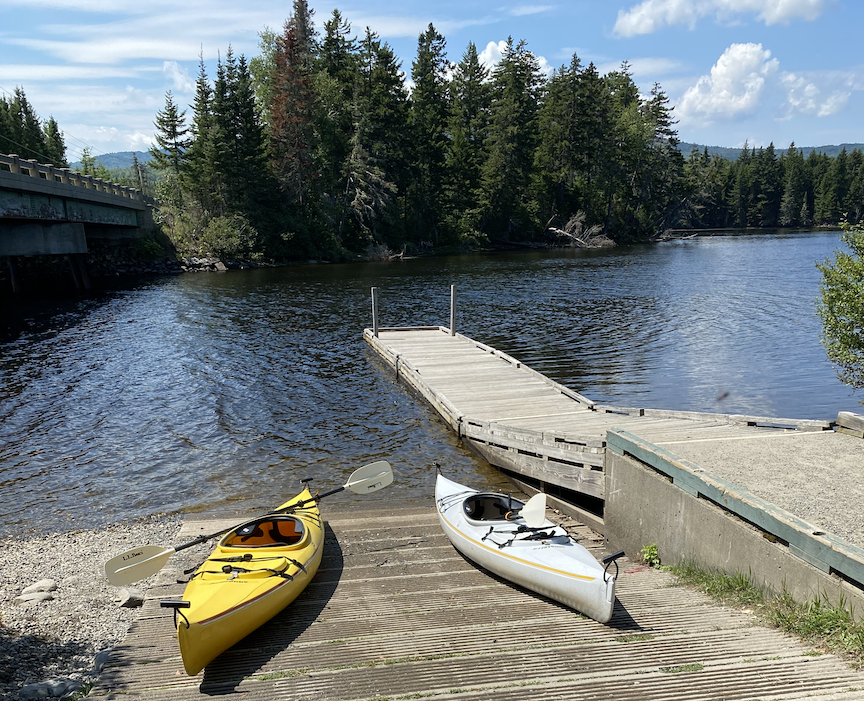
Rangeley Lake, the body of water we have a view of from our house, is about seven miles long and 4 miles wide with a shoreline of about 37 miles and we’ve explored most of it by water. We’ve launched from our HOA beach and paddled south to Greenvale Cove, north to the town cove, and west to Maneskootuk Island. We’ve paddled Hunter Cove, a great place to see herons and loons, by entering from a nearby launch near a bridge and we’ve explored the South Bog islands at the northern end of the lake from both the Oquossoc marina and (with permission) from the L.L.Bean property on the west shore.

Beaver Mountain Lake (Long Pond) lies to the south of Rangeley Lake along Route 4. In fact, its outlet, Long Pond Stream, flows north into Rangeley Lake. The boat launch ramp where we put in is just off to the right side of the road. It’s a smaller lake of just over 500 acres and it’s easy to paddle the whole shoreline in a couple of hours. A marshy area on the southwestern end is a popular moose-feeding spot and we’ve seen mergansers skittering along the water in the stream at the northern end.

Mooselookmeguntic Lake, which is just across a land bridge from Rangeley Lake, is much larger with 57 miles of shoreline. We’ve put in at Haines Landing on the northeast shore, at a boat launch on the west shore, and from a campground on the south shore, from which we’ve paddled out around Toothaker and Students islands.

Cupsuptic Lake, which is directly connected to Mooselookmeguntic, used to be a separate body of water dissected by a short, narrow river. They were joined when the water level of Mooselookmeguntic was raised fourteen feet after a dam was built in 1850. We’ve put into Cupsuptic Lake by turning south from a boat launch on the Cupsuptic River and also via the boat launch on the west shore of Mooselookmeguntic.

Upper Richardson Lake is west of Cupsuptic on the south side of Route 16 and we’ve used the boat launch at the northern end. The lake is long and narrow (about 14 miles by 1 and ½). We’ve paddled to Upper Dam on the northeast edge and past the home of Carrie Stevens who revolutionized the world of fly tying at the end of the first quarter of the twentieth century. She had a shop at the home called Rangeley Favorite Trout and Salmon Flies. Her most famous fly was called The Gray Ghost and one of the trails at nearby Saddleback Ski Area is named after it.

Continuing further west toward the New Hampshire border, Lake Azizcohos lies on the north side of the road. The shoreline is mostly undeveloped. The lake is narrow but 18 miles long and was created by a dam on the Magalloway River, the lake’s main inlet and outlet. We’ve put in at a public boat launch by Black Brook Cove Campground at the southern end. From there, we paddled around an island and explored a couple of coves on the eastern side where we found large pieces of driftwood that we loaded on the kayaks and brought home for outdoor decoration. One time, we decided we wanted to explore the northern end but didn’t want to paddle so many miles up. Instead, we checked the map and took some logging roads toward the upper eastern shore. We got lost once but luckily a truck came by and set us right. On the way, we passed an inscription on a granite memorial stone. It read, “THIS WW2 MEMORIAL IS DEDICATED TO THE CREW OF THE B-17-J 43-38023 WHICH CRASHED ON THIS LOCATION ON 11 JULY 1944 THEY GAVE THEIR LIVES FOR THIS COUNTRY.” The names of the crew were listed as well. When we finally reached the lakeshore, we saw Bosebuck Mountain Camps across the way on the western shore and we launched our kayaks to explore the northern end of Azizcohos.

Lake Umbagog is a little further west along Route 16 and lies in both Maine and New Hampshire. It’s fed by the Magalloway River coming from Azizcohos in the north and the Rapid River coming from Upper Richardson to the east. (A cabin on the shoreline of the Rapid River close to Umbagog was the home of Louise Dickinson Rich, author of the book We Took to the Woods published in 1942. It was set in the 1930s and was described as "a witty account of a Thoreau-like existence in a wilderness home.”) Lake Umbagog is almost 11 miles long and is part of the Umbagog National Wildlife Refuge. We’ve put in on the south shore from a public boat launch at Umbagog Lake State Park, paddling around to observe some of the wildlife, including bald eagles. The lake is the source of the Androscoggin River which runs southeast to the Atlantic Ocean.

When we head east from Rangeley, we come to huge Flagstaff Lake which has 147 miles of meandering shoreline. It’s extremely shallow in places, especially in drought years.  We’ve put in from the bridge in Eustis near the lake’s midpoint and also from the extreme southern end near Carrabassett Valley. The lake has a drowned ghost town beneath the surface which was created in 1950 when the Central Maine Power Company built a hydro dam on the Dead River that feeds into it. It enlarged the lake and flooded the village of Flagstaff and several surrounding towns.

In addition to the larger lakes, we’ve paddled smaller rivers, lakes, and ponds as well– the Kennebago and Cupsuptic Rivers, Lower Richardson, Little Kennebago, and Loon Lakes, Haley, Dodge, Gull, Sandy River Ponds, as well as Chain of Ponds near the Canadian border.

Paddling has given us, not only exercise but also a peaceful way to explore the beauty of wilderness areas. While our muscles work, our minds destress.

Comment

A Short Trip to Saint Croix

July 2, 2023 Joan Mularz

“I think the Caribbean countries face rising oceans and they face an increase in the severity of hurricanes. This is something that is very, very scary to all of us. The island states in the world represent - I remember this number - one-half of 1 percent of the carbon emissions in the world. And they will - some of them will disappear.

Steven Chu, American scientist

My husband and I often get bitten by the travel bug and this year we wanted to explore somewhere we’d never been as part of our wedding anniversary celebration. Due to commitments, we had only a short period for a getaway, so a Caribbean island only a few hours from Florida, seemed a good choice. With a little research, we booked a hotel for five nights on Saint Croix and were able to get a flight there from Fort Lauderdale. Saint Croix is one of the Leeward Islands in the  Caribbean Sea and is part of the  United States Virgin Islands (USVI), an unincorporated territory of the United States.

The island has had an interesting, if chaotic, history. It was inhabited by several indigenous groups in previous centuries and had different names. Its Taino name was Ay Ay ("the river"). Its Carib name was Cibuquiera ("the stony land"). From 1625 on, the island was ruled at various times by Dutch, English, French, and Spanish settlers until 1695 when it was abandoned and lay uninhabited for many years. In 1733, the Danish West India Company bought Saint Croix. For nearly 200 years, Saint Croix, St. Thomas, and St. John were known as the Danish West Indies. In 1916, Denmark sold those islands to the United States. Formal transfer to the U.S. took place on 1 April 1917. The island's inhabitants were granted United States citizenship in 1927.

We picked up our rental car at Henry E. Rohlsen Airport upon arrival. Though it was set up like any U.S. car with a left-side steering column, the island requires that you drive on the left side of the road—odd for a U.S. territory. My husband opted to be the driver and relied on me to navigate and keep reminding him to keep left on turns. It took some getting used to, but he did well despite narrow, winding, and hilly roads.

Our hotel on Grapetree Bay was lovely but quite a distance from either of the island’s two towns, Christiansted being ten miles away and Frederiksted twenty-five miles. Thus, restaurants and shops were not within walking distance, but some were worth the drive. I would highly recommend Susan Mango, a women’s clothing boutique in Christiansted. It specializes in “island style” items and supports indigenous businesses around the world run by women. One dinner restaurant that we enjoyed was Duggan’s Reef, set on pretty grounds overlooking Teagues Bay, east of Christiansted. A white fish in passionfruit sauce that we had there was memorable. We had a nice catfish lunch at the Beachside Café at Sandcastle on the Beach in Fredericksted, and the Christiansted waterfront had quite a few eating places to choose from.

Though we had a seafront room at our hotel, we were on the rocky south shore and the good swimming beaches were on the north shore, requiring long drives to reach them. The hotel does have a great pool though. Some nice sand beaches that we found for swimming and snorkeling were Cane Bay in the north, the Fredericksted beachfront on the western side, and Cramer Park toward the northeastern point. The latter is on the way to Point Udall, the easternmost point in the United States of America.

Saint Croix has taken a beating over the years due to hurricanes. In 1989, Hurricane Hugo struck the island with Category 4 winds. The U.S. Army, the FBI, and the U.S. Marshals Service restored order. The island is still showing some of the effects of Category 5 Hurricane Maria which hit in September 2017. Sustained winds of 150 mph and gusts of up to 250 mph damaged or destroyed 70% of the buildings on St. Croix, including schools and the island's only hospital. Many buildings in the main towns have still not been rebuilt.

Since Maria hit the west side the hardest, Christiansted, the former capital of the Danish West Indies, is faring better than Fredericksted. Though reconstruction is ongoing, Christiansted has preserved many of the 18th-century solid stone buildings in pastel colors with bright red tile roofs lining the cobblestone sidewalks. They combine Danish architectural style and African influences because the town was constructed by African slaves.

Saint Croix is an island of haves and have-nots. There are simple dwellings in the valleys and multi-million-dollar homes on the hillsides. It also seems to be a place that attracts diverse people from the mainland U.S. looking to leave old lives behind and start fresh in a tropical setting. We met a teacher from Seattle working at an island elementary school whose library was destroyed by the last hurricane, a singer who left the Midwest to entertain island-style, a waiter from Michigan with a degree in advertising and a minor in English hoping to write a book, a woman from Buffalo, New York swapping lake-effect snow for sunshine and warmth, and an artist from Maine working in a shop and exhibiting in a Christiansted gallery. They all seemed happy with their decisions.

On our last day on the island, we stopped at Salt River Bay National Historical Park and Ecological Preserve. Columbus landed there in November 1493 and immediately was attacked by the Kalinago tribe. It was the first recorded fight between Spanish explorers and a New World native population. The Spanish never colonized the Island but most or all of the native population was eventually dispersed or killed. Columbus did leave one lasting thing on the island, however. He named it Isla de la Santa Cruz (meaning "island of the Holy Cross”), which the French translated to Sainte-Croix The French name was partially retained under Danish rule as Sankt Croix and the island was finally given its current spelling, Saint Croix, following the US takeover.

Comment

From Zero to 52

June 1, 2023 Joan Mularz

“Love is the condition in which the happiness of another person is essential to your own.”

 Robert Heinlein, Author

 This year, my husband and I are celebrating 52 years of marriage by taking a five-day trip from Florida to St.Croix in the U.S. Virgin Islands.

Over the years, we have toasted our wedding anniversaries in many places. We were married in New York in 1971, but I was pregnant with my daughter and we lived in New Jersey when we defrosted the tiny top layer of our wedding cake and celebrated #1. I was also pregnant for #2, that time with my son, and we had moved to Massachusetts. Anniversaries 3 through 8 were marked in the Bay State as well.

My husband’s work took us to Italy where we had our 9th, 10th, and 11th celebrations then we partied in Massachusetts again for numbers 12 through 15.

Another work-related move to Germany allowed us to celebrate anniversaries 16 through 21 there.

Back in Massachusetts again, we celebrated quite a few (numbers 22 through 31. Those years included our Silver Anniversary (#25) when our children gave us an apple tree which we planted in the backyard. And I remember a dinner on a deck overlooking the Essex River for our 30th.

For number 32, my husband and I took a trip to Ireland. We rented a house in the southwestern coastal town of Schull for the first week, spent time in Dublin and Galway after that, and explored some of my Irish roots in Askeaton, a small town not far from Limerick.

Anniversaries numbered 33 through 39 were feted back home in Massachusetts, but number 40 was celebrated during a trip to the island of Rhodes, Greece. We started the day in Kalithea, the site of ancient therapeutic baths. The Italians restored the seaside buildings in 1929 and you can walk the grounds, gardens, and tide pools, lounge by the sea, and eat and drink at their cafe. Several movies have been filmed here, including "Zorba the Greek.” On the way back home, we took a detour to the acropolis of Ialyssos where we found lots of peacocks running around free and an interesting mixture of buildings and ruins, including a 4th-century BC Christian baptistry and a 2nd-century BC Palace of Athena.  On the edge of the cliff was a Byzantine fortress and the centerpiece was a lovely Greek monastery with a courtyard from the 15th century AD.  A shaded walk with Italian stations of the cross led to a giant cement cross overlooking a valley. In the late afternoon, we headed to the beach for a while then retreated to our patio before heading out for a celebratory anniversary dinner alfresco in Rhodes Town.

Anniversaries 41 through 43 were in Massachusetts, but we were in Juno Beach, Florida for #44 and the following day we attended a family wedding at the Breakers on Palm Beach Island. We continued our celebration with a road trip to the Florida Keys, staying in Islamorada and Key West, before a long drive home to Massachusetts where we enjoyed anniversary celebrations 45 through 47.

After relocating to Florida, we dined at Carmine’s Ristorante on a marina in Palm Beach Gardens for #48 and at another Florida restaurant for #49.

Our Golden 50th was feted over several days in Florida with our grown children. The main celebration dinner was at Jetty’s Restaurant on the water in Jupiter, followed by Prosecco and a cake frosted with gold leaf at home. The next morning, a mimosa cruise on a catamaran in West Palm was followed by dinner at Guanabana’s Restaurant in Jupiter.

Last year, we made a reservation for #51 at the Beacon Restaurant at Love Street in Jupiter, but the place had to postpone the date due to some issues they were experiencing. They rescheduled us for the next evening, but the same thing ensued. The upside was that they sent us two dinner vouchers, one for each postponement and we celebrated there at a later date.

Though I don’t remember the specifics of all the years, I do know that they were happy occasions, many of them sharing the day with our children. We have been blessed and I’m so grateful.

Comment

Exploring Where Famous Writers Wrote

May 1, 2023 Joan Mularz

“A writer who waits for ideal conditions under which to work will die without putting a word on paper.”

E.B. White, author of Charlotte’s Web


E.B. White would have admired the young Stephen King’s ability to write despite less-than-ideal surroundings. Before King became recognized as one of the best horror writers of all time, he was a struggling English teacher living out of a trailer with his wife and couldn’t even afford his own typewriter. He used his wife’s as he worked at a makeshift desk that was sandwiched between the washing machine and the dryer. He would literally lock himself in the laundry room to do his writing. It was there that he created his first hit novel Carrie.

Literature Nobel Prize winner William Faulkner wrote his epic novel As I Lay Dying during the night shift as he worked at a power plant.

Though some famous authors wrote under challenging conditions, some wrote in what were ideal places for them.

Spy novelist John le Carré wrote mostly on trains and a four-hour delay aboard a crowded train gave J.K. Rowling the idea for the Harry Potter series. Others wrote on the move as well. Sir Walter Scott is considered to be the inventor of the historical novel, but he was also a poet. Marmion, one of his most famous poems, was written as he rode a horse. Wallace Stevens wrote his poetry on slips of paper while walking. Gertrude Stein liked to write in the driver’s seat of “Lady Godiva” her Model T Ford while her partner Alice B. Toklas ran errands. Vladimir Nabokov preferred reading and writing in the privacy of a parked car, always writing on index cards, a portable strategy that allowed him to compose on the move while his wife drove him around on butterfly expeditions. Riding of a different kind inspired Joseph Heller, who famously stated that the closing line of Catch-22 came to him on a bus. Tom Wolfe not only wrote about traveling but wrote his book The Electric Kool-Aid Acid Test while traveling across America in the LSD-fueled bus with the “Merry Pranksters” Ken Kesey and Neal Cassady.

Many of the writers of the so-called Lost Generation like Simone de Beauvoir, Jean-Paul Sartre, Ernest Hemingway, Albert Camus, and F. Scott Fitzgerald hung out at Parisian cafes to connect with other writers and spend time writing, but they often wrote major works elsewhere. Camus finished the. first draft of The Stranger in the dreary Hôtel Poirier in Montmartre. Fitzgerald wanted tranquility and wrote The Great Gatsby in Valescure near the French Riviera seaside resort of St. Raphael.

As a journalist, Hemingway managed to send out stories from battlefields during wartime, but his novels were another matter. Though he and his first wife lived in an apartment on the rue Cardinale Lemoine in Paris, he rented another space, at 39 rue Descartes, where he did his writing. In Madrid, Spain, he sometimes wrote at a table in Restaurante Sobrino de Botin. The library in his house in Havana, Cuba, Finca Vigía, is where he wrote For Whom the Bell Tolls, The Old Man and the Sea, and 5 other novels. He also wrote several iconic works, including To Have and Have Not, in a studio on top of a carriage house at his home in Key West, Florida. He wrote on his Underwood typewriter while standing up.

Other writers also wrote while standing, including Lewis Carroll and sometimes Virginia Woolf who also wrote in a basement storage room in a cozy old armchair and later in a garden shed where she wrote “A Room With A View.”

On the other extreme, Truman Capote wrote lying down. Capote went so far as to declare himself “a completely horizontal writer.” As James Joyce’s eyesight deteriorated he too began to write in bed. Lying on his stomach at night in a bright white coat that gave off a kind of white light, Joyce wrote with blue crayons that made large lettering easy to read. Edith Wharton also wrote in bed, her dog under one arm, the other arm occupied with pushing the pages to the ground for her maid to pick up and for her secretary to type. Marcel Proust wrote in bed at night, sleeping during the day and blocking out the noise of the bustling Parisian street by lining the walls with cork. Dame Edith Sitwell wrote brilliant poetry and insightful critiques only after taking a short nap in – not a bed or on the sofa – but in a coffin.

Garden sheds were popular with some writers. Roald Dahl’s shed was a writing sanctuary filled with an odd collection of personal paraphernalia. He pinned a quote from Edgar Degas to the wall: “Art is a lie to which one gives the accent of truth.” George Bernard Shaw’s writing hut was built on a revolving mechanism, allowing Shaw to follow the sun throughout the day as he wrote. He named the hut ‘London’ so his staff wouldn’t be lying when they said he’d ‘gone to London’. Dylan Thomas wrote in a bike shed that sat precariously on stilts on the cliff above his boathouse in Laugharne, Wales. He filled it with pictures of Byron, Walt Whitman, Louis MacNeice, and W.H. Auden as well as lists of alliterative words. Mark Twain (nee Samuel Clemens) wrote some of his greatest works, including The Adventures of Huckleberry Finn and The Adventures of Tom Sawyer in a small, wooden, octagonal hut with a brick fireplace. It was built by his in-laws in Elmira, New York where he often summered. It has since been relocated to the middle of Elmira College’s campus.

Agatha Christie created her plots in a large Victorian bathtub whilst munching on apples. Poet Rod McKuen wrote song lyrics in his bathtub. Dalton Trumbo too wrote in the bath at night, although not alone. He liked the company of a parrot, a gift from the actor Kirk Douglas. 

Hotels are popular places for authors to work. Thomas Wolfe, Jack Kerouac, Arthur Miller, and William Burroughs all spent some time writing in the infamous Chelsea Hotel in New York City.

Many famous writers have stayed at the Pera Palace Hotel in Istanbul, but one of the most notable was Agatha Christie, who frequented Room 411. Legend has it she wrote her bestseller Murder on the Orient Express there. Maya Angelou wrote only in rented hotel rooms and liked to rent one in her hometown and pay for it by the month. She required only a bed, a table, a bath, Roget’s Thesaurus, a dictionary, the Bible, and usually a deck of cards and some crossword puzzles. She had all the paintings and decorations removed and allowed no member of staff or management to enter. “Just in case I’ve thrown a piece of paper on the floor, I don’t want it discarded”.

Bars and cafes are often places that attract writers. The first story of the boy wizard, Harry Potter, was mostly written in an Edinburg, Scotland pub called The Red Elephant and at Nicholson’s Café owned by J.K. Rowling’s brother-in-law in the same city. Heinold’s dive bar in Oakland, California was the writing place of novelist Jack London. It was where he spent many hours drinking and writing notes for Call of the Wild. Jack Kerouac was known for pumping out his tales at Vesuvio Café across the street from City Lights Bookstore in San Francisco, California. Allen Ginsberg also did some of his best work there. In Dublin, Ireland, you can channel the likes of James Joyce and Brendan Behan while having a tipple at the Brazen Head tavern. They are among the many writers, starting in the 12th century, who drank a pint or two there. However, Joyce wrote Ulysses in Zurich, Trieste, and in Paris where it was published by Sylvia Beach who owned the first Shakespeare and Company bookstore.

Comment

The Hunting Cruise

April 1, 2023 Joan Mularz

“Everyone’s mood was spread in the air, the tiny streets of Panarea were filled with amorous expressions heard at full volume”.

Michelangelo Antonioni, Italian film director 

(This short story was inspired by my visit to the Aeolian Islands off the northern coast of Sicily last year.)

She was definitely in her element. Though her occupation was humble, she not only owned it, she radiated enjoyment. It’s what attracted him to her, a waitress in a tourist bar on the Italian island of Lipari.

From the moment he sat down at the outdoor table for a late lunch, he couldn’t take his eyes off her. As she made her rounds, he was mesmerized by the way she swayed and smiled at customers and how men’s eyes followed her. Dressed in strappy sandals, an inexpensive black mini skirt, and a simple black tee, she looked both sexy and hip. The women he often dated had their own money and were impressed with his family history. He hoped this one would be lured by the obvious luxury of his Bruno Cucinelli boat shoes which cost more than she would make in a week. In truth, money was his main asset, and he hoped it would suffice to charm her.

 “Buongiorno, Signore. Cosa vuole?”

Her arrival at his table and the sultriness of her voice disarmed him. What did he want? The truth would have been, “Come away with me!” but he was bred not to be impulsive. He requested a menu. “La lista, per favore.”

While perusing the offerings, he explained it was his first time in port.

“You came by ferry?” she asked in Italian.

“Yacht.”

Her eyes grew as large as saucers. “How exciting it must be to cruise on a yacht!”

“You never have?”

“For me, it’s only a dream to cruise our islands, Signore, especially to Panarea.”

He made a quick mental change of plans, and his face relaxed into a benevolent expression. “Then I must make your dream come true.”

“You are a genie?”

“I’m cruising to Panarea this evening. You’re welcome to join me.”

She pouted and fluttered her eyes. “But I don’t know you, Signore, and I could lose my job if I’m not back by morning.”

“Stop calling me ‘Signore.’ My name is Sandro, and I have many friends in high places if you need references.”

“A man with such friends must have a big yacht, no?”

“Sixteen meters—big enough for entertaining but small enough for comfort.”

“It sounds amazing, but I fear Panarea is too exclusive for me. I wouldn’t fit in….”

“You’ll be the most beautiful woman there, and you’ll be with me.”

 “If you’re sure….”

“I’m positive. Besides, this job isn’t worth missing out on A-list, yacht-hopping parties. You’ll love it.”

“You make it sound so exciting. How can I refuse?”

“Come to the harbor tonight at eight and look for the ‘Bella Figura’ at the end of the third pier.  I’ll be aboard waiting to whisk you away for an unforgettable night. Trust me.”

A satisfied smile spread across her lovely face. “I’ll be there.”

“Perfetto. Now I will trust you. What do you recommend for lunch?”

“The pasta with swordfish is our local specialty.”

“Excellent, and bring me a half-liter of your local red wine.”

“Malvasia. Excellent choice, Sandro.”

He watched her sashay away with a predatory look of satisfaction. That was easy and I don’t even know her name.

#

The sleek, white body of the ‘Bella Figura’ looked splendid gleaming in the evening light. As Elisa strode closer, she saw Sandro on the deck eyeing her. It was time to reel him in a little more. She placed her overnight case on the dock, put her fist to her heart, and pointed to his love boat. He blew a kiss and rushed to meet her at the aft boarding platform.

“You look ravishing this evening. Bellissima.”

“Grazie, Sandro. I hope my dress meets the standards of a Panarea party.”

Heat rose to his face as his gaze raked over her form, rendering him speechless. Instead, he bunched the fingertips of his right hand together, drew them to his lips, and kissed them.

 “I hope that means I’m permitted to come aboard.”

“Yes, but please remove your shoes.”

Her questioning eyes prompted him to explain, “The teak decking scuffs.”

Fussy for a party animal, she thought. She complied before offering her hand. He took her bag and steadied her as she boarded. He was all good manners after that, showing her where to leave her belongings in her own quarters. Then he led her to the helm and offered her a seat next to his own. Thus, they began the short trip northeast on the dark sea, to the smallest Aeolian island—he waiting for her to want him and her wanting something else.

As they rounded the island, the view revealed a hillside dotted with twinkling lights, and the surrounding waters were awash with yachts glittering in the night.

Elisa gasped. “It’s like a fairyland.”

Sandro leaned close to her ear and whispered, “And we can fulfill our dreams here.”

Elisa shivered. I hope so.

 Sandro maneuvered the ‘Bella Figura’ into a skerry-fringed cove where dozens of yachts were moored side-by-side and rafted together. The party was in full motion with pulsating music and lights and oodles of people.

“Ready to join the party?”

“Sure, but how do we get there? Swim?”

“Of course not. I’ll deploy the fenders, move in close to one of the boats on the outer edge of the group, lasso its cleats, pull us close, and secure the ropes on our end.”

“Sounds daunting.”

“I’ve been doing it for years, so a piece of cake. Watch and be impressed, bella.”

His deft execution proved he was indeed an old hand at yacht-hopping. She had chosen well.

“Voila! We can now step into the party instead of swimming to it.”

 Elisa’s heartbeat ramped up as she stepped across to their neighbor’s yacht and scanned the faces caught up in the frenzy. Sandro placed his hand on her waist and steered her forward.

He shouted to be heard above the din. “I’ll get us some drinks then we’ll circulate. Okay?”

 She flashed him a thumbs-up. Circulating was exactly what she needed to do.

Before he pushed his way through to one of the crowded bars, Sandro said, “Wait for me here while I order. I recommend a White Lady cocktail made with Panarea Island gin, but if you prefer champagne, just say the word.”

“I’ll trust your recommendation.”

She had a moment of freak as he disappeared into the thirsty throng. I used the word ’trust.’ I’m losing my edge.

She was torn when Sandro returned bearing two frosty cocktail glasses with frothy, pale-blonde concoctions topped with lemon slices. I’m parched and they look appealing, but are they safe? I need my wits about me. I’ll err on the side of caution.

Sandro handed her a glass.“Cin cin!”

She held her glass high, repeated the toast, and touched the rim to her lips without taking a sip.

“Let’s circulate,” she said. “I want to see everything.”

Sandro took her hand and weaved through the revelers, taking time to introduce her to people here and there, including a French Count who embraced him as a close friend. She was surprised. Many people seemed to like him and he acted like he was proud to be with her. What’s up with this guy? she wondered.

After one go-round, he said, “You’ve barely touched your drink. Would you prefer something else?”

“It’s fine,” she lied. “I guess I’m too excited to drink.”

He set her glass on a nearby surface and drew her close. “Let’s dance.”

“Only if we dance our way to the next boat. I want to take it all in.”

“It will just be more of the same. Let’s enjoy the moment here.”

“But Sandro, you’ve seen it before. It’s all new to me and I need to see for myself. Please!”

“Sorry. I’m being selfish. As you wish.”

He took her hand and they stepped across to another boat. Her search began once more.

His brow wrinkled. “Are you looking for someone?”

“Just committing it all to memory.”

At her insistence, they yacht-hopped several more times, and she pretended to sip a few more drinks, always scanning the crowds.

Around midnight, she pointed to the next one on their path and urged Sandro forward.

“Not a good idea.”

“Why not? Are you bored with me already?”

“You, my dear, remain delightful. That boat has a bad reputation.”

Her senses switched to alert mode.

“Are they into something illegal?”

“Perhaps, but I have no firsthand knowledge. Friends have heard rumors of ill-treated women and other unsavory things.”

“Yet they allow them to be part of this… this party?”

“The owner of the yacht is well-connected in nefarious ways, or so I’m told. People are afraid to make a fuss.”

“So, he gets a free pass to do whatever he wants? Unacceptable!”

“Take it easy, bella. We came here to enjoy ourselves, no?”

“I need to see what’s over there, Sandro.”

“That’s crazy! Are you looking to be mistreated? I can’t let you put yourself in harm’s way.”

“I’m not asking you to. I’ll go on my own.”

Sandro’s voice rose. “Just like that, you’d abandon me? I confess I enticed you to join me to seduce you, but you’re nice and I’ve done my best to treat you with respect tonight. Have I been so boring? Are you one of those women who craves a bad boy experience?”

“Shhh! Calm down, Sandro. Tonight, you’ve surprised me in a good way, but I have a confession to make too. I came here for an ulterior motive.”

“Let me guess. You were interested in my money.”

“No. I was looking for a way to come to Panarea.”

“You want to find someone richer than me?”

“No. I want to find my sister.”

“She’s lost and you think she’s here?”

“She fell for a nasty piece of work with a big yacht two years ago. She said he was taking her to Panarea. I haven’t heard from her since. That unsavory boat I want to hop onto sounds like his kind of operation. I need to know if she’s there.”

“And then what?”

“I’ll rescue her.”

“It’s a noble idea, but even with my help, there’s no chance in hell we can walk her off that yacht.”

 “I know that, and I don’t intend to try. Tonight will be a scouting mission. I’ll smile and schmooze and look around, then leave. If she’s there, my team will do the actual rescuing.”

“Your team?”

“I work for AISI, the internal information and security agency. My AISI team is waiting for instructions. If she’s there, they’ll extract my sister and investigate the evil doings on that boat. So, are you up for another yacht hop, or am I on my own?”

“No way am I letting you go over there alone. Just answer me one question before we visit them.”

“Ask.”

“You’re not  a waitress?”

“Definitely not and that’s a good thing. I was so out of my element there.”

xxx

Comment

International Journey of a Curriculum Embracing Technology

March 1, 2023 Joan Mularz

“If we teach today as we taught yesterday, we rob our children of tomorrow.”

John Dewey

 In September 1992, the Butler Middle School of Technology opened in a new building in Lowell, Massachusetts. (What is notable is that available technology was minimal at first. The Internet wasn’t made available to the public until the following April of 1993 and the school Intranet was only in the process of being set up.) Technology advances ramped up quickly in the following years and we were eager to learn.

Sheila Kennedy and I were hired as Family Consumer Science teachers for grades 5-8, and they asked us to design a modern and meaningful curriculum. At the same time, Fleet Bank approached the school with the offer of a community partnership if the school would be interested in community service. Sheila and I jumped on the idea and it became the third quarter of our 7th and 8th-grade curriculums.

In early 1993, Fleet provided an introductory celebration in our auditorium and offered seven adult advisors. That year approximately 280 7th and 8th-grade students (including special education, bilingual, and ESL students) participated. We called them the Fleet Youth Leaders.

They identified community needs and formed service teams to help meet those needs. Each team was matched with an adult advisor who was either a staff member, administrator, parent, or community representative. In addition to doing community service, the students were required to research a social issue related to their service, prepare a computer report, and design a poster display. At the end of the quarter, Fleet provided an award ceremony at the Kennedy Library in Boston for exemplary team projects. The bank continued to support us for two more years and our program followed the same format.

At the beginning of 1996, Jacqueline Carr, another Family Consumer Science teacher, and I renamed the program the Butler Youth Leaders and we began to apply for grants to solve the financial challenges and to expand the horizons of the program with the acquisition of more technology. We taught the students how to produce multimedia video infomercials utilizing computer digital video editing to educate the larger community about the needs they identified. We began a collaboration with the computer technology teacher, and the media center director so that students could fully utilize Internet and Intranet capabilities, as well as computer word processing skills for producing their research reports.

 In 1997, some of our students participated in a TV show for MCET (Massachusetts Corporation for Educational Television) demonstrating digital video editing, and in cooperation with our art department, the use of graphics.

We introduced website design into our program in 1998 and, in 1999, the first Butler Youth Leaders website was created. In 2000, we formed a Butler School partnership with Kids Energy Corporation, enabling students to apply online for grants for their projects and to design individual project websites that Kids Energy made available for their use. In 2000, we also added the capability of putting the videos into CD-ROM and VHS formats. (This now sounds old school but it was cutting edge at the time.)

Over nine years, the program was the recipient of a Massachusetts Department of Education Lighthouse Grant, four innovative teacher grants from the University of Massachusetts, Lowell, one service learning grant, and one grant from the Compaq Computer Corporation.

We presented the program at the Macworld Computer Technology Conference in Boston in 1997, at four NELMS (New England League of Middle Schools) conferences in Massachusetts and Rhode Island,  the Christa McAuliffe Technology Conference In New Hampshire, a MassCUE (Massachusetts Computer Using Educators) conference, a Department of Education Technology Conference, a Massachusetts Title I Conference and at several workshops for the Lowell Public Schools Professional Development Program.

 Materials from the Butler Youth Leaders became part of a permanent archive and time capsule in the Smithsonian National Museum Of Natural History, Washington, D.C. in 1999.

.In March of 2000, we received an e-mail message from the Massachusetts Department of Education inviting us to enter our Butler Youth Leaders Program into a worldwide competition for the best information technology projects in the field of education. That July we faxed our project submission form to Rome, Italy where the competition would take place. In September, we were given the tools to link our website to the Global Junior Challenge website. In October, we received two welcome packs and in November we received congratulations that we were one of 89 finalists out of 588 project entries from 49 countries!

In December of 2000, Jackie and I traveled to Rome to participate in the Challenge's final events. We set up our project exhibit at the two-day “iYouth Into the Digital Age Conference” at the Fiera di Roma, along with exhibitors from many countries. On the evening of December 4, 2000, we attended an awards ceremony in Palazzo Senatorio (Rome’s City Hall) on the Campidoglio (Capitoline Hill) where the Mayor of Rome opened the ceremony and the President of the Italian Republic handed out prizes to the top projects. We did not win but received medals for being finalists, which made us proud enough.

 In 2001, the program was used as the case study for MIT's ‘We Wired the Classroom’ conference. The conference gathered teachers, professors, media professionals, researchers, and writers to discuss the roles of new media in the development of educational materials.

Those nine years were a teaching high for me. I had the best co-workers and enthusiastic and productive students. I like to think we made a small difference.

Comment

Advice from Fictional Travelers

February 1, 2023 Joan Mularz

“To move, to breathe, to fly, to float,
To gain all while you give,
To roam the roads of lands remote,
To travel is to live.”


― Hans Christian Andersen, The Fairy Tale of My Life: An Autobiography

In real-life travel, I am a flaneur. I love to aimlessly wander cities to experience them as they are, not as I’m told they should be. I enjoy the spontaneity, serendipity, and surprises of having no set itinerary.

In literary travel tales, I enjoy being a voyeur. There is nothing better than immersing oneself in a place made interesting by good writing. And some authors, through their traveling characters, have given eloquent advice that stands the test of time.

Odysseus is the hero of Homer’s 8th or 7th century B.C. epic poem Odysseus. He is depicted as being renowned for his intellectual brilliance, guile, and versatility. One of his profound statements is, “A man who has been through bitter experiences and traveled far enjoys even his sufferings after a time.” In other words, time heals all wounds such that we can look back and laugh at our worst moments.

Geoffrey Chaucer wrote The Canterbury Tales in 1392, but some of his advice still resonates today. This one is from The Wife of Bath Tale: “It seems to me that poverty is an eyeglass through which one may see his true friends.” 

The traveling duo of Don Quixote and Sancho Panza was created by the 17th-century Spanish novelist, Miguel de Cervantes. Though Don Quixote is a crazy gentleman with delusions about chivalry, he occasionally gives some good advice, such as: “all human efforts to communicate—even in the same language—are equally utopian, equally luminous with value, and equally worth the doing.” 

In Gulliver’s Travels, written in 1726 by Jonathan Swift, Gulliver experiences the disorientation of being different from the locals but he keeps an open mind. He learned from his experiences and passed on this advice: “They have a notion, that when people are met together, a short silence does much improve conversation: this I found to be true; for during those little intermissions of talk, new ideas would arise in their minds, which very much enlivened the discourse.” 

Mark Twain (a.k.a. Samuel Clemens) wrote his novel Huckleberry Finn in 1885. It’s a morality tale about a white boy and a black man both seeking freedom from oppression. Huck dispenses his advice in a southwestern U.S. dialect:  “Right is right, and wrong is wrong, and a body ain’t got no business doing wrong when he ain’t ignorant and knows better.” And “If you tell the truth you do not need a good memory!”

In the novel, The Wonderful Wizard of Oz, written by L. Frank Baum in 1900, a young girl named Dorothy is sent on a journey when she is caught up in a twister. Along the way, she dispenses advice to new friends: “A heart is not judged by how much you love, but by how much you are loved by others” and “True courage is in facing danger when you are afraid...” 

In the Harry Potter novels written by J.K. Rowling (1997-2005), the characters travel in mind-blowing ways—by a train invisible to non-wizards, by apparition, and by flying broomsticks. Some of them give excellent advice:  "It takes a great deal of bravery to stand up to our enemies, but just as much to stand up to our friends" (Albus Dumbledore),  "Time will not slow down when something unpleasant lies ahead." (Harry Potter), and  "If you want to know what a man’s like, take a good look at how he treats his inferiors, not his equals" (Sirius Black).

Comment

Cooking Adventures

January 1, 2023 Joan Mularz

 “Cooking is an act of love, a gift, a way of sharing with others the little secrets -- 'piccoli segreti' -- that are simmering on the burners.”

  Sophia Loren  

Living in Italy awakened my taste buds and inspired me to learn how to cook Italian food

My first foray into cooking classes was with a guy named Tony who had been a chef on a cruise line.  The classes took place in Pinetamare, a coastal resort north of Napoli. Each session had at least 10-15 people and he demonstrated while we took notes. Afterward, we got to taste the results.

Perhaps because he was used to cooking for large groups, his recipe amounts were often large. For example, his Pesto Alla Genovese serves 30 people and both his Mozzarella in Carrozza and Pasta e Fagioli Alla Napoletana serve 14. His Melanzane Alla Parmigiana recipe uses over 5 pounds of eggplant!

 Before showing us how to make stuffed Calamari, he instructed us how to buy and clean the fresh squid: 1. Wash well in cold water. 2. Pull out the tentacle section from the body cavity. 3. Remove the guts being careful not to break the sac of ink. 4. Cut off the eyes. 5. Pull out the mouth. 6. Remove the spine. (He added a warning: If the calamari are not shiny, they’ve been frozen.)

About a year later, I had the opportunity to participate in a more intimate setting. I went with 2 other women and spent many mornings in the home kitchen of Marianna, an Italian woman who lived in Posillipo, one of the hillsides in Napoli. We would chat, watch, learn, take notes, and then sit down for lunch with Marianna. The meal was always paired with a bottle of red wine—Montepulciano d’Abruzzo. I have almost 5 dozen of her recipes and often use them. Some of my favorites are Pasta Ai Quattro Formaggi, and Pasta Con Melanzane, Panna, e Salsa. She taught us to make rollups similar to filled manicotti but using crepes instead of pasta. That dish was covered with Ragu Napoletana, a thick tomato sauce which simmers for 7 hours. She also taught us how to make 2 different versions of quick tomato sauce. One has olive oil, onion and dry white wine added to chopped tomatoes. The other adds oil, garlic, basil, and parsley. The latter can be varied as All’ Arrabiata by adding hot pepper, as Alla Puttanesca with black olives and capers, or as Alla Pizzaiola with oregano.  For good pasta, she recommended Dececco or Voiello, and for good olive oil: Dante, Bertolli, or Carapelli.

While in Italy, I met a French woman named Jacquie who offered to teach a small group of us how to cook some French cuisine. We met at her home and it was a similar format to Marianna’s— chatting, watching, learning, taking notes, and then sitting down for lunch with Jacquie. I have almost 3 dozen of her recipes. Some of my favorites are Roasted Gigot, Coq Au Vin, and Sauce Rémoulade

When we moved to Germany, I didn’t take German cooking lessons. However, I did learn how to cook some Chinese dishes from a Chinese/American woman named Dinah. A few friends and I joined her in her kitchen for lessons and lunch once a week for a month.  We made such things as Spicy Chicken Wings, Stir-Fry Beef with Julienne Vegetables, and Mu Shu Pork with Pancakes.

My travels have taught me to appreciate cooking with fresh ingredients and to enjoy wine, mussels, fresh crispy bread, and a variety of cheeses, my favorite being Gorgonzola.

Comment

Reverse Crossings

December 1, 2022 Joan Mularz

"The immigrant's heart marches to the beat of two quite different drums, one from the old homeland and the other from the new. The immigrant has to bridge these two worlds, living comfortably in the new and bringing the best of his or her ancient identity and heritage to bear on life in an adopted homeland."

Mary McAleese, Former President of Ireland

My only grandparent not born in the U.S. was my paternal grandmother Mary. In 1890 at the age of seventeen, she left her family, impoverished by years of the Irish famine, high taxes, and unfair laws, and she emigrated to New York City. She traveled by the Cunard ship Bothnia and found work as a domestic servant for a wealthy family on Manhattan’s Upper West Side. Later on, she married and had six children, five of whom lived to adulthood. During World War II, she was considered a Gold-Star Mother because all five of her sons served in the U.S. Armed Forces. Our extended family gathered every Sunday and holiday at the home she and my grandfather owned. Grandma died in 1968 at the age of 95.  

She often told us that she had come from Cork and had lived in Ballyengland. However, thanks to my brother’s genealogical research, we learned that her ship had left from Queenstown (renamed Cobh in 1921), a seaport in County Cork. However, she was born and raised in a townland called Ballyengland within the small town of Askeaton in County Limerick. The town is on the N69, the road between Limerick and Tralee and is built on the banks of the River Deel some 1.8 miles upstream from the estuary of the River Shannon. Among the historic structures in the town are a castle dating from 1199 and a Franciscan friary dating from 1389.

 A townland (Irish: baile fearainn) is a small geographical division of land used in Ireland and in the Western Isles in Scotland, typically covering 100–500 acres. The concept of townlands is based on the Gaelic system of land division, and the first official evidence of the existence of this system can be found in church records from before the 12th century. It was in the 1600s that they began to be mapped and defined by the English administration for the purpose of confiscating land and apportioning it to investors or planters from Britain. Until the 19th century, most townlands were owned by single landlords and occupied by multiple tenants.  Mary’s family were tenants who worked the land at Hollywood House in Ballyengland.

In 2003, some 113 years after Mary made her long voyage of survival, I flew to Ireland to see where she came from. Unlike hers, my trip was a vacation. I found Askeaton to be a picturesque town that was prospering. Coolrahnee House, the B&B on the outskirts of Askeaton that my husband and I stayed at, was fairly new with modern amenities and the owners were welcoming. When I mentioned my grandmother as we enjoyed a cup of tea with them, they perked up at hearing her maiden name. They knew locals with the same name and made a call. Soon, a young guy showed up, and listened to my story, but said he didn’t think his family was related to my grandmother. However, he suggested that we talk with his elderly mother who might know who my relatives were and if they were still in town.

We met his mother outside of the church where she had attended Sunday services and she said she would show us around Ballyengland to look for my relatives. We stopped at a home where the surname was the same, but again, no relation. They did, however, give our local companion directions to Hollywood House.

We came to a large walled estate that we were told was now owned by an Italian woman who exported textiles. The gate was locked, but through it, on the grounds behind the large main house, we could see a thatched-roof cottage which just might have been Mary’s Irish home.

My brother, who did the genealogical research, hasn’t just visited Ireland one time like me. He applied for and received dual citizenship. Though all of our great-grandparents were born in Ireland, it was only Grandma Mary who made his bid possible. Under the Irish Nationality and Citizenship Act of 1956, people born outside Ireland can claim citizenship if a grandparent was born there. As a musician, my brother performs in both countries. In 2003, he wrote a song called “Balleyengland” for his first album. Like Mary, he has bridged both worlds.

Comment

Word Journeys in the Age of Technology

November 1, 2022 Joan Mularz

“There is nothing permanent except change.”

Heraclitus


Many English words have been appropriated to mean something completely different online. The pre-Internet meanings are still valid in their original contexts. The technological vocabulary does not replace them, but rather adds another layer of meanings for specific use.  Here are some examples:

Boot

Pre-Internet: a sturdy item of footwear covering the foot, the ankle, and sometimes the lower leg; a hard kick

Online: to start up a computer


Bump

Pre-Internet: a light blow or a jolting collision; a protuberance on a level surface

Online: an online slang term for the practice of posting filler comments to move a post to the top of a discussion thread, increasing a message or thread's status and visibility.


Block

Pre-Internet: a large solid piece of hard material, especially rock, stone, or wood, typically with flat surfaces on each side; make the movement or flow in (a passage, pipe, road, etc.) difficult or impossible; impress text or a design on (a book cover).

Online: to prevent someone from contacting you on a social network or from viewing your profile.


Canoe

Pre-Internet: a long narrow boat that is pointed at both ends and that is moved by a paddle with one blade.
Online: a Twitter conversation with more than three participants


Catfish

Pre-Internet: a freshwater or marine fish with whisker-like barbels around the mouth, typically bottom-dwelling.
Online: a person who sets up a false personal profile on a social networking site for fraudulent or deceptive purposes.


Cloud

Pre-Internet: a visible mass of particles of condensed vapor (such as water or ice) suspended in the atmosphere of a planet.
Online:  any of several parts of the Internet that allow online processing and storage of documents and data as well as electronic access to software and other resources.


Firehose

Pre-Internet: a large-diameter water-filled tube used to extinguish fires.

Online: a very large stream of data.

Footprint

Pre-Internet: a track or mark left by a foot or shoe.
Online: a unique set of characteristics, actions, etc., that leave a trace and serve as a means of identification.


Friend

Pre-Internet: one attached to another by affection or esteem.
Online: to add a person to one’s list of contacts on a social networking website.


Follow

Pre-Internet: to go or come after or behind someone or something; to pursue in an effort to overtake
Online: to subscribe to someone’s updates on social media


Handle

Pre-Internet:  a part of something that is designed to be held by your hand; to manage

Online: your screen name; the name you go by on the Internet.


Like

Pre-Internet: similar to
Online: to indicate one’s enjoyment of, agreement with, or interest in website content, especially in social media


Meme

Pre-Internet: an idea, behavior, style, or usage that spreads from person to person within a culture
Online: a cultural item in the form of an image, video, phrase, etc., that is spread via the Internet and often altered in a creative or humorous way


Ping

Pre-Internet: a sharp sound like that of a striking bullet
Online: to contact someone by sending a brief electronic message, as a text message


Profile

Pre-Internet: a representation of something in outline; a concise biographical sketch
Online: the personal details, images, user statistics, social-media timeline, etc., that an individual creates and associates with a username or online account


Sandbox

Pre-Internet: a low box filled with sand that children can play in
Online: an environment in which software developers or editors can create and test new content, separate from other content in the project


Swipe

Pre-Internet: a criticism or insult that is directed toward a particular person or group; a swinging movement of a person’s hand, an animal’s paw, etc
Online: to move the fingers across a touchscreen


Tablet

Pre-Internet: a flat piece of stone, clay, or wood with writing on it; a pill

Online: a general-purpose computer contained in a touchscreen panel


Tag

Pre-Internet: to attach a label to; to add to something, especially as an afterthought
Online: to link to someone else’s profile in a social media post, commonly a photo or status update


Text

Pre-Internet: a book or other piece of writing, especially one that is studied

Online: to send an electronic message by mobile phone


Timeline

Pre-Internet: a table listing important events for successive years within a particular historical period
Online: a collection of online posts or updates associated with a specific social-media account, in reverse chronological order


Troll

Pre-Internet: a dwarf or giant in Scandinavian folklore inhabiting caves or hills
Online: a person who sows discord on the Internet by starting arguments or upsetting people


Tweet

Pre-Internet: a chirping note

Online: a very short message posted on the Twitter website


Unplug

Pre-Internet: to disconnect something, such as a lamp or television from an electrical source or another device
Online: refrain from using digital or electronic devices for a period of time


Viral

Pre-Internet: of, relating to, or caused by a virus
Online: becoming very popular by circulating quickly from person to person, especially through the Internet


1 Comment
← Newer Posts Older Posts →


You can also reach me through:

Facebook: https://www.facebook.com/joanwrightmularzauthor

X: https://x.com/Jwright_mularz

Instagram: https://www.instagram.com/rangepalm/

Pinterest: https://www.pinterest.com/jowalmu71/

POWERED BY SQUARESPACE.